


You finish a beautiful kitchen. The cabinets line up perfectly. The lighting looks custom. The homeowner smiles, hugs your team, and says they’ll tell everyone about you.
Then the next week gets quiet.
The phone slows down. You check old estimates. You wonder if you should post on Facebook, run an ad, ask for referrals, or just wait. A lot of remodeling companies live in that stop-and-go cycle. One month is packed. The next feels thin.
That’s why digital marketing for remodeling contractors works better when you stop treating it like a random promotion and start treating it like a build. A real build has a foundation, structure, systems, and finishes that all work together. Your marketing should work the same way.
Table of Contents
- Your Marketing Is A House Not A Billboard
- Pouring the Foundation Your Digital Job Site
- Getting Found by the Right Homeowners with SEO
- Using Google Ads to Invite Eager Buyers
- Turning Website Visitors into Real Leads
- Never Lose a Lead With an Automated System
- Frequently Asked Questions About Digital Marketing
Your Marketing Is A House Not A Billboard
A billboard is simple. You pay for space, your name goes up, and you hope the right person sees it at the right time. That’s how many remodelers handle marketing. They try one ad. They boost one post. They ask for a few referrals. Then they wait.
A house works differently. Every part has a job. The foundation holds everything up. The framing gives shape. The wiring and plumbing make the place functional. If one part is missing, the whole build struggles. Digital marketing for remodeling contractors works the same way.

The opportunity is big enough that this system matters. The U.S. home remodeling market surpassed $450 billion in 2024, and 90% of buyers now turn to the internet for all home building needs, from design-build projects to finding a contractor, according to No Boundaries Marketing on digital marketing for remodeling contractors.
That means homeowners aren’t waiting for a truck wrap to drive by. They’re searching online, comparing options, reading reviews, and deciding who looks trustworthy before they ever call.
What a billboard mindset looks like
A billboard mindset usually sounds like this:
- "We need leads fast." So you run ads without fixing your website.
- "We already have a website." But it acts more like an online brochure than a sales tool.
- "Most of our work comes from referrals." Which feels good until referrals slow down.
- "We tried marketing before." But only one piece was used, not a connected system.
A steady pipeline usually doesn’t come from one tactic. It comes from several pieces working together at the same time.
Other home service and property businesses face the same challenge. If you want a simple outside example, these proven digital marketing strategies for real estate show the same pattern. The businesses that win don’t rely on one lucky channel. They build a process.
What a house mindset changes
With a house mindset, each part of marketing supports the next one.
Your Google presence helps people find you. Your website helps them trust you. Your photos help them picture their own project. Your follow-up system keeps the lead from going cold. Instead of hoping business appears, you create a path people can walk through.
That’s the big shift. You’re not buying attention once. You’re building an integrated system that keeps working.
Pouring the Foundation Your Digital Job Site
If your marketing house has no foundation, everything above it gets shaky. For a remodeler, the foundation has two parts. Your website. Your Google Business Profile.
One is your model home. The other is your storefront on the busiest road in town.
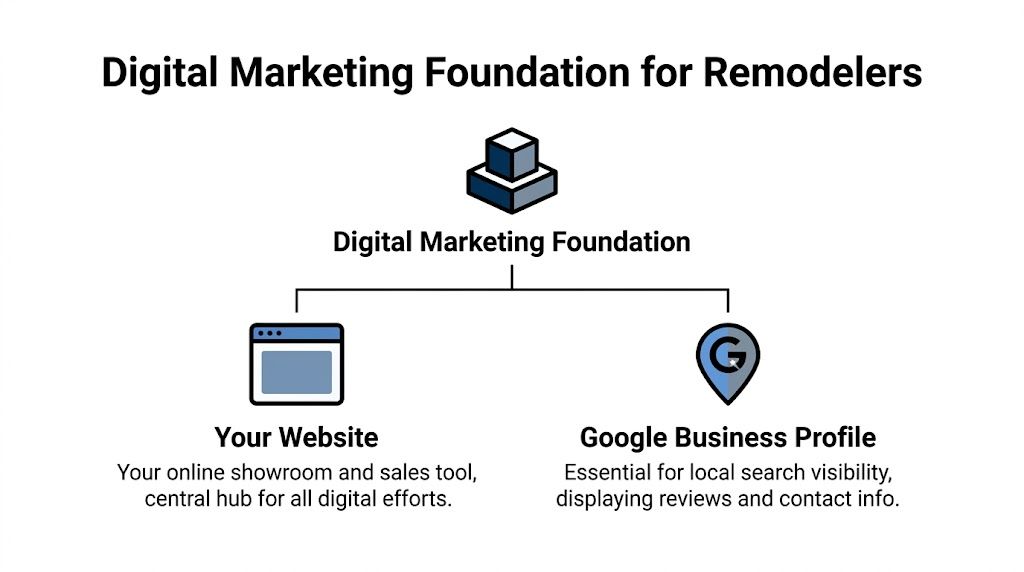
Your website is the model home
A good remodeling website shouldn’t just say what you do. It should show how you work, what you build, and why a homeowner should trust you with a major investment.
Think about what happens when someone lands on your site. They’re asking quiet questions in their head:
- "Do these people do the kind of work I want?"
- "Do they work in my area?"
- "Do they feel professional?"
- "Can I see real projects?"
- "What do I do next?"
If the site is slow, cluttered, or vague, people leave. If the site is clean and clear, they stay longer and move closer to contacting you.
A strong remodeling site usually includes these basics:
Service pages for real jobs
Don’t lump everything into one page. Kitchen remodels, bathroom remodels, additions, and outdoor living projects each deserve their own page.Location signals
Homeowners want a local contractor. Your site should make your service area obvious.Project photography
Before-and-after work, finished spaces, and detail shots do more selling than generic claims.Simple contact paths
Quote forms, click-to-call buttons, and consultation requests should be easy to find.
For a practical look at page structure and conversion, this guide on how to design a remodeling website that converts visitors into leads is a useful reference.
Your Google Business Profile is the storefront
Your Google Business Profile is what many people see before they ever visit your website. It shows up in Google Search and Maps. It carries your reviews, service area, photos, hours, and contact details.
This part sounds small, but it’s not. If your website is the model home, your profile is the sign out front with the lights on.
The details need to match everywhere online. According to Gushwork’s guide to digital marketing for remodeling contractors, keeping your Name, Address, and Phone consistent across 50+ online directories can boost local search visibility by 40-60% within 3-6 months.
Practical rule: If your phone number, address, or business name appears differently across the web, Google gets mixed signals. Mixed signals lead to weaker visibility.
What to check first
A busy owner doesn’t need a giant checklist to start. Begin here:
- Claim the profile: Make sure you control your Google Business Profile login.
- Fix the basics: Business name, address, phone, hours, and categories should be accurate.
- Add real photos: Show kitchens, baths, additions, crews, and finished details.
- Match your info everywhere: Directory listings should mirror your core business details.
- Link to the right pages: Send people to useful pages, not just a generic homepage.
This foundation doesn’t feel flashy. Concrete never does. But it’s what keeps everything else from cracking later.
Getting Found by the Right Homeowners with SEO
If the foundation is poured, people still need a way to reach the house. SEO builds those roads. It also puts signs in the right places so the right homeowners can find you.
Many remodelers hear "SEO" and think it means stuffing a city name onto a page over and over. It doesn’t. Good SEO helps Google understand what you do, where you do it, and why your business belongs in front of a local homeowner searching for help.
Local SEO puts signs on the right streets
Local SEO is what helps you show up for searches with local intent. A homeowner usually doesn’t search for a random broad term. They search more like a person talks.
They type things such as:
- "kitchen remodeler in Plano"
- "home addition contractor near me"
- "bathroom renovation company in my city"
Those searches carry stronger buying intent because the homeowner is already narrowing the field.
A lot of confusion happens here. Owners think ranking for the biggest keyword is the goal. It usually isn’t. A broad phrase can bring broad traffic. A more specific phrase can bring a better fit.
That’s why pages should be built around actual services and local service areas. Your title tags, headings, photo names, page copy, and internal links should all support that same message.
If you want a deeper walkthrough, this complete SEO guide for remodelers breaks down how service pages, local intent, and search visibility fit together.
Helpful content answers questions before the estimate
SEO isn’t only about service pages. It also includes helpful content that answers the questions homeowners ask before they hire someone.
Think about the difference between these two visitors:
- One searches for a contractor because they’re almost ready.
- Another searches for planning help because they’re still figuring things out.
Both matter.
A helpful article can bring in the early-stage homeowner and build trust before a sales call ever happens. A planning piece, a design question, or a process guide can do a lot of quiet selling.
For example, a remodeler who serves kitchen clients could publish content around timeline questions, layout decisions, or finish planning. A homeowner reading a guide like how to plan a kitchen remodel is already mentally stepping into the project. If your own site answers those same kinds of questions clearly, you become the contractor who feels prepared and easy to work with.
Homeowners often choose the company that helped them understand the project before they ever asked for the sale.
What good SEO feels like in real life
Good SEO doesn’t feel like tricking Google. It feels like making your business easy to understand.
When your pages match what local homeowners need, Google can connect the dots. When your content answers real questions, homeowners trust you sooner. When those pieces work together, you stop chasing random traffic and start attracting better-fit inquiries.
Using Google Ads to Invite Eager Buyers
SEO is a long build. Google Ads are faster. They work like paid invitations sent to homeowners who are already raising their hand.
That doesn’t mean Ads replace SEO. They do a different job. SEO helps you earn visibility over time. Ads help you show up now for searches tied to active demand.
SEO and Ads do different jobs
For remodelers who want simple language, here's an analogy: SEO is the marathon. Google Ads are the sprint.
According to Spot On Solutions on digital marketing strategies for home remodeling companies, Google Ads can deliver a 3-7x ROI within 90 days for remodeling contractors. The same source recommends using specific keywords like "home addition contractor [city]" instead of broad terms, and budgeting 5-10% of revenue to generate 100-500 leads per year.
That only works when the targeting is tight. Broad traffic burns money. Specific search intent brings better conversations.
| Factor | Local SEO (The Marathon) | Google Ads (The Sprint) |
|---|---|---|
| Speed | Builds over time | Can start producing visibility quickly |
| Cost pattern | Investment in content, site structure, and local authority | Pay for each click or lead opportunity |
| Best use | Long-term visibility and trust | Filling the pipeline while organic presence grows |
| Control | Less immediate control over rankings | Strong control over keywords, geography, and budget |
| Ideal searcher | Researching and comparing | Ready to act soon |
Search Ads and LSAs
Google Ads usually means two different tools for remodelers.
Search Ads are the text ads that appear on Google results pages. They let you target keywords tied to specific jobs and cities. These work well when the ad copy matches the homeowner’s search and sends them to a focused page.
Local Services Ads, often called LSAs, sit in a different placement and can carry the Google Guaranteed badge. That badge can help a homeowner feel safer about contacting you, especially when they’re comparing several companies quickly.
A simple setup often works better than a fancy one:
- Use specific keywords: Focus on jobs you want.
- Send clicks to matching pages: Kitchen ad to kitchen page. Addition ad to addition page.
- Show proof fast: Include finished projects, reviews, and a clear contact step.
- Watch search terms: Remove junk traffic that doesn’t match your business.
Decision rule: Use Ads when you need demand now. Use SEO when you want demand to compound. Use both when you want stability.
What not to do
The biggest mistake is running ads to a weak page. If the ad promises one thing and the page feels generic, the click is wasted.
The second mistake is buying broad terms because they have more volume. A remodeler doesn’t need more clicks. A remodeler needs the right homeowner in the right area asking about the right project.
That’s why ads work best inside a larger system, not as a stand-alone trick.
Turning Website Visitors into Real Leads
A visitor lands on your site. They like the photos. They scroll a little. Then they leave.
That happens every day when a website doesn’t guide the visitor. A good remodeling website should act like the perfect salesperson in a model home. Friendly. Clear. Helpful. Never pushy. Always ready with the next step.
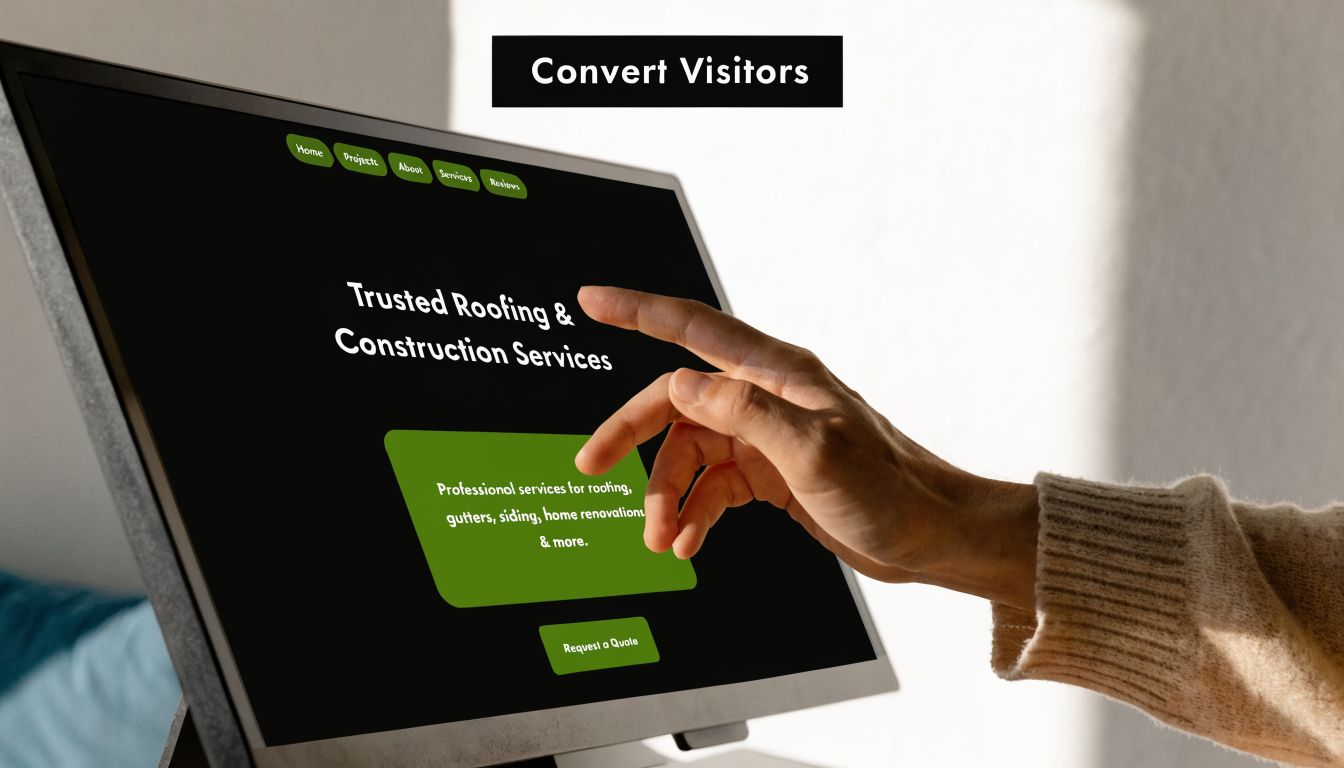
Your pages should guide not confuse
A homeowner shouldn’t have to hunt for basic answers. If the page is busy, unclear, or full of industry jargon, the visitor gets tired and leaves.
Think of a kitchen remodel page that does this well. The top of the page shows beautiful finished work. The headline says exactly what you do. A button offers a clear next step such as scheduling an estimate. As the visitor scrolls, they see the process, the service area, and examples of completed projects.
That flow matters because people don’t read websites like manuals. They scan. They look for clues.
Useful page elements include:
- Strong project galleries: Finished work helps homeowners picture what you can do.
- Simple calls to action: Buttons like "Get a Free Estimate" or "Book a Consultation" remove guesswork.
- Service clarity: Tell people exactly what kinds of projects you take on.
- Clean layout: Make the page easy to skim on a phone.
This guide on how to turn your website into your best salesman shows how those pieces work together on a remodeling site.
Trust needs to show up fast
Photos get attention. Trust closes the gap.
That trust can come from testimonials, review snippets, project details, warranty information, team photos, and clear explanations of how your process works. A homeowner making a large buying decision wants to feel that your company is organized and steady.
A common mistake is hiding proof on a separate page that nobody sees. Put trust where the decision is happening. Place it near quote buttons, inside service pages, and beside project examples.
If a visitor has to work hard to trust you, they usually won’t.
A good website asks for the next small yes
Not every visitor is ready for the same action. Some want to call. Some want to fill out a form. Some want to look at work first and contact you later.
That’s why your site should offer obvious next steps without overloading the page. One clear primary action usually works better than five competing ones. The goal isn’t to force a lead. It’s to make the next small yes feel easy.
Never Lose a Lead With an Automated System
Leads rarely arrive when you’re sitting at your desk. They come in while you’re driving, meeting a client, checking on a crew, or solving a job site problem.
That’s where many remodeling companies lose good opportunities. Not because the work isn’t good. Because the follow-up breaks.
A CRM acts like a lead project manager
A CRM is a customer relationship management tool. In plain English, it’s a smart system that keeps track of leads, conversations, follow-ups, and status changes.
Instead of writing notes on paper, checking missed calls manually, or trying to remember who asked for what, a CRM keeps the pipeline organized.
It can help you answer questions like:
- Who filled out a form yesterday?
- Who called but didn’t get reached?
- Who booked a consultation?
- Who needs a follow-up this week?
That matters because a lead pipeline is still a pipeline. If you don’t manage it, things leak.
Automation keeps you responsive when you are busy
Automation is the helper that does the fast repetitive work. A missed-call text is the easiest example. Someone calls. You miss it. The system sends a quick text back right away so the lead knows you saw them.
According to Blue Corona’s contractor marketing statistics, remodelers can nurture leads more effectively by using remarketing for 10-15% of an ad budget with proof assets such as before-and-afters, and by using a CRM to trigger automated follow-ups like missed-call texts. The same source says 40% of consumers decide on a contractor after seeing just one online review.
That tells you something important. The lead doesn’t just need a response. The lead needs proof and follow-up together.
A simple automated system might include:
Missed-call text-back
The lead hears from you even when you can’t answer.Lead tagging
Kitchen lead, bath lead, addition lead, referral lead. That keeps follow-up cleaner.Reminder tasks
You know when to call, email, or check in again.Remarketing with proof
If someone visits your site and leaves, your before-and-after content can help bring them back.
One option remodelers use for this kind of setup is a system like Constructo Marketing’s done-for-you approach, which includes a whitelabeled GoHighLevel CRM for lead tracking and follow-up automation alongside website, SEO, and ad work.
Fast response feels professional. Consistent follow-up feels trustworthy. Together, they keep good leads from disappearing.
The point isn’t to sound robotic. It’s to make sure no one slips through the cracks when your team is busy doing real work.
Frequently Asked Questions About Digital Marketing
Most remodelers don’t need more marketing buzzwords. They need clear answers that help them decide what to do next.
The smart way to think about digital marketing for remodeling contractors is this: you’re not buying isolated tactics. You’re building a system that supports predictable growth. Some parts help people find you. Some parts help them trust you. Some parts help you respond fast enough to win the job.
Common Remodeler Marketing Questions
| Question | Answer |
|---|---|
| How much should a remodeling company budget for marketing? | A common benchmark is 5-10% of revenue, as noted earlier in the article from the Google Ads source. What matters most is matching the budget to your growth goals and the kinds of projects you want to attract. |
| Should I focus on SEO or Google Ads first? | If you need leads quickly, Ads can help sooner. If you want long-term visibility, SEO matters. Many remodelers do best when both work together. |
| How long does it take to see results? | Some channels move faster than others. Ads can produce opportunities sooner, while SEO usually takes longer to build. The bigger point is consistency. Systems tend to beat one-off campaigns. |
| Do I need a new website? | Not always. But if your current site is hard to use, unclear, or weak at converting visitors, it may need a redesign or at least key improvements. |
| Is Google Business Profile really that important? | Yes. It’s often one of the first things local homeowners see when they search. A weak profile can hurt first impressions. |
| Can I do this myself? | You can handle parts of it yourself, especially reviews, photos, and basic profile upkeep. But many owners eventually want help because the work touches website strategy, SEO, Ads, tracking, and follow-up systems. |
A lot of owners ask the wrong final question. They ask, "What marketing tactic should I try?" A better question is, "What system do I need so leads arrive more consistently and get handled properly when they do?"
That’s the shift that usually changes the business.
If you want help building that kind of integrated system, Constructo Marketing works with remodelers on websites, local SEO, Google Ads, and lead follow-up automation designed for residential projects. If you’re tired of patching together random tactics, it’s a practical place to start looking at a more connected approach.