


Google Local Service Ads are special ads at the very top of Google that let customers call you directly, and you only pay Google when a real customer contacts you. They run on a pay-per-lead model, and in a 2023 survey, shopper preference for clicking them rose from 20.5% to 29.43%, while preference for traditional Google Ads fell from 16.75% to 10.99%.
If you're a remodeler, that sounds promising. But if you chase $75K to $300K projects, you probably have one big question behind the basic one: is this a smart fit for my business, or just another lead source that sends small jobs and bad-fit inquiries?
That's the part most articles skip.
A plumber can win with a fast phone call and a same-day fix. A design-build remodeler usually can't. Your leads need more trust, more qualification, and a lot more budget alignment. So if you're searching for what is google local service ads, you don't just need the beginner definition. You need the practical version for a high-ticket remodeling company.
Table of Contents
- Tired of Paying for Clicks That Go Nowhere?
- What Are Local Service Ads Really?
- How Google Local Service Ads Work For You
- LSAs vs Google Ads vs Local SEO for Remodelers
- Should Your Remodeling Business Use LSAs?
- Getting Started and Optimizing Your LSA Campaign
- Frequently Asked Questions from Remodelers
Tired of Paying for Clicks That Go Nowhere?
A lot of remodelers have lived through this.
You pay for ads. The phone rings. Your estimator gets hopeful. Then the lead says they want a handyman, a repair, or a tiny update that doesn't match your business at all. You still spent money, your team still spent time, and nothing moves forward.
That frustration is exactly why Local Service Ads got attention so quickly. They work differently from regular Google Ads. Instead of paying for someone to click, you pay when a customer contacts you through the ad by phone, text, or email. For a service business owner, that's a much easier idea to trust.
The shift in customer behavior is real, too. A 2023 survey found that preference for clicking on LSAs grew by 43.56%, while clicks on traditional Google Ads dropped by 34.4% according to Market My Market's analysis of Local Service Ads growth.
That doesn't mean LSAs are magic. It means homeowners increasingly like this format because it feels direct and simple.
Why this feels different to a remodeler
With a normal PPC ad, a homeowner clicks, lands on a page, pokes around, and may disappear.
With an LSA, the ad itself is built for contact. The person searching is usually trying to find someone local right now. They see a business profile, reviews, trust signals, and a button to call or message. That removes steps, and fewer steps usually means less friction.
Practical rule: LSAs aren't mainly a traffic tool. They're a contact tool.
For a remodeler, that's both the appeal and the caution.
The appeal is obvious. Better trust, better placement, and higher intent.
The caution is that high intent doesn't always mean high budget. Someone can be very serious about hiring a contractor and still be looking for a project far below your minimum.
Why you should care now
If homeowners are shifting attention toward LSAs, ignoring them gets risky. Even if you already rank well in Maps or run PPC, these ads can still sit above both. That changes what people see first when they search.
For some remodelers, LSAs become an important lead source. For others, they're best used as one layer in a bigger system. Either way, they're no longer something you can shrug off as "just another Google ad."
What Are Local Service Ads Really?
The simple version
Think of LSAs like Google's fast pass line for local service companies.
Instead of waiting down the page with everyone else, approved businesses can show up at the very top of search results and in Google Maps for service-related searches. The ad is mostly built from your Google Business Profile, and Google automates the ad creation for you.

That matters because LSAs don't ask you to write big ad headlines, build complex keyword lists, or design a fancy campaign from scratch. Google pulls in business details like your name, hours, review rating, service area, phone option, photos, and the Google Guaranteed badge when you're eligible.
If you've been trying to understand what is google local service ads in plain English, here's the easiest answer: it's a Google-run local referral system dressed like an ad.
What the homeowner actually sees
A homeowner searching for a service usually sees a short list of businesses with trust signals up front. That may include:
- Your business name
- Your review rating and review count
- Your business hours
- Your service area
- Your photos
- A call or message option
- The Google Guaranteed badge
That badge is a big deal because it tells the homeowner Google verified parts of your business before letting you into the program. For a person choosing who to invite into their home, that lowers anxiety fast.
LSAs also use hyper-local targeting. Google can match based on the searcher's location and your service area, which makes the platform especially tied to local proximity.
A standard ad says, "Click and learn more." An LSA says, "Here are trusted local pros. Contact one now."
That's why these ads often feel more like a shortlist than an advertisement.
Google also keeps the format tight. You don't get much control over copy or creative. Some owners hate that. Others love it because it cuts out a lot of setup headaches. If you want a broader look at how paid search fits local service companies, this guide on boost local service leads using Google Ads is a useful companion to the LSA conversation.
For remodelers, the big takeaway is simple. LSAs can create trust before your website even enters the picture. That's powerful when a homeowner is choosing between several contractors they've never met.
How Google Local Service Ads Work For You
Google grades your business like a report card
Google doesn't rotate LSAs randomly. It decides who shows up based on a handful of factors that act a lot like a school report card.
Your budget and bids matter. Your reviews matter. Your response speed matters. Your profile completeness matters. Your distance from the searcher matters. If two companies both do kitchen remodels, Google is trying to guess which one is most likely to help the customer and get a good outcome.
For remodelers, the two easiest pieces to understand are reputation and speed. According to ALM Corp's breakdown of LSA ranking factors, businesses with a 4.8+ star rating and fast response times can see 50-70% of their leads convert into customers because of the high-intent nature of the platform.
That doesn't mean every remodeler will hit that range. It means the system strongly rewards trust and fast follow-up.
Verification is part of the product
Before your ad can run, Google checks that your business is legitimate. Depending on your category and market, that can include licenses, insurance, and background checks. For larger remodeling companies with more field staff, this step can feel slow and annoying.
But that friction is also part of why the ad works.
A homeowner doesn't know which remodeler is reliable from a search result alone. Google's screening process helps fill that trust gap. In simple terms, Google is doing some of the homework first.
If your Google Business Profile is weak, your LSA setup usually feels weak too. That's why a solid Google Business Profile optimization checklist for remodelers is worth reviewing before you expect strong ad performance.
What you need to do well
If you want LSAs to perform, focus on the basics that move ranking and close rates:
- Answer fast: Missed calls and slow message replies hurt twice. You lose the lead, and you signal lower responsiveness to Google.
- Collect strong reviews: A high rating with meaningful review volume builds confidence fast.
- Keep the profile complete: Detailed services, accurate hours, real photos, and matching business information all help.
- Set realistic service areas: Don't spread too far if your team can't respond well or if distance weakens the kinds of jobs you want.
Faster response isn't just customer service. It's a ranking signal and a revenue habit.
Many owners get stuck because they treat LSAs like a switch they can flip on and ignore. That usually leads to sloppy follow-up, weak qualification, and disappointing results. The businesses that tend to win treat the dashboard like a live lead channel, not a one-time setup task.
LSAs vs Google Ads vs Local SEO for Remodelers
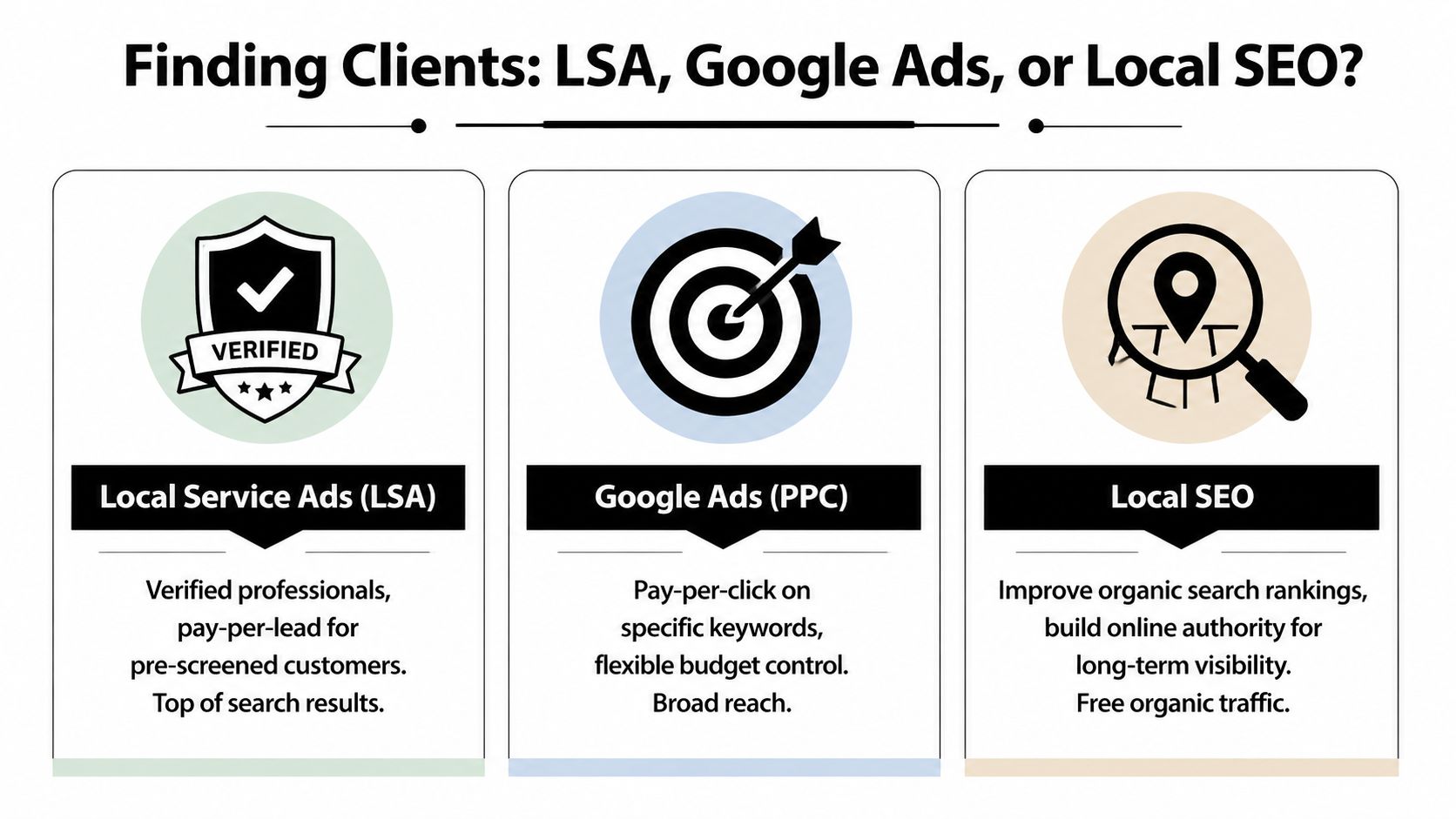
Three tools, three jobs
Remodelers often lump these together because they all show up on Google. That creates confusion.
They are not the same tool.
Local Service Ads are built to capture direct contacts from local searchers. You pay per lead. Google controls most of the ad format. This is the shortest path from search to phone call.
Traditional Google Ads are more hands-on. You pick keywords, shape messaging, send traffic to landing pages, and pay when someone clicks. That gives you more control, but also more room to waste money if the targeting is sloppy.
Local SEO is different again. You're improving your visibility in Maps and organic search over time through your Google Business Profile, website content, reviews, and local relevance. That takes longer, but it helps you show up when homeowners are researching, comparing, and planning bigger projects.
If you want a broader framework for the paid-versus-organic side of this decision, OneNine has a helpful resource to compare PPC and SEO strategies.
Local marketing channels at a glance
| Feature | Local Service Ads (LSAs) | Traditional Google Ads (PPC) | Local SEO (Maps/Organic) |
|---|---|---|---|
| Cost model | Pay per lead | Pay per click | Ongoing investment in optimization |
| Setup style | Mostly automated by Google | Manually controlled | Built through GBP, website, and local signals |
| Best for | People ready to contact a business | Targeting searches with custom messaging | Long-term local visibility and trust |
| Control level | Lower | Higher | Medium |
| Lead type | Direct calls or messages | Clicks that may or may not contact you | Visitors in research and comparison mode |
| Speed | Can produce leads quickly after approval | Can produce traffic quickly | Builds over time |
| Best use for remodelers | Capturing high-intent local inquiries | Filtering and shaping offers more precisely | Winning trust for larger, longer-consideration projects |
What this means for a remodeling company
If you do kitchens, baths, additions, or full-home work, Local SEO usually helps with the longer buying cycle. Homeowners looking at bigger projects often compare portfolios, read reviews, and browse service pages before they ever reach out.
PPC helps when you want tighter control over messaging. If you need to speak directly to "design-build kitchen remodel" or "home addition contractor," regular Google Ads can let you shape that message better than LSAs.
LSAs sit in a different spot. They are strong at getting the conversation started. They are weaker at pre-qualifying project size, style fit, or budget before the lead arrives.
Use LSAs to start conversations, PPC to shape demand, and Local SEO to build long-term trust.
That doesn't mean you must run all three. It means each one solves a different problem.
If your business already invests in paid search, this overview of pay-per-click advertising for contractors can help you think about where standard Google Ads fit beside LSAs instead of against them.
For many remodelers, the smartest play isn't choosing one channel forever. It's deciding which channel should do which job.
Should Your Remodeling Business Use LSAs?
When LSAs make sense
LSAs can be a very good fit if your remodeling business wants more local visibility, values trust signals, and has someone ready to answer and qualify leads quickly.
The Google Guaranteed badge helps a lot with homeowners who don't know you yet. In remodeling, trust starts before the estimate. If a homeowner is comparing unfamiliar companies, that badge and a strong review profile can make you feel safer to contact.

LSAs also make sense if your company offers a mix of services. If you do both larger remodels and some mid-sized projects, the platform may deliver enough qualified opportunities to be worthwhile even if not every inquiry is perfect.
Another good fit is a company with tight intake discipline. If your office can answer quickly, ask smart screening questions, and move the right people into consultations, LSAs become more useful.
Where remodelers get burned
Here, generic LSA advice breaks down.
According to Intero Digital's overview of Local Service Ads for businesses, LSAs work well for quick-service trades, but they can be harder for high-ticket remodelers because the platform centers on immediate-need searches while remodelers often rely on a longer, more consultative sales cycle for $75K+ work.
That's the heart of it.
Google can match for service type and location. It doesn't know whether the person contacting you has the budget, timeline, design expectations, or project seriousness you require. So if your company only wants major renovations, you may still get inquiries for cosmetic updates or smaller jobs.
Here are the signs LSAs may be a limited fit as a primary channel:
- You only take very large projects: If your minimum is high and strict, the mismatch risk goes up.
- Your sales process is long and design-heavy: LSAs create contact fast, but they don't educate the lead much beforehand.
- You don't have strong intake staff: Without quick qualification, expensive leads can slip away or clog your pipeline.
- Your market searches differently: Some homeowners planning luxury or complex remodels may spend more time researching in Maps, organic results, and portfolio pages than using a direct-call format.
LSAs can open the door. They don't decide whether the person walking through it is your ideal client.
For many remodelers, that's the right way to think about them. Not as the whole marketing strategy. As one source of opportunities that needs filtering and support from stronger branding, Local SEO, and a solid sales process.
Getting Started and Optimizing Your LSA Campaign

What setup looks like
Getting started is pretty simple on paper.
You create the account, connect the right business details, choose your service areas, submit licenses and insurance where required, complete verification, and set a budget. Because Google builds the ad from your business profile, accuracy matters a lot. If your information doesn't match cleanly, problems show up fast.
This is one place where remodelers should slow down and be precise. Use specific service descriptions instead of vague ones. "Kitchen remodel" is better than a broad phrase that could mean anything. Your service area should reflect where you want work, not every place your trucks could technically reach.
How to make the account stronger over time
The account gets better when the profile gets better. According to Dagmar Marketing's guidance on LSA profile quality and photo requirements, businesses with detailed service descriptions, 10+ high-resolution square photos, and 24/7 responsiveness can receive 2-3x more visibility than incomplete profiles.
That gives you a very practical checklist:
- Add real project photos: Use clean, square, high-quality images. Before-and-after work is especially helpful for remodeling.
- Tighten service definitions: Be specific about what you do so Google can match better.
- Protect responsiveness: Make sure calls ring through and messages get handled promptly.
- Review lead quality often: Notice patterns. If certain ZIP codes or service types send poor-fit leads, refine what you can.
Don't run LSAs without tracking
This part matters more for remodelers than for many trades.
A kitchen remodeling lead may take time, follow-up, and multiple conversations before it turns into a signed project. If you only look at raw lead count, you can fool yourself. You need to know which leads were valid, which booked, which turned into estimates, and which closed.
That is why pairing LSAs with a CRM matters. A system for follow-up, missed-call text-back, note tracking, and pipeline visibility can stop expensive leads from dying in the gap between first contact and actual consultation. If you want a deeper look at the full lead system around channels like LSAs, this guide to lead generation for contractors gives useful context.
Better tracking doesn't make bad leads good. It helps you spot patterns faster and stop paying for confusion.
Frequently Asked Questions from Remodelers
Can LSAs work for bigger remodeling jobs?
Yes, but usually not by themselves.
LSAs can absolutely generate inquiries for remodeling companies. The issue isn't whether the leads are real. The issue is whether the lead fits your minimum project size, process, and price point. Bigger jobs usually need more education and more trust-building than a direct-call ad can provide on its own.
What if I keep getting weak leads?
This is one of the biggest complaints from remodelers.
LSAs qualify by service type and location, not budget. That means some leads will be real people asking for the wrong kind of project. The good news is that documented invalid leads can often be disputed. According to WordStream's guide to Local Service Ads and lead disputes, businesses can get credit back for about 70% of invalid leads when they document them properly in the LSA dashboard.
A practical process looks like this:
- Tag the bad lead fast: Note why it was invalid.
- Keep records: Save message history, call notes, and any proof of mismatch.
- Submit the dispute in the dashboard: Don't wait too long.
- Watch patterns: If the same bad-fit lead type keeps appearing, your intake and targeting need attention.
How do I think about ROI?
For a remodeler, ROI from LSAs shouldn't be judged by lead count alone.
Judge them by lead validity, booked appointments, estimate rate, close rate, and eventual job value. If your projects are large, one well-qualified opportunity can matter more than a pile of weak inquiries. LSAs tend to work best when someone on your team qualifies quickly, follows up consistently, and rejects bad-fit leads without wasting days on them.
If you're asking whether LSAs are "worth it," the honest answer is this: they're worth testing when you have the operations to handle them. They're usually disappointing when you expect Google to pre-screen for budget and scope on your behalf.
If you want help building a lead system that fits high-ticket remodeling instead of generic contractor marketing, Constructo Marketing focuses on making remodelers locally dominant for the kinds of projects that move the business forward. They combine local search visibility, paid traffic, website conversion strategy, and CRM follow-up so you can judge every lead source, including LSAs, by real pipeline and revenue instead of guesswork.