


You build beautiful homes. Then your phone rings with the wrong people.
Somebody wants a handyman quote. Somebody else has champagne taste and a paper-cup budget. Another person clicked your ad, looked at one page, and vanished. Meanwhile, you're staring at a marketing report full of jargon that doesn't tell you one thing you care about. Did this turn into a real job or not?
That’s why most home builders ads fail. Not because ads are bad. Because builders get sold loose parts instead of a working system. A click by itself is useless. A form by itself is weak. Even a phone call can be a waste if nobody tracks it, qualifies it, or follows up fast.
Advertising still matters. A study highlighted by Denim Marketing says every $1 spent on advertising generated over $20 in sales activity, and builders saw website sessions grow 20% year-over-year. Your buyers are online. They’re researching before they ever call you.
The fix is simple. Stop thinking about ads like a slot machine. Start thinking like a builder. Build the whole thing. Front door, hallway, office, follow-up, closeout. That’s how you turn ad spend into predictable revenue.
Table of Contents
- Stop Guessing and Start Building Your Lead Machine
- Pouring the Foundation Before You Spend a Dollar
- Choosing Your Best Fishing Spots and Bait
- Crafting Ads That Attract High-Value Clients
- Setting Your Budget and Measuring What Matters
- Your 90-Day Blueprint for Predictable Leads
Stop Guessing and Start Building Your Lead Machine
A lot of builders run marketing the same way a rookie swings a hammer. Hard, fast, and all over the place.
They boost a few posts. They try Google Ads. They hire somebody who talks about impressions and reach. For a month, leads trickle in. Then the junk starts. Wrong locations. Tiny jobs. People who only want pricing. Money goes out. Nothing solid comes back.
Most ad campaigns break in the same place
The ad usually isn't the first problem. The system behind it is.
A homeowner clicks. Then what? They land on a cluttered website with ten menu options, a blurry stock photo, and a contact form that asks for name, email, and hope. Nobody filters for budget. Nobody tags the lead source. Nobody answers quickly. Then the builder decides “ads don’t work.”
Ads worked. The handoff failed.
Most builders don’t have a traffic problem. They have a sorting and follow-up problem.
The builders who win treat marketing like production. They don't toss money at platforms and pray. They create a path that guides the right prospect from curiosity to conversation.
Think like a builder, not like a gambler
You already know how to build in sequence. Site prep first. Foundation next. Framing after that. Marketing works the same way.
Your home builders ads are just the first touch. They are not the whole machine. The machine includes:
- The ad that attracts the right type of homeowner
- The landing page that matches what the ad promised
- The prequalification step that filters out bad-fit leads
- The CRM that tracks every call, form, and follow-up
- The sales process that turns qualified leads into signed projects
If one part is weak, the whole thing leaks.
Here’s the blunt truth. If you want $75K to $300K jobs, stop marketing like you’re available for everything. General messaging brings general leads. Tight messaging brings better ones.
A simple way to judge your setup
Ask yourself these three questions:
| Question | Bad answer | Good answer |
|---|---|---|
| Who is this ad for? | “Anyone needing work” | “Homeowners in my service area planning a major remodel or custom build” |
| Where does the click go? | “My homepage” | “A page built for that exact service” |
| What happens after they inquire? | “We check emails when we can” | “Every lead is tracked and followed up right away” |
If you can’t answer those clearly, you don’t need more ad spend. You need a lead machine.
Pouring the Foundation Before You Spend a Dollar
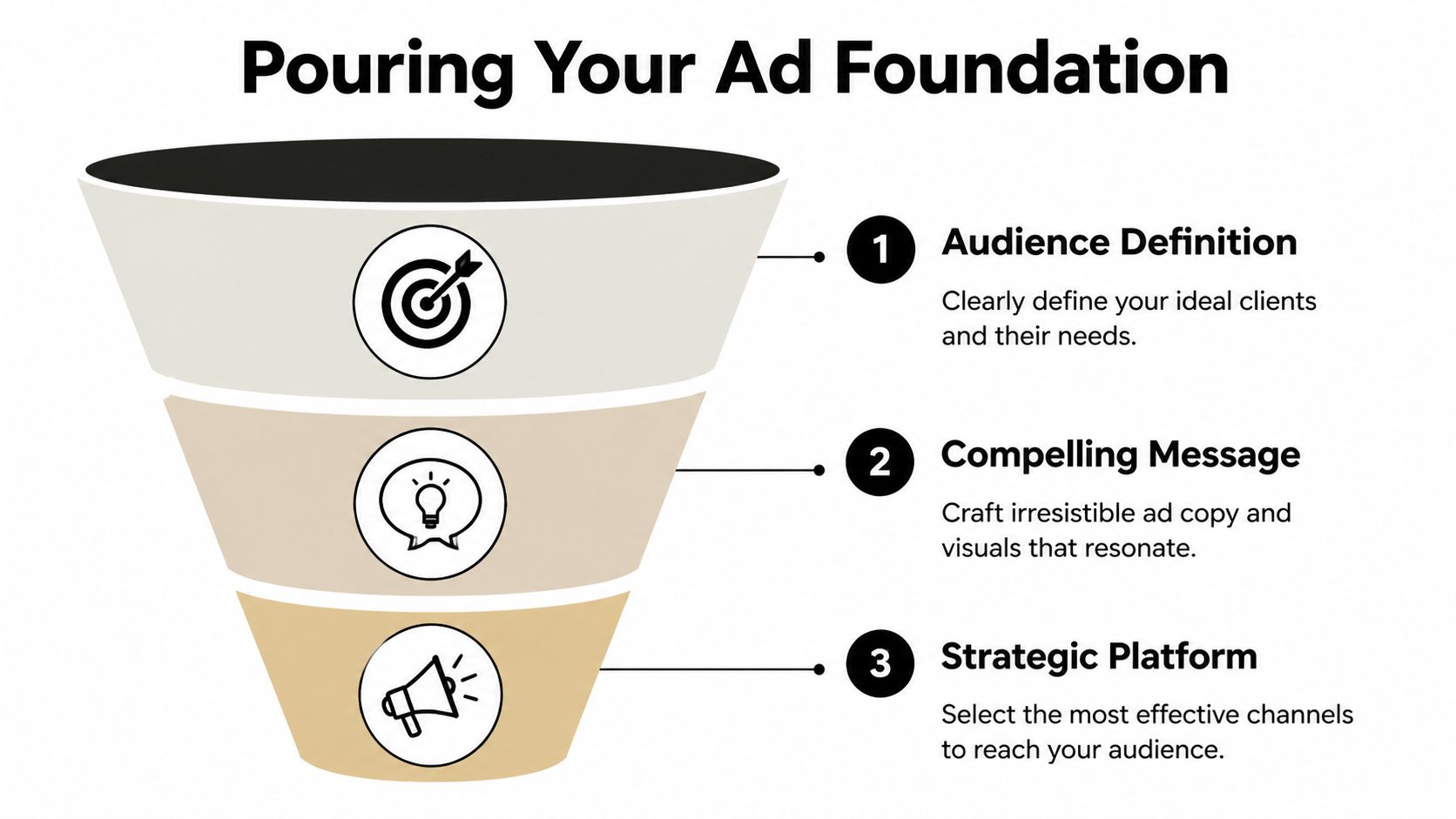
You wouldn't pour a slab on loose mud. Same rule here. Before you spend on home builders ads, build the base that holds the weight.
Your landing page is the job site trailer
Don’t send paid traffic to your homepage. That’s lazy, and it costs you.
A good landing page does one job. It speaks to one service, one market, and one kind of buyer. If you build custom homes, the page should be about custom homes. If you build additions, the page should be about additions. Keep the promise tight.
The page should include:
- A clear headline that says what you do and where you do it
- Real project photos from your own work
- A short process section so buyers know what working with you feels like
- A prequalification form that screens for fit
- One call to action instead of five competing ones
If you want stronger organic visibility to support paid traffic later, study this guide to SEO for home builders. Paid and organic work better together when both point to focused service pages.
Your offer must be clear and useful
Most builders bury the ask. “Contact us” is weak. It gives the buyer no reason to act.
Give them a clear next step. Offer a project consultation. Offer a design-planning call. Offer a guide that helps them prepare for a major remodel or build. Keep it practical. High-value homeowners respond to clarity, not hype.
A better offer sounds like this:
Practical rule: Ask for the next commitment, not the whole marriage. A consultation is easier to say yes to than “request a quote.”
Your page should also prequalify. Ask what kind of project they want. Ask location. Ask timeline. Ask budget range. If your business is built around larger residential work, your form should say so.
Your CRM is the follow-up foreman
This part gets ignored the most, and it costs builders real jobs.
Top-performing builders connect ads to a CRM, track leads from click to contract, and send traffic to landing pages with prequalification forms. That’s a key reason they achieve 5–8% lead-to-contract conversion rates while others struggle below 2%, according to BG Collective’s builder marketing benchmarks.
A CRM doesn’t need to be fancy. It needs to do the boring work every single time.
Use it to handle the basics:
- Capture every lead source so you know which ad produced the inquiry.
- Notify your team fast when a form or call comes in.
- Trigger follow-up if you miss a call or don’t reply right away.
- Track status from new lead to consultation to contract.
- Show you the truth about which campaigns produce revenue, not just clicks.
Without that, you’re driving with no dashboard.
Here’s the child-simple version. Ads bring people to the door. The landing page greets them. The form checks if they belong there. The CRM makes sure nobody walks away unnoticed. That’s your foundation.
Choosing Your Best Fishing Spots and Bait
Running ads without targeting is like fishing in a parking lot. Wrong place. Wrong result.

If you want high-value projects, you need to fish where those buyers are. For most builders, that means two spots. Google for demand that already exists. Facebook and Instagram for demand you want to shape before the buyer starts searching.
Google Ads for ready-now demand
Google is the best fishing hole when somebody already knows they need help.
These people search phrases tied to action. Things like custom home builder near me, home addition builder in their city, or new construction homes in a specific area. They’re not browsing for entertainment. They’re trying to solve a problem.
Use Google Ads when you want:
| Platform | Best use | Best traffic type | Biggest mistake |
|---|---|---|---|
| Google Ads | Capture active demand | High-intent searchers | Broad keywords and loose geography |
| Facebook and Instagram | Build demand and stay visible | People earlier in the journey | Weak creative and vague offers |
The targeting advice is simple. Keep geography tight. Target only the cities and neighborhoods you want to build in. Keep keyword groups tight too. Don’t dump every service into one campaign.
If you need help thinking through search intent, LPagery's construction keyword tips are useful for separating broad, noisy phrases from service-specific terms that match how real buyers search.
Facebook and Instagram for early-stage buyers
Meta platforms are different. Buyers there usually aren’t raising their hand as clearly as they do on Google. They may be dreaming, comparing styles, saving inspiration, or researching who looks trustworthy.
That makes Facebook and Instagram useful for visual services. Kitchens, additions, luxury outdoor spaces, custom homes. Good creative matters more here. The platform rewards strong images, real project videos, and clear positioning.
If you’re trying to understand platform fit for contractor campaigns, this breakdown of Facebook ads for contractors gives a practical look at where social fits in the lead mix.
Bad bait attracts bad leads
The bait is your targeting plus your message.
If your bait says “all construction services,” you’ll catch people who want everything from a gutter patch to a full custom build. That’s not a lead strategy. That’s a junk magnet.
Use filters that match the work you want:
- Service area focus keeps spend inside the places you can serve profitably.
- Project-specific messaging tells the market what you want more of.
- Visual proof signals whether you’re a premium builder or a bargain option.
- Prequalifying language helps discourage low-budget shoppers.
If you want better fish, stop using cheap bait.
A lot of builders worry that narrow targeting will shrink lead volume. Good. That’s the point. You don’t need more conversations. You need better ones.
Crafting Ads That Attract High-Value Clients
A homeowner clicks your ad for a custom build, lands on your site, likes what they see, then disappears for three weeks while they compare builders, talk budget, and ask their spouse ten different questions. If your ad strategy stops at the click, you lose that job to the builder who keeps showing up and captures the lead when the timing finally lines up.
That’s why your ads need to do two jobs. They need to attract the right prospect and feed a lead-capture system that keeps working after the first visit.

Use creative that sells the caliber of work you want
High-value clients judge fast.
They can tell the difference between a builder with a clear standard and one throwing random project photos into an ad account. Use real photos and short video from your best jobs. Show the kitchen with custom millwork. Show the rear elevation at dusk. Show the detail shot that proves your trim carpenter knows what he’s doing. Show progress-to-finish sequences if your process is part of the sale.
Keep the creative tightly matched to the project type you want more of. If you want luxury additions, run luxury additions. If you want custom homes, stop mixing in small handyman-style jobs that drag down your positioning.
If you need help turning raw jobsite footage into usable ad variations fast, the ShortGenius AI ad creative tool can help you build more video and image options without making the ads look fake.
Write copy that filters before the form fill
Good copy should save your sales team time.
Weak builder ads say the same tired things. Quality work. Family-owned. Free estimates. Those lines don’t attract serious buyers. They attract anyone with a pulse and a half-formed project idea.
Your ad should make the right prospect think, “This builder does my kind of project.”
Use this structure:
Name the project clearly
“Planning a custom home in [city]?”State the result
“Build a home designed around how your family lives.”Add a proof point
Mention your design-build process, construction management, permit handling, or portfolio.Set the next step
Ask for a consultation, site visit, or planning call. Don’t default to “contact us.”
That simple shift improves lead quality because it pre-sorts people before they ever hit your CRM. If you want examples of how ad copy, keyword intent, and landing pages should line up, read this PPC guide for contractors.
“Your ad should qualify the lead before your estimator ever picks up the phone.”
Build follow-up into the ad plan from day one
High-value residential projects rarely close on the first click. Chatter Buzz Media’s home builder benchmarks note that 97% of traffic often does not convert right away, and retargeting those visitors can lift conversions 2 to 3 times. The same benchmark report says a view-through rate above 10% is a useful mark for video ads.
That lines up with how homeowners buy. They visit. Leave. Compare. Revisit. Delay. Then come back when the project feels real.
So run retargeting from the start, not as an afterthought. Use a second-wave message that answers the questions people have after the first visit. Show finished projects. Show testimonials. Show a short video from the owner explaining how your process works. Then push every form fill, call, and booked consultation straight into your CRM so your team can follow up fast and track which ads produce real opportunities, not just cheap leads.
That’s how ads start acting like a lead system instead of a slot machine.
Setting Your Budget and Measuring What Matters
Builders get into trouble when they ask the wrong question.
The wrong question is, “How little can I spend?”
The right question is, “What system can I afford to run long enough to learn what works?”

Watch the few dials that matter
Think of your campaign like a truck headed to a job. You don’t stare at every bolt. You watch the key gauges.
For home builders ads, the main dials are simple:
- Cost per click
- Click-through rate
- Cost per conversion
- Lead quality
- Lead-to-contract performance inside your CRM
The first three tell you whether the ad traffic is efficient. The last two tell you whether that traffic is worth buying.
Use benchmarks like guardrails, not trophies
Here’s the benchmark data worth paying attention to. In the homebuilder space, Google Ads average $193.75 per conversion, while specialized campaigns can reduce that to $25.79 per conversion. Optimized display campaigns have achieved $0.36 cost per click and 0.92% click-through rates, nearly double the broader benchmark, according to Astralcom’s homebuilder digital advertising benchmarks.
That tells you something important. The gap between sloppy and well-run campaigns is massive.
Use this quick table as a dashboard:
| Metric | Broad benchmark | Optimized benchmark | What it tells you |
|---|---|---|---|
| Google Ads cost per conversion | $193.75 | $25.79 | Whether your search campaign is wasting money or filtering well |
| Display ad cost per click | $0.54 | $0.36 | Whether your audience and creative are efficient |
| Display ad click-through rate | 0.47% | 0.92% | Whether the ad is getting attention from the right people |
Don’t obsess over vanity numbers. A cheap click from the wrong homeowner is still expensive.
What to change when the numbers look bad
If clicks are coming in but conversions are weak, don’t panic and don’t instantly raise the budget. Fix the weak link.
Use this order:
- Check the search terms or audience targeting
If the wrong people are clicking, your campaign aim is off. - Check the offer
If the ask is vague, qualified buyers hesitate. - Check the landing page
If the page doesn’t match the ad, visitors bounce. - Check follow-up speed
A slow callback can ruin a good lead. - Check CRM tracking
If you can’t see click to contract, you can’t judge profit.
A campaign can look expensive on the ad platform and still be profitable in the CRM. The reverse is also true.
That’s why serious builders track all the way through the sale, not just to the first form fill.
Your 90-Day Blueprint for Predictable Leads
You don’t need a complicated marketing master plan. You need a punch list and the discipline to work it.
Days 1 through 30
Build the system before you chase volume.
Set up one focused landing page for one core service. Connect your forms and calls to your CRM. Write simple follow-up automations so no lead sits cold. Gather your best project photos and videos. Decide which locations you want.
Then build one clean campaign. Not ten.
Your checklist:
- Choose one service line you want to grow first
- Define your market area tightly
- Create one landing page with one job
- Install CRM tracking for calls, forms, and lead status
- Load real project media into your ad account
Days 31 through 60
Launch. Watch. Adjust.
Don’t rewrite everything every other day. Let the campaign produce enough signal to learn from. Review lead quality inside the CRM, not just on the ad dashboard. Listen to call recordings if you have them. Read every form submission. Look for patterns.
If leads are low quality, tighten the message. If traffic is decent but nobody converts, fix the page or offer. If good leads come in but nobody books them, the sales handoff is the problem.
Days 61 through 90
Start stacking the system.
Add retargeting so interested visitors keep seeing your brand. Test a second ad angle using different project photos or a different hook. Build a second landing page for another service only after the first one is stable.
By this point, you should know:
| Problem | Likely cause | First fix |
|---|---|---|
| Clicks but no inquiries | Weak page or unclear offer | Tighten message and simplify form |
| Inquiries but bad-fit projects | Loose targeting or vague copy | Narrow audience and prequalify harder |
| Good leads but poor close rate | Slow follow-up or weak sales process | Improve speed and handoff |
| No clear answer on ROI | Missing CRM tracking | Track from click to contract |
This is the whole game. Build the foundation. Pick the right channels. Use creative that shows your real work. Track what matters. Improve one weak link at a time.
Do that, and home builders ads stop feeling like gambling. They start behaving like a system you own.
If you want help building that full lead-capture system, Constructo Marketing specializes in helping remodelers and builders attract $75K to $300K residential projects with focused SEO, Google Ads, conversion-driven websites, and CRM follow-up that keeps leads from slipping through the cracks.