


You just wrapped a beautiful remodel. The photos look sharp. The client is happy. Your crew did real craft work.
Then Monday shows up and the same old problem is back. The pipeline feels thin, referrals are uneven, and you’re staring at the phone like it owes you money.
That’s where most remodelers get stuck. They’re excellent builders, but their lead flow is held together with duct tape. A referral here. A Facebook post there. Maybe some paid ads someone set up and forgot. It’s not a system. It’s hope.
A contractor seo agency should fix that. Not with fluff. Not with vanity reports. With a real machine that puts your company in front of homeowners who are already searching for the kind of work you want.
The reason this matters is simple. The broader SEO and internet marketing consultant sector in the US grew at a 21.9% CAGR between 2020 and 2025, which tells you one thing clearly. Online visibility has become a basic requirement for growth, not a side project (industry growth data from IBISWorld). If you want a practical primer on how businesses increase organic traffic, that’s a useful outside read. But for remodelers, traffic alone isn’t the job. Qualified leads are the job.
Table of Contents
- You're Great at Building But Your Phone Is Not Ringing
- What a Real Contractor SEO Agency Builds for You
- Two Plays That Win High-Value Remodeling Jobs
- How Much to Pay and What Is the Real ROI
- How to Hire the Right Agency and Spot the Red Flags
- Case Study From Word-of-Mouth to Predictable Growth
- The Final Blueprint for Your Marketing Foundation
You're Great at Building But Your Phone Is Not Ringing
A lot of remodelers live in this cycle. You finish one strong project, then spend the next few weeks wondering where the next good-fit homeowner will come from. Not just any lead. The kind of client who wants quality, has a real budget, and isn’t collecting free estimates for sport.
That stress wears owners down. You can be great in the field and still feel shaky in the office because the schedule depends too much on referrals and luck.
A contractor seo agency is supposed to solve that by building visibility where homeowners look. Picture putting your shop sign in the busiest part of town, except the town is Google and your sign works all day, every day. When someone searches for kitchen remodeling, home additions, or a bathroom contractor in your area, your company needs to be there. If you’re not there, someone else gets the call.
Good marketing for a remodeler should feel like a backlog with a process, not a gamble with a logo.
The problem is that many agencies talk like technicians and work like amateurs. They’ll sell you blog posts, rankings, and a monthly report full of arrows going up. Meanwhile, your estimator is still chasing cold leads and your missed calls are still going nowhere.
Here’s the plain-English version. SEO means making your business easier for Google to understand, trust, and show to local homeowners. A specialized contractor seo agency does that in a way that matches how people buy remodeling work. They don’t just chase traffic. They try to attract a homeowner who’s ready to talk about a serious project.
Why generic marketing keeps failing remodelers
Generalist agencies treat a remodeler like a dentist, a lawyer, or an online store. That’s sloppy work. Remodeling has a longer sales cycle, more trust friction, more visual proof requirements, and bigger consequences if you attract the wrong customer.
You don’t need more names in a spreadsheet. You need a better flow of the right conversations.
- Bad fit leads waste production time. Your team spends energy on people who were never going to buy.
- Weak websites undersell strong craftsmanship. The work is high-end, but the site feels cheap.
- No follow-up system kills expensive opportunities. Even a good lead turns cold fast when nobody responds well.
That’s why I’m blunt about this. If your marketing doesn’t produce steady, qualified local demand, it’s not marketing. It’s overhead.
What a Real Contractor SEO Agency Builds for You
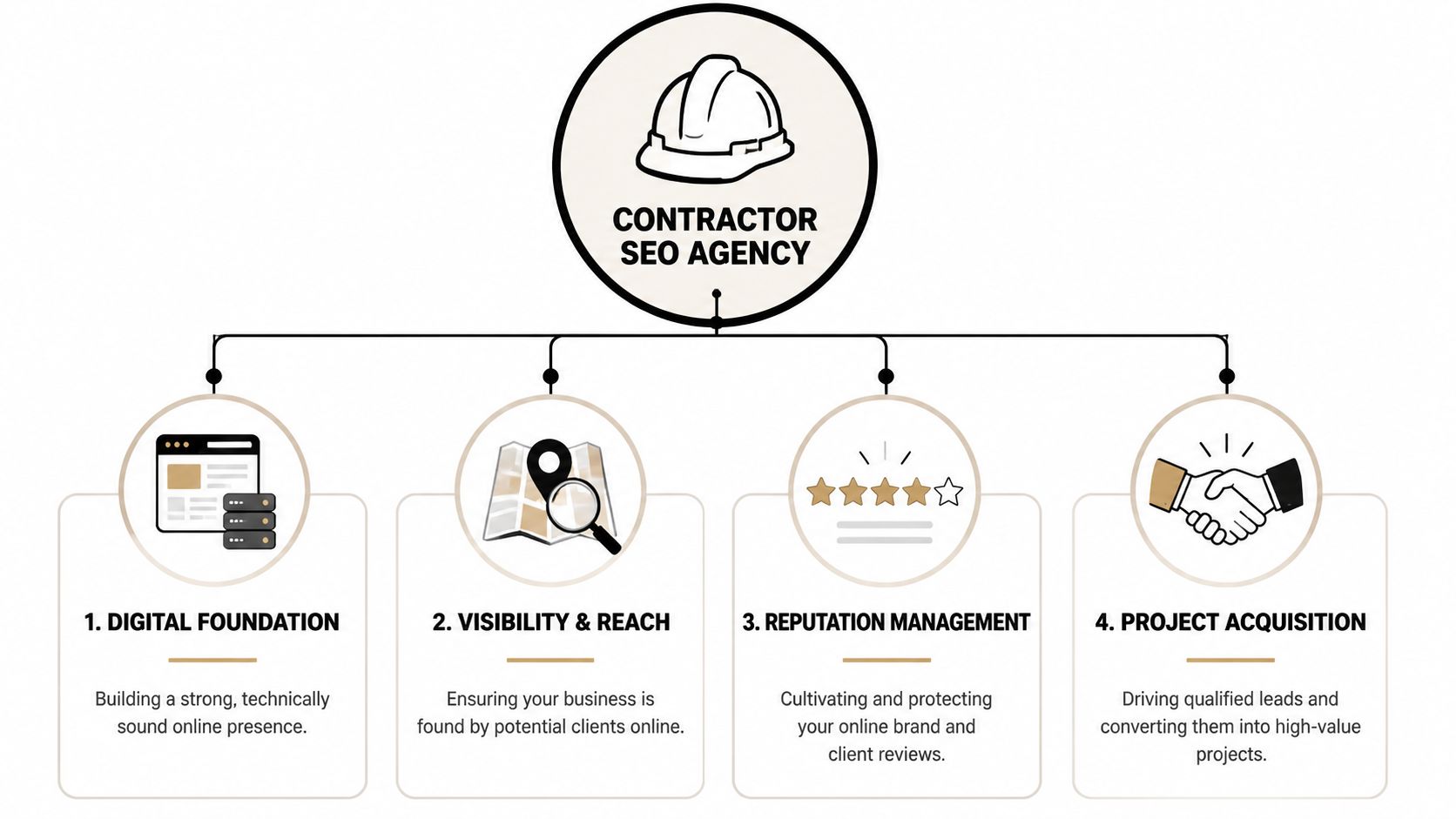
A real contractor seo agency should work like the general contractor for your marketing system. They don’t just swing one hammer. They coordinate the whole build so every piece works together.
That means your maps visibility, website, paid traffic, reviews, and CRM all need to connect. If one trade never shows up, the job stalls. Marketing works the same way.
The foundation is local search
Local SEO is the slab. If it’s crooked, everything above it fights you.
For a remodeler, local SEO means making sure Google understands three simple facts. What you do. Where you do it. Why homeowners should trust you. That includes your Google Business Profile, service pages, city pages, reviews, site structure, and the technical details under the hood.
If you want an example of how the website side should support that visibility, this piece on designing a remodeling website that converts visitors into leads is worth your time.
A strong foundation also includes content that mirrors real homeowner questions. Not fluff. Useful pages like process guides, remodeling timelines, and service-specific pages that match buyer intent. If your team is creating educational material, even video-first teams can borrow ideas from this guide for video content creators to turn expertise into durable written assets.
The rest of the build has to connect
The website is the framing. It gives shape to everything else. A remodeler’s site should show finished work, explain process, handle objections, and make it easy for the right person to take the next step. It should act like a calm, competent salesperson. Not a brochure from 2016.
Then come the utilities. Google Ads can create immediate demand while SEO compounds over time. But only if the campaign is tight. Broad, junk keywords burn money. Strong campaigns focus on buyer-intent terms and send people to pages built for conversion.
The final piece is the smart home system. Most agencies commonly fail in this area.
A lead comes in from search. Then what?
If the answer is “someone in the office checks the inbox,” you don’t have a system. You have a leak. The agency you hire should understand CRM automation, pipeline tracking, and missed-call text-back. A tool like GoHighLevel is often whitelabeled for this kind of setup. Constructo Marketing is one company in this niche that pairs local SEO, AI-focused SEO, websites, ads, and a whitelabeled GoHighLevel CRM for remodelers. That combination matters because rankings don’t pay the bills. Closed jobs do.
Practical rule: Never buy SEO without asking what happens in the first five minutes after a lead comes in.
Here’s what the full build should include:
- Local visibility work: Google Business Profile optimization, service pages, review generation, and location relevance.
- Conversion architecture: Pages for kitchens, baths, additions, and outdoor living that speak to homeowners like adults.
- Demand capture: Paid search for high-intent terms while organic visibility grows.
- Lead management: CRM tagging, automated follow-up, appointment workflows, and a way to recover missed calls.
If an agency can’t explain how those pieces fit together, they’re not building a system. They’re just selling tasks.
Two Plays That Win High-Value Remodeling Jobs
Most remodelers don’t need twenty marketing tactics. They need a few plays that match how homeowners search and choose.
Start with these.

Play one owns the map
Google Maps isn’t a side feature. For local contractors, it’s prime real estate.
When a homeowner searches for a kitchen remodeler nearby, they usually want a company in their area, not a theory. That’s why local search visibility matters so much. One technical move that helps is LocalBusiness Schema, which is code added to your site so Google can better understand your business details. With proper setup, your search result can show richer information like ratings and service details. That matters because 60% of contractor leads come from location-based searches, according to LinkGraph’s contractor SEO write-up.
Here’s the first-grader version. Schema is like labeling drawers in your workshop. If every drawer says exactly what’s inside, people find the right tool faster. Google works the same way.
To support that map play, your site also needs pages that match the actual services you sell. If you’re trying to sharpen that side of your system, this guide on lead generation for contractors covers the bigger picture.
Play two filters for buyers not browsers
A lot of contractors get burned by Google Ads because the setup is loose. The agency buys clicks instead of building intent filters.
Good ads don’t chase everybody. They target homeowners showing purchase behavior. Someone searching for a remodeling company in their city is different from someone browsing design ideas late at night. One is shopping. One is scrolling.
A smart paid search setup usually does a few things well:
- It narrows the service focus. Ads should match profitable categories, not every possible service under the sun.
- It sends people to the right landing page. Kitchen leads should land on a kitchen page, not the homepage.
- It screens before your team gets involved. The form, offer, and copy should discourage low-fit shoppers.
If your ads bring in people who say “we’re just getting ideas,” the campaign wasn’t tight enough.
These two plays work together. Maps visibility builds trust and captures local searchers. Buyer-intent ads let you turn on demand while the organic side grows stronger. That’s a real playbook. Not magic. Just solid blocking and tackling.
How Much to Pay and What Is the Real ROI
Let’s get to the part owners care about. Cost.
A contractor seo agency is usually hired on a monthly retainer. That’s normal. It’s ongoing work, not a one-time repair.

What the market usually charges
Contractor SEO retainers commonly range from $1,500 to over $8,000 per month, with basic local SEO often starting around $1,500 to $3,000 per month and fuller programs reaching $5,500 or more, based on Embarque’s contractor SEO agency pricing overview.
That price spread makes sense. Some firms are just cleaning up a Google Business Profile and publishing light content. Others are handling technical SEO, service pages, paid ads, conversion work, and CRM integration.
If you want a grounded look at budgeting on the remodeling side, this resource on how much a remodeling company should spend on marketing and what it really costs is useful.
How to think about return like an owner
Don’t think about SEO like buying a stack of blog posts. Think about it like buying equipment.
You’d spend money on a machine if it made the company better, faster, and more profitable. Same idea here. The question isn’t “What does it cost?” The question is “What does one good project cover?”
If your agency fee sits in the middle of the normal market range and that system helps you land one strong remodeling job that you otherwise would not have won, the math can make sense very quickly. Remodelers understand this particularly well. One right-fit project can carry a lot of weight. One wrong-fit campaign can waste months.
That’s why I don’t care much about traffic reports on their own. I care about:
- Lead quality: Are these homeowners in your target lane?
- Sales efficiency: Does the team spend less time on junk inquiries?
- Close rate visibility: Can you trace which leads turned into real opportunities?
- Capacity planning: Do you have enough demand to schedule work with confidence?
A side note from another industry applies here too. If you’ve ever read about how online stores improve ecommerce conversion, the same principle shows up. Getting visitors is only half the job. Turning interest into action is the primary job.
Cheap SEO that sends the wrong people is expensive. Strong SEO that helps you book the right work is cheap by comparison.
If an agency can’t talk about return in terms of lead quality, speed to contact, and closed jobs, they’re talking about the wrong scoreboard.
How to Hire the Right Agency and Spot the Red Flags
Hiring the wrong agency is like hiring a framer who says measurements are more of a suggestion. You might not notice on day one. You’ll notice when everything starts leaning.
This is where remodelers need to get tougher. A polished sales deck doesn’t mean the company knows your business. You need to ask better questions and listen for the right kind of answers.
Red flags that should end the call
Some agency behaviors are automatic no’s.
- Guaranteed rankings: Nobody controls Google. If they promise a specific rank, they’re selling fantasy.
- Traffic obsession: More visitors means nothing if your sales team hates the leads.
- No talk about follow-up: This one is a killer. Up to 70% of contractor leads are lost due to poor follow-up, which is exactly why vetting the follow-up process matters so much (First Page Sage on contractor agency evaluation).
- Generic industry language: If they talk to a remodeler the same way they talk to a med spa, keep walking.
- No CRM discussion: If they don’t ask how leads are tracked, contacted, and nurtured, they’re not thinking far enough downstream.
Green flags that show real competence
The right agency usually sounds more like an operator than a salesperson.
They ask what jobs you want more of. They ask about your market, margins, close rates, sales process, and production capacity. They want to know whether your office answers calls fast and whether missed calls get recovered. They care about the entire path from search to signed contract.
A good partner should also be willing to say no. No to bad-fit services. No to spreading budget too thin. No to chasing every town in a huge radius if you can’t serve them well.
The right agency doesn’t just ask how to get you more leads. They ask whether your business can catch them.
Essential interview questions for a contractor SEO agency
Use this table when you interview agencies. It will save you from a lot of nonsense.
| Category | Question to Ask | What a Good Answer Looks Like |
|---|---|---|
| Fit | Do you work with remodelers like us? | They speak clearly about kitchens, baths, additions, outdoor living, and longer sales cycles. |
| Strategy | What would you fix first in our marketing? | They give a logical priority order instead of saying everything is urgent. |
| Website | How do you make a site convert, not just rank? | They talk about service pages, trust signals, project galleries, offers, forms, and call handling. |
| Local SEO | How do you improve map visibility? | They mention Google Business Profile work, service relevance, reviews, location signals, and site support. |
| Ads | How do you avoid junk leads from paid search? | They focus on buyer-intent keywords, tighter targeting, and matching landing pages. |
| CRM | What happens after a lead comes in? | They discuss CRM workflows, lead routing, automations, and missed-call text-back. |
| Reporting | What do you report every month? | They talk about qualified leads, source tracking, pipeline visibility, and business outcomes. |
| Sales | How do you help us improve close rates? | They care about response time, follow-up sequence, and sales process visibility. |
| Accountability | What would make you a bad fit for us? | They answer directly and don’t pretend to be right for every company. |
Here’s the simplest hiring filter I know. If an agency only talks about rankings, they’re selling lumber. If they talk about rankings, conversion, follow-up, and revenue flow, they’re thinking like a builder.
Case Study From Word-of-Mouth to Predictable Growth
Oak & Beam Remodeling is fictional, but the story is real enough to feel familiar.
They did excellent work. Most of their jobs came from referrals. Some months felt full. Some months felt thin. The owner spent too much time wondering whether the pipeline would hold and not enough time running the company the way he wanted.

They didn’t need more random exposure. They needed a system. So the business tightened its service positioning, rebuilt key pages around the jobs it wanted, improved its local search presence, and stopped letting inbound leads die in an inbox. Every inquiry got tracked. Missed calls got a response. The website started doing some of the pre-qualification work before the first conversation.
The shift wasn’t flashy. It was disciplined.
Soon, the owner wasn’t asking, “Where will the next job come from?” He was asking, “Which projects fit us best?” That’s a healthier problem. The team could plan better, hire with more confidence, and stop taking weak-fit work just to keep the board full.
Predictable growth usually looks boring from the outside. That’s because good systems remove drama.
That’s the business outcome a contractor seo agency should create. Not just more attention. More control.
The Final Blueprint for Your Marketing Foundation
A contractor seo agency should build something permanent for your business. Not a campaign that vanishes when the ad spend stops. A foundation.
That foundation has a few load-bearing parts. Local visibility. A website that sells. Paid traffic with intent. A CRM that catches and follows up with every lead. Leave one part out and the structure gets shaky.
This is not complicated when you strip away the jargon. Homeowners search. They compare. They judge trust fast. They contact the company that looks competent and responds well. Your marketing system should support that buying behavior from start to finish.
You already know what happens when someone builds on a bad base. Cracks show up later. Marketing works the same way.
If your phone isn’t ringing consistently, don’t buy more random tactics. Hire a partner who can build the full system and prove they understand how remodeling companies win work.
If you want that kind of system built for a remodeling business, Constructo Marketing focuses on local SEO, AI-focused SEO, Google Ads, conversion websites, and CRM follow-up for remodelers pursuing larger residential projects. The big question to ask any agency, including them, is simple: can they help you get found, get chosen, and make sure no lead slips through the cracks?