


Most seo for remodelers advice is backwards.
It tells you to chase rankings, post random social content, and celebrate traffic like traffic pays for framing crews, designers, and jobsite overhead. It doesn't. A booked project does. If you want SEO to matter, it has to connect to a real lead system that helps you win the kinds of jobs you want.
That matters because organic search drives 55–70% of inbound lead volume for established remodeling contractors, and new or under-optimized sites often need 9–12 months to reach stable positions for high-value keywords, with typical investment in the $1,000–$3,500 monthly range, according to these remodeling SEO statistics. So yes, SEO matters. But no, it isn't magic, and it definitely isn't a pile of disconnected tactics.
If you're a remodeler, you're already good at systems. You schedule trades, manage selections, handle budgets, and keep projects moving. Marketing should work the same way. Google Business Profile gets you seen. Your website proves you're credible. Your content answers questions before the sales call. Ads speed up demand. A CRM catches and follows up with every lead. That's how SEO turns into revenue.
Table of Contents
- Why Most SEO Advice for Remodelers Is Wrong
- Win Your Neighborhood with Local SEO
- Turn Your Website Into a 24/7 Salesperson
- Become the Go-To Expert in Your Town
- Amplify Your Results with Ads and Automation
- Track the Scoreboard Not Just the Stats
- Your First 90 Days A Simple SEO Plan
- Frequently Asked Questions
Why Most SEO Advice for Remodelers Is Wrong
The bad advice usually sounds like this. “Post more on Instagram.” “Write blogs every week.” “Get more traffic.” None of that is wrong by itself. It's wrong when it's treated like the whole plan.
A remodeling company doesn't need more random attention. It needs the right homeowner, in the right town, searching for the right project, then taking the next step. That's a system problem, not a content problem.
Rankings are not the job
A lot of agencies sell SEO like it's a trophy case. They talk about keyword positions, impressions, and clicks. That's like a builder bragging that the lumber arrived while ignoring the fact that the house still isn't finished.
What you need is simpler:
- Get found locally: show up when someone searches for the service you sell.
- Pre-qualify the lead: make pricing level, project type, and quality obvious.
- Make response easy: calls, forms, and text follow-up need to work without friction.
- Track closed revenue: know which pages and channels lead to signed work.
SEO for remodelers should act like a sales pipeline, not a vanity project.
Most marketing feels fuzzy because it has no spine
That “fuzzy” feeling many remodelers have about marketing is usually a sign that nobody built the structure underneath it. You've got a website over here, a Google profile over there, some ad spend in another bucket, and no clean handoff between them.
That's why owners get frustrated. The phone rings, but the leads are mixed. Traffic goes up, but booked work doesn't. The agency sends reports, but nobody can answer a basic question like, “Did our kitchen page create any real opportunities this month?”
Here's the blunt version. If your SEO strategy doesn't connect search visibility to lead capture, follow-up, and sales tracking, then it's not really a strategy. It's activity.
Good SEO makes you local first
For a remodeler, SEO is not about trying to become famous on the internet. It's about becoming known in your service area. Think “Local Famous.” When a homeowner in your town searches for a kitchen remodeler, a bath remodeler, or an addition contractor, your name should feel familiar before they ever call.
That's why broad marketing advice misses the point. Remodelers don't win because they post the most. They win because they build trust at every stage of the search.
Win Your Neighborhood with Local SEO
If your website is your showroom, your Google Business Profile is your front door sign.
For local search, it's the first thing I'd fix. Not your logo. Not your color palette. Not your blog calendar. Your Google Business Profile.
According to this remodeler local SEO guide, Google Business Profile is the single most impactful local SEO asset for remodelers, a competitive threshold for Map Pack presence is 15–25 reviews with a 4.5+ average rating, and visibility in the Map Pack often takes 2–4 months in mid-size markets.
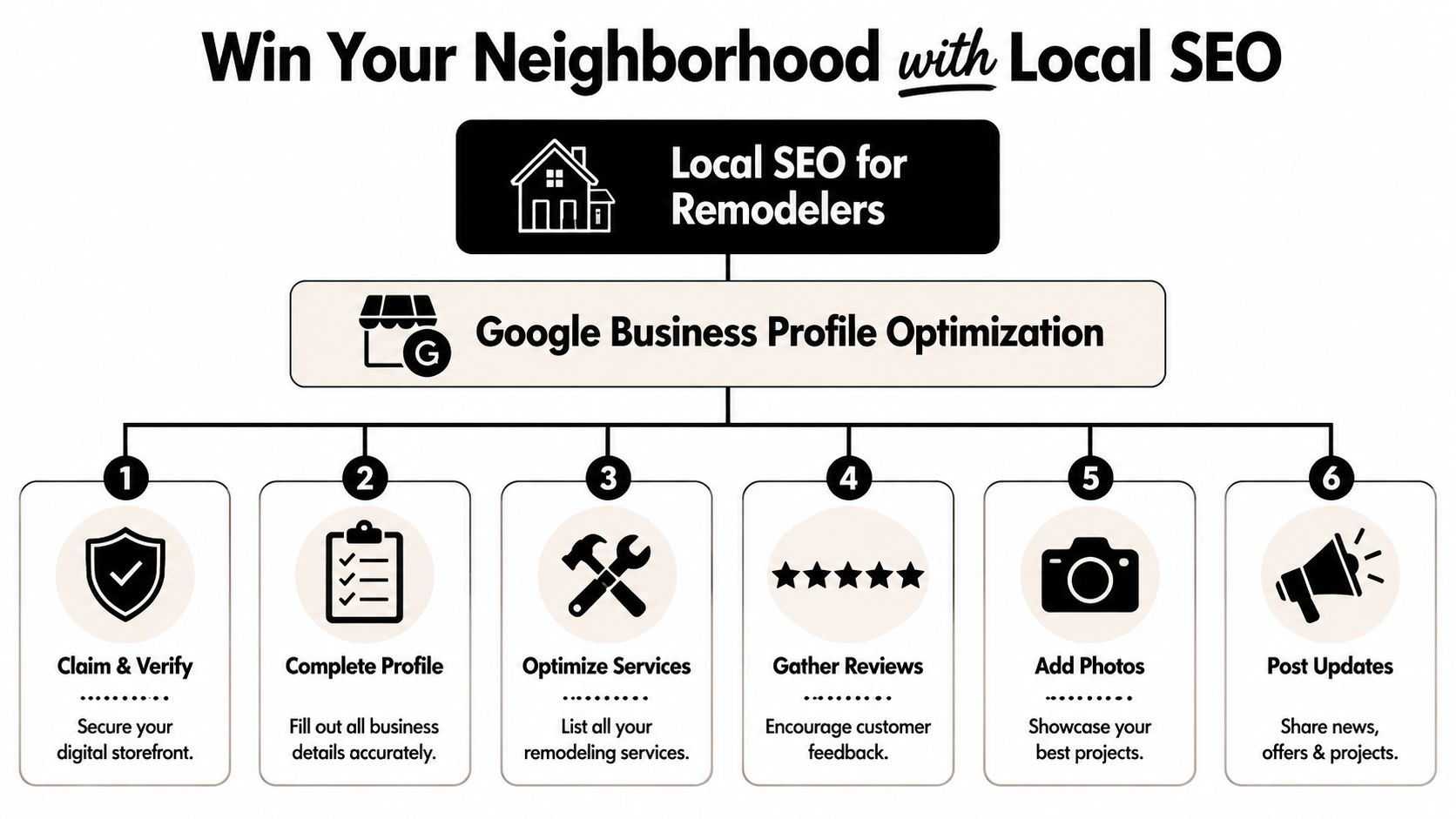
Treat your Google profile like a jobsite sign
If your profile is incomplete, inaccurate, or sloppy, Google has no reason to trust it and homeowners have no reason to click it.
Start with the basics:
- Use the right main category. If you specialize in kitchens and baths, don't hide under a broad label that makes you compete with everybody.
- Fill out every core field. Services, service areas, hours, phone, website, and business description all matter.
- Upload real project photos. Clean before-and-after work beats stock photography every time.
- Keep your name, address, and phone consistent everywhere. Your business details should match across directories.
If you want a practical outside reference, this Google Business Profile management playbook gives a solid walkthrough of the maintenance side many contractors ignore after setup.
Reviews are digital word of mouth
Reviews are not a side task for the office manager. They are a ranking and trust asset.
Ask every happy client. Ask at the right moment. Don't wait six months after final punch. A fresh review with a real comment about the project carries weight with both Google and future clients.
A simple review process works better than a heroic one:
- After a milestone: ask when the client is happiest, not when you remember.
- Use a direct link: remove friction so they can leave the review fast.
- Coach the team: PMs and designers should know when to tee up the request.
- Reply to reviews: show future homeowners that you pay attention.
Practical rule: if getting reviews depends on memory, it won't happen consistently.
Citations are your business cards around town
Citations sound technical. They're not. They just mean your business is listed correctly in the places homeowners and Google expect to find it, like Houzz, Yelp, Angi, and similar directories.
Imagine your business card is in every good Rolodex in town. If your info is wrong in half those places, trust drops.
A strong shortcut is to work from a checklist instead of guessing. This Google Business Profile checklist for remodelers is useful for making sure the pieces are covered.
What to focus on first
| Priority | What to do | Why it matters |
|---|---|---|
| First | Fix profile accuracy | Wrong info kills trust fast |
| Second | Add project photos | Homeowners buy with their eyes |
| Third | Build a review habit | Reviews influence clicks and local visibility |
| Fourth | Clean up citations | Consistency supports local trust |
Local SEO is the fastest path to becoming visible where you work. For most remodelers, that's where the phone starts ringing first.
Turn Your Website Into a 24/7 Salesperson
A lot of remodeling websites are pretty and useless.
They look polished, but they don't guide the homeowner anywhere. They don't answer the right questions. They don't separate services clearly. They don't make it easy to call. That's a brochure, not a salesperson.
Your website should act like the best person on your team. It should welcome the visitor, explain what you do, show proof, answer objections, and ask for the next step.
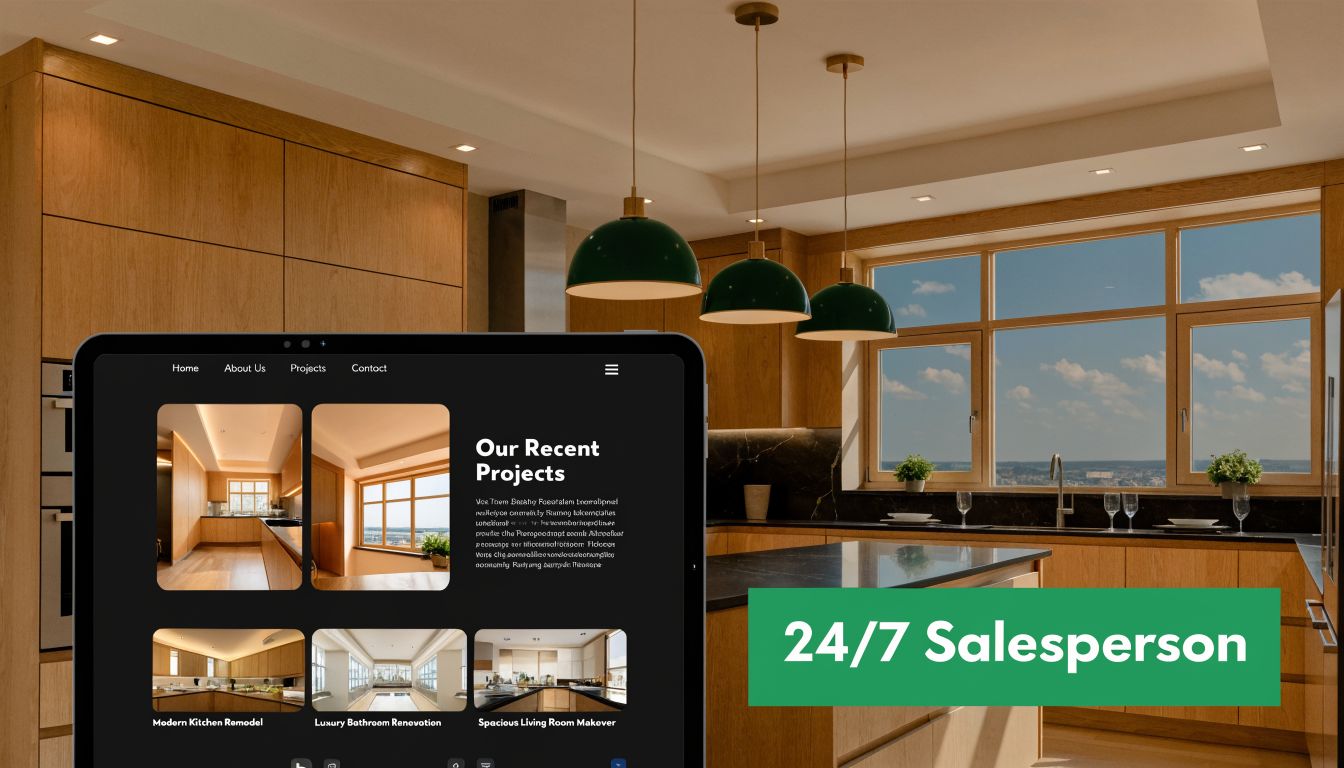
Build separate rooms in the showroom
Don't bury all your services on one generic page.
If you do kitchens, baths, additions, and whole-home remodels, each one deserves its own page. A homeowner looking for a kitchen remodel wants to land on a page that is clearly about kitchens. Same with baths. Same with additions.
That structure helps in two ways. First, Google understands the page better. Second, the homeowner feels like they found the right company, not a vague contractor who does “a little of everything.”
Clear signage beats clever copy
For on-page SEO, clarity wins.
According to these on-page SEO benchmarks for remodelers, a page title under 60 characters like “Kitchen Remodeling [City] | $75K+ Custom Designs” is important, optimized pages can rank in the top 3 within 4-8 months and drive 40% more quote requests, and a site that takes longer than 3 seconds to load sees 53% of visitors leave.
That means your website needs:
- Direct page titles: say exactly what the page is about.
- Fast load times: large image galleries should be compressed, not dumped onto the page raw.
- Simple headers: break content into useful sections a homeowner can scan.
- Strong calls to action: “Schedule a consultation” beats vague filler.
If a homeowner has to hunt for your phone number, your website is making the sale harder than it needs to.
A click-to-call button is one of the easiest fixes you can make, especially on mobile. If your team needs a plain-English reference, this guide on how to implement click to call is worth reviewing.
Proof belongs on service pages, not hidden away
Many remodelers tuck their best project photos into a gallery and leave the service pages thin. That's backwards. Your service pages should contain proof.
Show the kind of work tied to that service. Add process details. Mention the type of client and scope you're built for. If you focus on higher-ticket remodeling, your copy and examples should make that obvious.
A simple service page framework looks like this:
- What you do
- Who it's for
- What the process looks like
- Examples of recent work
- Common questions
- Clear next step
If you're reworking the site, this guide on designing a remodeling website that converts visitors into leads is a useful planning reference.
A good remodeling website doesn't just impress people. It moves them.
Become the Go-To Expert in Your Town
Most remodelers think “content” means blogging for the sake of blogging. That's why they hate it.
The useful version is much simpler. Write down the questions homeowners ask before they hire you. Then answer those questions better than anyone else in your town. That's content.
If somebody asks your team every week, “How much does a kitchen remodel cost here?” and you still don't have a page about it, you're leaving trust on the table.

The best topics are the ones sales already hears
Good content usually isn't creative. It's practical.
Start with topics like these:
- Cost questions: kitchen remodel cost in your city, bathroom remodel budget ranges, addition planning costs.
- Process questions: how long a remodel usually takes, when to hire a designer, how selections affect timeline.
- Decision questions: quartz vs quartzite, walk-in shower pros and cons, whether to stay or move.
These topics work because they match homeowner intent. They also help qualify leads. A person reading a detailed cost page is usually much further along than someone scrolling social media for inspiration.
Build a small library, not a pile of posts
A smart content strategy looks more like a workshop wall than a junk drawer. Everything has its place.
One strong “pillar” page might be your kitchen remodeling service page. Around that, you build supporting pieces like local cost guides, design trend articles, permit FAQs, and project case pages. Then you link them together.
That makes it easier for Google to understand your expertise, and it makes it easier for a homeowner to keep exploring.
The remodeler who answers the buyer's real questions usually earns the first serious conversation.
Use AI like an apprentice, not a replacement
AI can help. It can speed up outlines, organize notes, and draft rough copy. But if you let it write generic fluff and publish it untouched, you're going to sound like everyone else.
Use it the same way you'd use a new apprentice. Let it do prep work. Then your team adds the judgment.
That means:
- feed it real project details
- give it your service area and client type
- have a human rewrite sections with actual experience
- add local specifics, photos, and process language
Video can help here too, especially when you don't want to write long articles from scratch. A short walkthrough of a recent project or a quick answer to a common question can become useful site content, email follow-up material, and social proof. If your team wants simple ideas, these low-budget video content marketing hacks are a practical place to start.
The point isn't to publish more. It's to become the most helpful expert in your market.
Amplify Your Results with Ads and Automation
SEO is the long game. Ads are the fast lane.
If you're already building organic visibility, paid search can put you in front of homeowners who are ready now. That's the right way to think about it. Not SEO versus ads. SEO plus ads.
According to this paid search data for remodelers, search ads convert at an average of 4.2%, which is 8.6 times higher than display ads, and 30–50% lead-to-job conversion rates are achievable when campaigns are paired with strong follow-up systems.
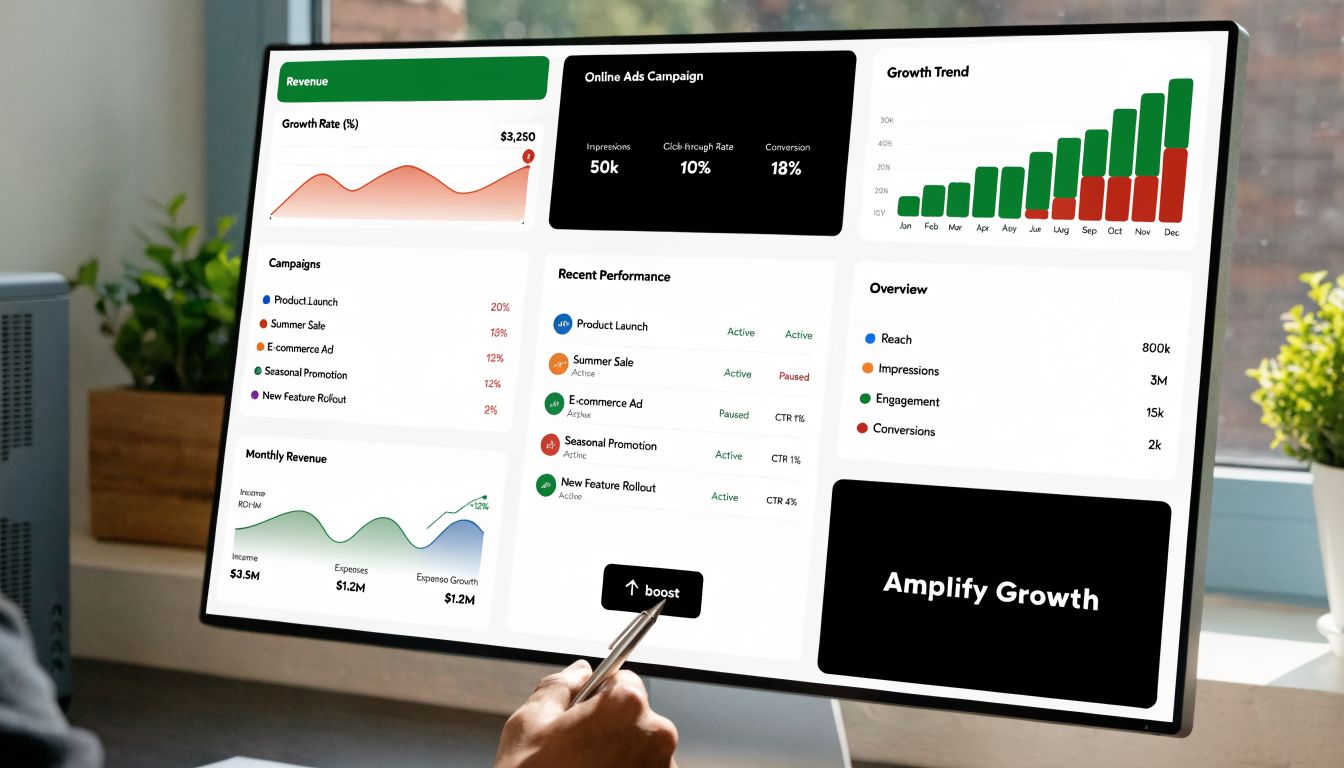
Use ads where intent is high
A remodeler usually doesn't need broad awareness ads first. Search intent is stronger. If someone is searching for your service in your town, that lead is warmer than someone who casually saw a display banner while reading the news.
That's why I'd prioritize:
- Google Search Ads for service-specific demand
- Local Services Ads if they fit your category and market
- Retargeting only after the core search system is working
If your sales process is solid, ads can fill the gap while SEO builds.
The CRM is your automated receptionist
This is the piece most companies skip, and it costs them leads.
A CRM should catch every form fill, every call, every missed call, and every ad lead. Then it should trigger the next action without your staff needing to remember everything. Text-back. Email confirmation. Pipeline stage. Reminder to call. Follow-up sequence.
Without that system, you're paying to generate opportunities and then dropping some of them on the floor.
Here's the simple version:
| Lead source | What should happen next |
|---|---|
| Website form | Instant confirmation and task for sales follow-up |
| Phone call | Logged, tagged, and assigned |
| Missed call | Automatic text-back |
| Google ad lead | Routed into the same pipeline as organic leads |
One option in this category is an integrated setup that combines local SEO, Google Ads, and CRM workflows so lead capture and follow-up happen in one place. For example, lead generation for contractors outlines that kind of connected approach for remodelers.
Ads without automation create waste
If you answer the phone fast, qualify well, and follow up consistently, paid traffic can work very well. If you don't, ads just expose the weakness faster.
That's why the winning setup is not “run more ads.” It's “run ads into a system.” SEO creates authority. Ads create speed. Automation protects both.
Track the Scoreboard Not Just the Stats
A lot of remodelers are looking at the wrong scoreboard.
Traffic is not the scoreboard. Rankings are not the scoreboard. Even leads by themselves are not the scoreboard. Revenue is the scoreboard.
According to this report on remodeling marketing ROI, 78% of remodelers track vanity metrics like traffic, not lead-to-close rates. The same source says homeowners researching $75K+ remodels convert 40% higher when sites link SEO content to automated funnels, and integrated systems tracking SEO-attributed revenue can yield a 4x ROI.
Think like a coach, not a cheerleader
If you coached football, you wouldn't celebrate every first down like it was a win. You'd care about points on the board.
Marketing works the same way:
- Traffic is yards gained.
- Rankings are field position.
- Leads are red zone trips.
- Closed jobs are touchdowns.
That shift matters because it changes what you ask your agency or internal team.
Don't ask, “Did traffic go up?”
Ask, “Which source created qualified appointments?”
Ask, “Which service page led to real opportunities?”
Ask, “Which campaigns turned into signed contracts?”
When you track only clicks and calls, you can't tell the difference between busy and profitable.
What to measure every month
You don't need a giant dashboard with fifty charts. You need a handful of business numbers that tell the truth.
A useful monthly scorecard includes:
- Qualified leads by source: organic, paid, Google Business Profile, referrals
- Lead-to-appointment rate: how many inquiries turn into real conversations
- Appointment-to-proposal rate: whether sales is attracting the right fit
- Proposal-to-close rate: whether the opportunity quality is strong
- Revenue by source: what closed
If you can't connect a lead to a source and then to a sale, you're still guessing.
The page-level view changes decisions
Integrated tracking demonstrates its power. You may find that your kitchen cost guide drives serious leads while a generic gallery page drives almost none. You may find Google Ads works well for additions but not for baths. You may learn your Google Business Profile creates calls, but your website closes the trust gap.
That's useful. It tells you where to invest next.
The purpose of seo for remodelers is not to collect marketing trivia. It's to know what turns search visibility into signed work.
Your First 90 Days A Simple SEO Plan
Most remodelers don't need more information. They need an order of operations.
So keep the first ninety days simple. Don't try to “do SEO.” Build the first pieces of a working system.
Days 1 through 30
Start with local visibility and cleanup.
Your checklist:
- Claim and fully complete your Google Business Profile
- Choose the most accurate primary category
- Upload strong project photos
- Make sure your business info matches across major directories
- Create a review request process for happy clients
The reason this goes first is simple. It affects local trust quickly and it doesn't require rebuilding your whole website to start making progress.
Days 31 through 60
Fix the part of your website that makes money.
Don't rebuild everything at once. Pick one core service. Usually that's kitchens, baths, additions, or whole-home remodeling. Then build one page that deserves to rank and convert.
That page should include:
- what you do
- the area you serve
- who the project is for
- process overview
- project examples
- FAQs
- clear contact options
Then add one strong project page tied to that service. Real photos. Real scope. Real details.
A single strong service page beats ten thin pages every time.
Days 61 through 90
Add trust-building content and basic tracking.
Write one cost or planning article based on a real sales question. “How much does a kitchen remodel cost in [city]?” is a classic for a reason. Homeowners ask it because they need it.
Then set up a basic lead tracking process:
- Tag form fills by page source
- Log phone calls
- Track where appointments came from
- Review outcomes monthly
This is also the point where AI can help your team move faster. Use it to organize notes from sales calls, draft an outline from common questions, or repurpose project details into article starters. Then edit with a human brain before publishing.
What not to do in the first 90 days
Here's what I'd skip at the start:
- Don't chase every keyword in every nearby city
- Don't buy cheap backlinks from random vendors
- Don't publish thin blog posts just to look active
- Don't run ads without a follow-up process
- Don't judge SEO after a few weeks
The first ninety days are about foundations. Clean profile. Strong service page. Real proof. Review process. Lead tracking. That's enough to create momentum without turning marketing into another full-time job for the owner.
Frequently Asked Questions
How long does seo for remodelers take to work
It usually takes time. The exact pace depends on your market, competition, website quality, and how strong your local setup is. If you're expecting instant organic results, you'll be disappointed. If you build patiently and consistently, SEO becomes an asset that keeps working.
Should I do SEO myself or hire help
You can do parts of it yourself, especially Google Business Profile updates, review requests, project photos, and answering common customer questions in content. But many remodelers hit a wall on technical fixes, page structure, tracking, and ongoing execution. If you hire help, don't hire somebody who only talks about traffic.
Is Google Business Profile more important than my website
For local discovery, it can be the fastest lever. But it should not stand alone. Your profile gets attention. Your website earns trust. You need both.
Should I focus on SEO or Google Ads first
If you need leads sooner, ads can help while SEO builds. If you ignore SEO completely, you stay dependent on rented attention. The strongest approach is usually a combination of local SEO, a conversion-focused site, and paid search when follow-up is dialed in.
What kind of content should a remodeler publish first
Start with service pages, project pages, and practical articles that answer buying questions. Cost, process, timeline, material comparisons, and local planning questions are usually strong places to start. Don't write for other marketers. Write for the homeowner sitting at the kitchen table trying to make a decision.
How does SEO turn into a big remodeling job
A homeowner searches. Your business shows up. Your profile and website build confidence. Your content answers the scary questions. Your forms and phone tracking capture the lead. Your CRM follows up fast. Your sales process takes over. That's the chain. Break one link, and the result gets weaker.
If you want help building that kind of system, Constructo Marketing focuses on integrated marketing for remodelers, combining local SEO, AI-supported content, websites, Google Ads, and CRM follow-up so search visibility connects to real opportunities instead of just prettier reports.