


If you're a contractor, you probably know this feeling. One month the phone rings because a past client sends you a referral. The next month it's dead quiet, so you throw money at ads, buy some sketchy leads, or hire a marketing company that talks like a software manual and shows you graphs that don't mean a thing.
That's not a marketing plan. That's feast-or-famine with a logo on it.
SEO services for contractors matter because they help your business get found when a homeowner is already looking for the exact work you do. Not random clicks. Not tire-kickers. Not a cousin's friend who "might remodel next year." Real buyers. The kind who search, compare, and call.
For remodelers chasing bigger jobs, SEO isn't about vanity. It's about building a system that turns Google, Maps, ads, and follow-up into booked work and real cash flow.
Table of Contents
- What Is SEO and Why Should a Contractor Care
- The Core Parts of Contractor SEO Services
- How Long SEO Takes and How to Measure Success
- Connecting SEO with Ads and a Smart CRM
- How to Hire the Right Contractor SEO Agency
- What Success Looks Like for Remodelers and Trades
- Frequently Asked Questions About Contractor SEO
What Is SEO and Why Should a Contractor Care
SEO is simple. It means setting up your business so Google puts you in front of people searching for your work.
Moving to a new town requires building a reputation from scratch. You need signs, references, photos of finished jobs, clear contact info, and proof you do what you say. Google works the same way. It wants proof that you're a real contractor, in a real market, doing real jobs for real customers.
SEO is your online reputation system. It helps you show up when someone searches things like kitchen remodeler near me, roofing company in town, or bathroom remodel cost. If you don't show up, your competitor does. It's that plain.
A lot of contractors still treat marketing like gambling. They rely on referrals only, or they buy leads from third-party platforms and hope something sticks. That's like building a house with no footing and being shocked when it cracks.
According to Mordor Intelligence's SEO market analysis, the global SEO services market is projected to reach USD 83.98 billion in 2026, and construction services see an average 681% ROI with a 5-month breakeven period. That tells you this isn't fluff. Done right, SEO is a profit tool.
Practical rule: If homeowners are searching and your company isn't visible, you're handing work to somebody else.
If you want a plain-English look at how local visibility works in Google Maps, this Adwave guide to local visibility is worth reading. If you want a broader beginner-friendly breakdown of search basics, this overview of SEO from Constructo Marketing lays out the main pieces without the usual agency nonsense.
The Core Parts of Contractor SEO Services
Contractor SEO has a few moving parts, and each one affects a different part of the sales process. If an agency lumps everything into one vague monthly package, you're not buying a system. You're buying noise.
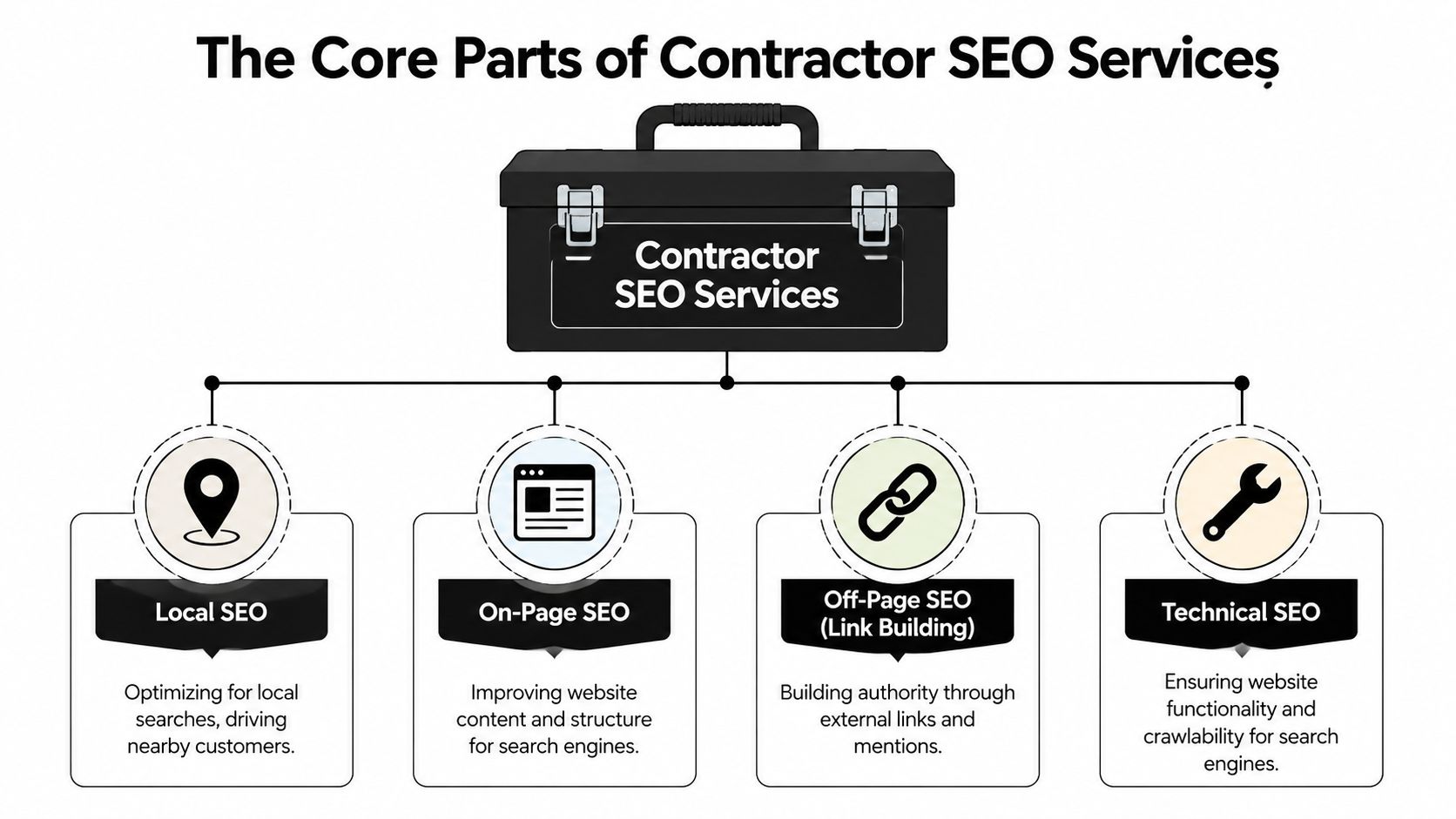
Local SEO brings in nearby buyers
For contractors, local SEO usually pulls the first real lead. It helps you appear in Google Maps, local service searches, and branded searches in your service area. That matters because homeowners are usually looking for someone close, available, and trustworthy now.
Your Google Business Profile does a lot of the heavy lifting. It needs the right categories, service areas, business details, project photos, and a steady flow of real reviews. If you want the nuts and bolts, this guide to Google Business Profile for contractors covers the setup in plain English.
Good local SEO work should include:
- Google Business Profile setup and maintenance: Categories, services, hours, photos, posts, and review responses
- City and service pages: Pages built for real towns and real jobs, with proof from local projects
- Citation cleanup: Your business details should match across directories and industry listings
- Review generation: A simple process that gets fresh reviews from happy customers without begging
Many contractors lose money on ineffective marketing tactics. Agencies often create fifty thin city pages, fill them with town names, and label it a strategy. Google sees through that. Homeowners do too.
On-page SEO turns traffic into calls
Your website needs to match how people search and how they decide. A homeowner does not type "premium residential transformation solutions." They search "bathroom remodeler in Plano" or "roof leak repair near me."
That means each page needs a clear job.
| Part | What it should do |
|---|---|
| Service pages | Target a specific service and explain how you handle it |
| Project pages and galleries | Show the quality, scope, and style of your work |
| Clear calls to action | Make it obvious how to call, text, or request an estimate |
| Trust signals | Prove you're legitimate with reviews, credentials, service area details, and real job photos |
Good on-page SEO also means writing copy that answers buyer questions before they ask them on the phone. Pricing range. Process. Timelines. Materials. Financing. Warranty. If your site dodges those topics, weaker competitors can still beat you by being clearer.
Technical SEO keeps your site from wasting good traffic
A slow, messy site bleeds money. It can rank poorly, load poorly, and frustrate people who were ready to contact you.
Technical SEO covers the parts homeowners never notice unless they break. Pages need to load fast, especially project galleries. Important pages need to be crawlable and indexable. Site structure needs to make sense. Schema markup should tell Google what your business does and where you work.
A proper technical review should check:
- Crawlability: Search engines can reach your important service and location pages
- Image performance: Large gallery images are compressed and loaded efficiently
- Schema markup: Business, service, and local information is labeled clearly
- Site structure: Pages support local intent instead of competing with each other
Contractors love to show off project photos, and they should. But if those images are huge, uncompressed, or buried in a clumsy gallery, they drag the whole site down.
Off-page SEO builds trust outside your website
Google does not judge your site in a vacuum. It also looks at the signals around it.
Off-page SEO includes links from relevant websites, mentions of your company across the web, and consistent business information in trusted directories. It also includes reputation signals, especially reviews. For a contractor chasing larger remodels or specialty jobs, these signals help separate a real company from a guy with a truck and a Gmail address.
This part gets abused all the time. Some agencies buy junk links, dump your business into spammy directories, and send a report full of charts. That kind of work can waste months. Good off-page SEO is slower, cleaner, and tied to your actual market.
The point of all this is simple. Local SEO gets you found. On-page SEO gets the right visitor to trust you. Technical SEO keeps the site from sabotaging you. Off-page SEO strengthens your reputation. Put together, those pieces help you attract better-fit leads, not just more clicks. That is how SEO starts feeding higher-value jobs instead of random tire-kickers.
How Long SEO Takes and How to Measure Success
You sign with an SEO company in January. By March, they send a report full of impressions, keyword charts, and colored arrows. Meanwhile, your phone is still filled with small repair jobs and price shoppers. That is the problem. Contractors are often told to judge SEO like a marketing toy instead of a sales system.
Real SEO takes time because it is supposed to change who finds you, what they think when they land on your site, and whether they turn into a booked estimate for a job worth chasing. If you want $75,000 kitchen remodels or larger additions, judge SEO by pipeline quality and closed revenue, not by pretty graphs.

The first wins are usually invisible to you
Early SEO work fixes the stuff that blocks growth. That can mean cleaning up bad page targeting, tightening your Google Business Profile, sorting out tracking, and making sure service pages match the towns and jobs you want.
This stage is not exciting. It is the prep work before the profitable work.
A good team should be able to show what they changed and why it matters to lead flow. If they hide behind jargon, walk away. Good SEO people can explain the job like a foreman explaining a punch list.
You should usually see the first signs of progress in a few months. Better map visibility. More qualified calls. More form fills from the right service pages. Closed jobs take longer because remodeling sales cycles are longer. That is normal.
SEO should produce steady traction. Fast promises usually mean junk traffic, junk leads, or flat-out nonsense.
Measure the stuff that pays you
A lot of agencies report on activity, not results. That is how contractors end up celebrating traffic while losing money.
Use a scoreboard that connects search traffic to sales:
- Phone calls from organic search and Google Maps
- Contact forms from service and location pages
- Booked consultations
- Estimate requests for your target job types
- Signed jobs and revenue tied back to source
- Average job size by lead source
That last one matters more than people admit. Ten leads for handyman work can waste more time than one solid basement finishing lead. SEO is doing its job when it helps you get better-fit opportunities, not just more names in the inbox.
Use stage-based goals, not random rankings
Rankings matter, but only in context. If you rank for terms that bring bargain hunters, you are not winning. If your site brings fewer leads but more of them turn into large projects, that is progress.
Here is a simple way to track it:
| Stage | What to watch |
|---|---|
| Early | Map visibility, calls, form fills, tracking accuracy |
| Middle | Qualified consultations, estimate requests, lead quality |
| Later | Signed jobs, revenue by channel, average project value |
This is also why SEO should never sit by itself in a corner. If you connect it with paid traffic and follow-up, you can see which channel produces real opportunities. A contractor lead generation system that ties SEO to ads and sales follow-up makes that much easier to measure.
Bad follow-up can make good SEO look broken
Here is some straight truth. Contractors blame SEO for leads they failed to work.
If calls go to voicemail, form fills sit untouched for two days, or your office gives weak first answers, your numbers will look worse than they should. That is not an SEO problem. It is an operations problem. Teams that improve home service customer interactions usually get more value from the same traffic because they stop fumbling good inquiries.
If your agency cannot tell you how many leads came in, how many were qualified, and how many turned into sold work, you are not measuring success. You are buying reports. Big difference.
Connecting SEO with Ads and a Smart CRM
SEO alone is good. SEO tied to ads and a CRM is better.
Think of SEO as the engine. Google Ads are the turbo button when you need leads sooner. Your CRM is the job foreman who makes sure nobody drops the ball after the phone rings.

SEO brings demand and ads speed it up
SEO builds your long-term presence. Ads can put you in front of buyers now.
That combo works well for remodelers and home service contractors because the channels do different jobs. SEO captures organic demand and builds authority. Ads let you target service keywords, test offers, and stay visible while your organic presence gets stronger.
But here's the catch. If you run ads and SEO without a system behind them, you won't know which leads are junk, which ones turn into meetings, and which ones become profitable jobs.
That's why integrated lead generation matters. This lead generation for contractors resource shows how the pieces fit together in one system instead of acting like separate toys.
Your CRM keeps good leads from leaking out
A CRM is not just a fancy contact list. It's the place where lead source, follow-up, appointments, and sales outcomes get tracked.
Onely's write-up on AI SEO agencies for contractors points out that contractors using a CRM integrated with marketing can track the full lead-to-revenue pipeline. That's a big deal for remodelers with longer sales cycles, because it shows which keywords and ads turn into booked projects.
A smart setup should help you answer questions like:
- Which calls came from SEO
- Which form leads came from ads
- How fast your team responded
- Which leads booked estimates
- Which jobs closed
If you miss calls, you need automation. If your follow-up is slow, you need reminders and text-back systems. If your office staff struggles with lead handling, tighten that process too. This guide on how to improve home service customer interactions is useful because a lead you don't answer isn't a lead. It's a donation to your competitor.
One option in this space is Constructo Marketing, which offers local SEO, Google Ads, and a whitelabeled CRM for remodelers. That's the right general model. Not because the logo matters, but because integrated systems beat disconnected marketing every time.
How to Hire the Right Contractor SEO Agency
Hiring an SEO agency is like hiring a key subcontractor. The right one keeps the project moving. The wrong one leaves you with delays, excuses, and extra costs.
Most agencies sell confidence first and clarity second. That's backward. You need clarity first.

Questions to ask before you sign
Start with direct questions. If they dodge, that's your answer.
One question matters more than most. Do you work with multiple contractors in the same market? Embarque's article on contractor SEO agencies highlights market exclusivity as a key issue. That's exactly right. If an agency is helping three remodelers in the same city, somebody is getting played.
Ask these before you sign anything:
- How do you define success: They should talk about qualified leads, booked jobs, and tracking. Not just rankings.
- Do you enforce market exclusivity: If not, you're funding your own competition.
- What do you fix first: A serious agency should mention technical issues, local presence, and conversion points.
- How do you report results: You want plain-language reporting tied to calls, forms, appointments, and sales outcomes.
- Who writes and builds the work: You need to know whether they're doing strategy or just outsourcing everything blindly.
A contractor-focused agency should also understand your sales cycle. A roofer chasing storm work and a design-build remodeler chasing larger residential projects do not need the same game plan.
If they can't explain their process simply, they either don't understand it or don't want you to.
Red flags that should kill the deal
Some warnings are obvious. Others are dressed up to sound smart.
Here are the big ones:
- Guaranteed rankings: Nobody controls Google. Promises like that are bait.
- No talk about lead quality: Traffic without qualification is noise.
- Generic city pages at scale: That's lazy work, and Google is getting better at spotting it.
- No CRM or attribution discussion: If they stop at clicks and rankings, they stop too early.
- They push tools instead of strategy: Tools matter, but they're not the job.
If you're curious what agencies use behind the scenes, this list of top 12 tools for SEO agencies gives you a useful peek at the software stack. Just remember, tools don't produce results by themselves. Buying a laser level doesn't make somebody a great framer.
A good agency should feel like a steady project manager. Clear scope. Clear communication. Clear accountability. No fog machine.
What Success Looks Like for Remodelers and Trades
The end goal isn't "better SEO." The goal is better jobs, better margins, and less dependence on random lead sources.
A remodeler example
A kitchen and bath remodeler usually doesn't need more traffic from everybody. They need more visibility with the right homeowners in the right neighborhoods.
The smart play is a tight local system. Service pages for the core jobs. Real project galleries. Google Business Profile updates. Location-focused content that answers homeowner questions before they call. Then tie every inquiry back to source in the CRM so the owner knows which searches and pages are producing serious consultations.
That kind of setup doesn't just create activity. It helps filter out low-fit leads and attract the people who already expect a higher-end project experience.
A roofer example
A roofer stuck on shared leads has a different problem. The phone rings, but the lead quality is weak and everybody is bidding the same job.
SEO gives that roofer a chance to build owned demand instead of renting it. A stronger Maps presence, cleaner service pages, better reviews, and fast follow-up can shift the business away from price-shopping lead platforms and toward direct calls from homeowners who found the company first.
The pattern is the same across trades. When contractors control their own visibility, they stop living at the mercy of somebody else's lead list.
Frequently Asked Questions About Contractor SEO
Do I really need a blog
Sometimes yes. Sometimes no.
You do not need to publish fluff every week just to say you have a blog. That's agency busywork. But you do need useful content that answers real buyer questions.
For a remodeler, that might mean pages about project timelines, cost expectations, design-build process, or service-area-specific concerns. For a roofer, it might be repair vs replacement questions or storm damage info. The point is simple. Write content that helps a homeowner move closer to hiring.
Can I do SEO myself
You can do parts of it yourself. A lot of contractors should.
You can upload job photos, ask for reviews, update your Google Business Profile, and make sure your website shows real work instead of stock junk. Those are high-value actions.
But full SEO gets technical fast. Site structure, schema, page targeting, lead attribution, call tracking, and conversion paths take time and know-how. If you're already running crews, bidding jobs, and managing cash flow, doing all of that well is tough.
A good rule is this:
- Do it yourself if you're willing to learn, stay consistent, and keep your scope small.
- Hire help if you want a complete system and don't have time to become a part-time marketer.
What should a serious contractor expect from an SEO partner
Expect straight answers and visible work.
They should be able to show what they're changing, why they're changing it, and how success gets measured. They should talk about your market, your services, your ideal project type, and how leads flow into your office. They should not drown you in jargon.
You should also expect honesty about timing. SEO isn't instant. But if the strategy is sound, the site is healthy, the local signals are strong, and the follow-up process is tight, the work compounds.
Good SEO doesn't just get you found. It helps you get chosen.
If you want help building a system instead of chasing random tactics, Constructo Marketing focuses on remodelers who want stronger local visibility, qualified homeowner leads, and better tracking from first click to signed job.