


Most advice about digital marketing for home builders is backwards.
You hear, “Post more on Instagram.” “Run some ads.” “Do SEO.” That's like telling a framer to start hanging cabinets before the slab is poured. Random tactics don't build a pipeline. Systems do.
Buyers don't move in a straight line anymore. By Q2 2025, builder websites saw search traffic soften while direct traffic and paid social grew, which tells you buyers are bouncing between channels before they ever raise a hand, according to Blue Tangerine's Q2 2025 builder marketing trend report. If you're betting everything on one channel, you're building on sand.
A good marketing system works like a house blueprint. Your website is the model home. Your Google Business Profile is the roadside sign. SEO is the neighborhood visibility. Google Ads is the paid traffic lane. Your CRM is the office manager who calls people back. Miss one piece and the whole thing gets sloppy.
If this feels familiar, you're not alone. A lot of contractors and builders make the same structural mistakes, and this breakdown of what contractors get wrong about digital marketing lays out the pattern clearly.
Table of Contents
- Why Most Digital Marketing for Builders Fails
- Build Your Digital Foundation First
- Attract Buyers with Local Search Engine Optimization
- Target Ready-to-Buy Clients with Google Ads
- Install a System to Never Lose a Lead
- Your Phased Marketing Implementation Roadmap
- Common Questions About Marketing for Builders
Why Most Digital Marketing for Builders Fails
Most builder marketing fails for one simple reason. The pieces don't connect.
A builder pays for a pretty website, but there's no clear offer, no strong location pages, no review strategy, and no follow-up when leads come in. Another builder buys ads, but sends traffic to the homepage. Another posts project photos all week long, but never gives buyers a reason to call. The tools aren't bad. The assembly is bad.
Practical rule: Don't ask whether a tactic is good. Ask whether it fits the system.
A lot of agencies sell parts because parts are easy to pitch. “We'll do SEO.” “We'll run Meta ads.” “We'll refresh your branding.” Fine. But a fancy front door doesn't help if there's no driveway leading to the house.
Here's what broken marketing usually looks like:
- Traffic with no conversion path: People visit, look around, then leave because the site doesn't answer price, process, location, or next-step questions.
- Leads with no follow-up: Calls get missed. Forms sit in inboxes. Sales staff follow up when they have time.
- Branding with no demand capture: The company looks polished, but it doesn't show up when someone searches for a builder in the service area.
- Reporting with no business meaning: You hear about impressions and clicks, but not call quality, appointment quality, or whether the lead was in your build zone.
Builders don't need more marketing activity. They need fewer leaks.
The best mindset is simple. Treat marketing like construction. You need sequence, trade coordination, and quality control. If the slab is off, every trade downstream suffers. If your website, search presence, and lead handling are off, every channel gets more expensive and less effective.
Build Your Digital Foundation First
If your foundation is crooked, every finish trade has to fight it. Your online presence works the same way.
Before you spend hard money on ads or content, fix the assets you own. That means your website and your Google Business Profile. One is where people decide whether to trust you. The other is how many of them find you in the first place.
Your website is the model home
Your site isn't there to impress your friends. It's there to move a stranger from “just looking” to “I should talk to these people.”
That matters because the average home builder website benchmark showed a 46.85% bounce rate and a 2.20% conversion rate, which means a lot of visitors leave without taking action, according to Astralcom's 2025 homebuilder digital advertising benchmarks.
A strong builder site needs a few basic things:
- Clear service-area language: Say where you build. Don't make Google or buyers guess.
- Project proof: Show real work, real photos, and enough detail for buyers to picture themselves hiring you.
- Simple conversion points: Calls, forms, consultation requests, and map directions should be easy to find.
- Process clarity: Explain what happens first, second, and third. Buyers hate mystery.
- Message match: If somebody lands on a page about custom homes in a specific city, that page should stay on that topic.
Think like a superintendent walking a client through a model home. You don't dump every option in one room. You guide the path.
A website that only looks good is like a staged kitchen with no plumbing. Nice photos. Wrong job.
Your Google Business Profile is the sign on the highway
Your Google Business Profile is often the first thing a local buyer sees. Reviews, photos, hours, categories, service area, and updates all shape whether that click goes to you or someone else.
Most builders underuse it. They claim the profile, add a logo, and walk away. That's lazy. A complete profile helps buyers understand what you do, where you work, and whether you're active right now.
Use this quick checklist:
| Asset | What to include |
|---|---|
| Primary category | Your closest core service |
| Service areas | The cities or regions you actually serve |
| Photos | Exterior, interior, progress, team, and finished work |
| Reviews | Consistent collection of honest client feedback |
| Business details | Hours, phone, website, and a solid description |
Your site is the destination. Your profile is the sign that gets people off the road and into the driveway. Build both before you chase more traffic.
Attract Buyers with Local Search Engine Optimization
SEO for builders isn't magic. It's location clarity plus trust plus a website Google can read without getting confused.
The easiest way to understand it is this. If your business were a physical office, SEO is choosing the busy corner where qualified buyers already walk by. You're not dragging random people in off the freeway. You're showing up where intent already exists.
Win the map pack before you chase anything fancy
For most builders, Local SEO is the most effective place to start. Google's map pack captures an estimated 40% to 50% of clicks for local searches, according to SAVO Group's home builder SEO guidance. That's a huge chunk of buyer attention.
If you build in Austin, don't optimize like a national brand. Build pages and profile signals around Austin, nearby communities, and the actual services you offer there. Google needs clean clues.
The basics that matter most are straightforward:
- Location pages: Create useful pages for each market you serve.
- Category alignment: Your profile, page titles, and on-site copy should describe the same core services.
- Review relevance: Ask clients to mention the type of project and location naturally.
- Internal links: Help Google move from your main service pages to city pages, galleries, and contact pages.
- Technical cleanup: Fast load times, mobile usability, clear navigation, and secure browsing all help.
If you want a simple refresher on how SEO content works in plain English, the Wand Websites SEO content guide is a useful primer.
Make your pages easy for Google to understand
A lot of people overcomplicate “AI-driven SEO.” Here's the first-grade version. Google is getting better at reading what your pages mean, not just spotting exact words.
That means weak pages get exposed faster. A thin page that says “quality craftsmanship” twelve times won't carry much weight. A page that explains your process, shows project types, answers common questions, and clearly ties those services to a location gives Google more to work with.
A builder website should answer buyer questions before the buyer calls. That includes:
- Where do you build
- What kinds of homes or projects do you take
- What does your process look like
- How can someone contact you
For map visibility, this guide on how to rank higher on Google Maps is worth reviewing.
Good SEO isn't tricking Google. It's making your business easier to understand than your competitor's business.
Done right, SEO compounds. One strong page can keep bringing in the right kind of visitor long after you publish it. That's why it belongs in the blueprint, not as an afterthought.
Target Ready-to-Buy Clients with Google Ads
SEO is the long build. Google Ads is the fast lane.
But most builders waste money here because they buy attention instead of buying intent. They target broad terms, broad geographies, and broad audiences. Then they wonder why the calls are junk.
Stop buying junk clicks
The highest-performing Google Ads setup for home builders is hyper-local and intent-based, not broad awareness advertising, according to Lasso Up's blueprint for qualified home builder leads.
That means targeting searches like:
- New homes in [city]
- Custom home builders near me
- Home builder in [specific area]
Those searches come from people already shopping. You don't have to educate them into wanting a builder. You need to prove you're the right builder.
Broad campaigns usually fail because they do three dumb things at once. They target outside the service area, they run when nobody can answer the phone, and they dump visitors onto generic pages.
What a builder ad account should include
A usable Google Ads setup looks more like a framed plan set than a junk drawer. Keep it tight.
| Campaign element | What it should do |
|---|---|
| Geo targeting | Focus on your actual build area and exclude places you don't serve |
| Ad schedule | Run when your team can respond fast |
| Keywords | Match high-intent local phrases |
| Landing pages | Mirror the exact service and location from the ad |
| Conversion tracking | Count calls and form fills that matter |
Responsive search ads can work well when the headlines match the search. Performance Max can help too, but only if you feed it real conversion data and solid creative. Otherwise you're handing the keys to a machine with bad directions.
The rule is simple. Don't send paid traffic to a homepage unless that homepage perfectly matches the search. Most don't.
Install a System to Never Lose a Lead
A lead without follow-up is jobsite debris. It costs you money and gets in the way.
Builders love talking about lead generation because it feels exciting. New clicks. New calls. New forms. But if nobody answers fast, logs the conversation, and keeps the prospect moving, all that top-of-funnel work turns into wasted spend.
Your CRM is your front desk
A CRM is just a smart contact list with memory. It tells you who called, what they asked, where they came from, and what should happen next.
That matters because a lot of buyers don't convert on the first touch. They ask a question, disappear, talk to a spouse, compare timelines, then circle back later. If your system is sticky notes, inbox searches, and “I think I called that guy,” you're leaking real opportunities.
A good setup should handle:
- Lead capture: Forms, calls, texts, and chat in one place
- Assignment: The right salesperson or estimator gets the lead fast
- Status tracking: New lead, contacted, appointment set, proposal sent, won, lost
- Reminders: Nobody forgets the next action
- Basic reporting: You can see which channels create real conversations
If you want a builder-specific look at what that system can include, this overview of CRM software for builders is a practical reference. One option in this category is Constructo Marketing's white-labeled GoHighLevel CRM setup, which is built around lead tracking and follow-up automation for contractors and remodelers.
The sale usually doesn't go to the builder with the nicest logo. It goes to the builder who responds clearly and keeps responding.
Automate the boring parts, not the human parts
Automation doesn't replace trust. It protects it.
One industry example says D.R. Horton reduced homeowner support tickets by 40% using automated post-purchase communication, according to Foundation's marketing strategies for home builders article. The lesson is bigger than support tickets. Consistent communication removes friction.
Use automation where speed and consistency matter most:
- Missed-call text back: If you miss the call, the prospect still gets an immediate response.
- New lead confirmation: Send a message that tells them what happens next.
- Appointment reminders: Reduce no-shows without extra staff time.
- Nurture emails: Share process, portfolio, FAQs, and next steps while they think.
- Post-project communication: Keep clients informed and protect the experience after the contract is signed.
Don't automate everything. Nobody wants robotic sales conversations on a custom build. Automate the handoff, the reminders, and the routine updates. Keep the consultative stuff human.
Your Phased Marketing Implementation Roadmap
Most builders stall out because they try to do everything at once. That's like ordering trusses before the plan is approved.
Use a phased rollout. Get the base right, then add traffic, then tighten lead handling. Sequence beats hustle.
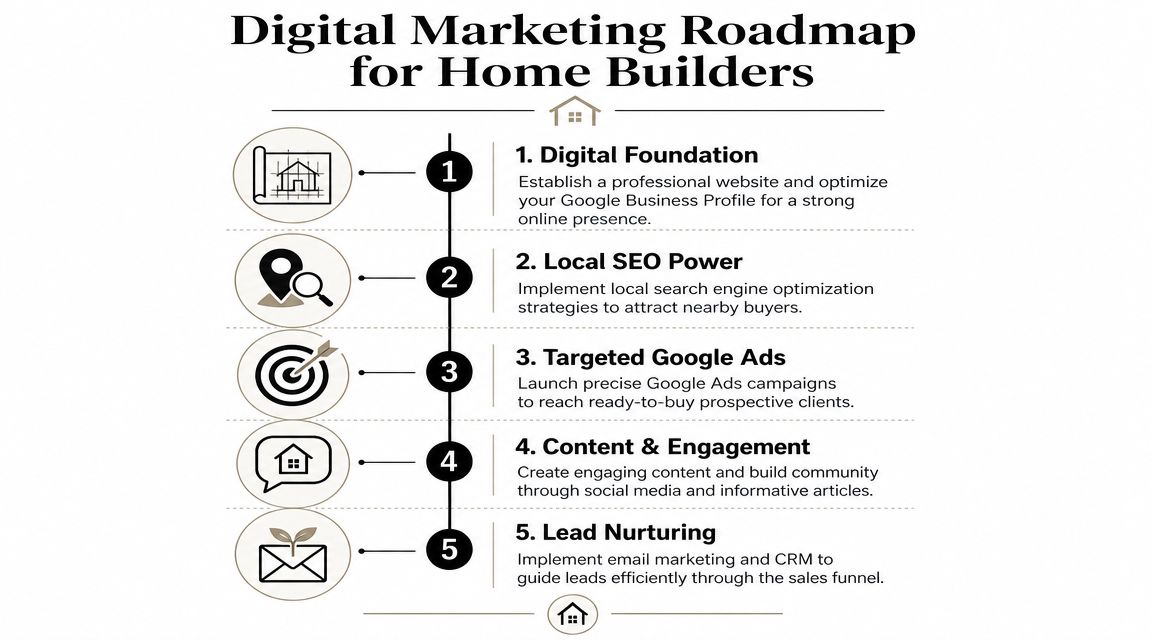
Phase 1 pour the foundation
Fix the assets you own first.
That means cleaning up your website, tightening your calls to action, clarifying your service areas, and fully building out your Google Business Profile. If your destination is weak, more traffic just exposes the weakness faster.
Use this phase to answer basic buyer questions clearly. Where do you build? What do you build? How does someone start?
Phase 2 frame the lead machine
Once the foundation is solid, add traffic from both directions.
Use Local SEO for long-term visibility and Google Ads for immediate demand capture. SEO helps you build durable presence in your service area. Ads let you show up for high-intent searches right now. Social and email can support the mix, especially when buyers are researching across channels and sharing content privately.
A simple build order looks like this:
- Clean up website pages
- Optimize Google Business Profile
- Publish or improve core local service pages
- Launch tightly targeted Google Ads
- Create helpful content buyers can share with spouses or partners
Phase 3 install the follow-up system
Most companies lose focus at this stage, and it is the point where significant revenue is lost.
Set up a CRM. Route forms and calls correctly. Add missed-call text back, lead acknowledgment, appointment reminders, and simple nurture sequences. Then train your team to use the system every day, not once a month.
If you can't track the lead, assign the lead, and follow up on the lead, you don't have a marketing system. You have expensive chaos.
The roadmap isn't complicated. Build the destination. Add qualified traffic. Protect the lead flow. That's the whole game.
Common Questions About Marketing for Builders
How much should a builder spend on marketing
Start with the work, not a random budget formula. If your website is weak and your follow-up is sloppy, don't pour money into ads yet. Fix the foundation first, then add paid traffic once you can convert and manage inquiries properly.
How long does digital marketing for home builders take to work
Some parts move faster than others. Google Ads can produce leads quickly when the targeting and landing pages are tight. SEO takes longer because Google has to crawl, understand, and trust your pages over time. Your website and CRM improvements can help almost immediately because they reduce waste from traffic you're already getting.
Should we do this in-house or hire help
If someone on your team can own the system, write clearly, manage vendors, review leads, and keep the wheels turning every week, you can keep parts in-house. If marketing keeps getting pushed behind estimating, operations, and jobsite fires, hire outside help. Just don't hire a vendor that sells one shiny tactic and ignores the rest of the machine.
A good partner should understand local search, paid search, websites, and follow-up systems together. That's the difference between buying a tool and building an engine.
If you want help building a real lead system instead of stacking random tactics, Constructo Marketing is built for that kind of work. They help contractors and remodelers combine Local SEO, Google Ads, conversion-focused websites, and CRM follow-up into one operating system so leads don't slip through the cracks.