


You're probably in a spot I see all the time. Your team does beautiful work. Clients love the finished product. Referrals still come in. But the lead flow feels uneven, and too many of the people filling out forms aren't a fit for the kind of remodels you want.
That usually isn't a craftsmanship problem. It's a visibility and follow-up problem.
A homeowner ready for a serious kitchen remodel or addition doesn't start by driving around looking for yard signs. They open Google. They compare a few companies. They look at photos, reviews, service pages, and whether your business feels current and trustworthy. If your online presence is weak, you lose before the first call.
That's why general contractor seo matters. Not as a bag of tricks. As a business system. You need Google visibility, a website that acts like a sales rep, Google Ads to add speed where needed, and a CRM that keeps good leads from slipping through the cracks.
Table of Contents
- Why SEO Is Your Best Salesperson
- Your Digital Storefront on Google Maps
- Building Your Website for High-Value Leads
- Content That Attracts Your Ideal Remodeling Clients
- Building Online Trust with Reviews and Links
- Using AI and Modern Workflows to Work Smarter
- From Clicks to Contracts: The Complete Lead System
Why SEO Is Your Best Salesperson
A good salesperson shows up on time, answers questions clearly, builds trust fast, and stays consistent every day. That's what strong general contractor seo does when it's built right. It puts your company in front of homeowners who are already looking for the exact work you do.

Most contractors I talk to don't need more “marketing.” They need a dependable path to the right buyers. And the internet is where that path starts now. More than 80% of consumers conduct online research before hiring a contractor, businesses that prioritize SEO were reported to see up to a 50% increase in leads, and nearly 60% of online searches now happen on mobile devices, according to this roundup of contractor SEO statistics.
That changes the game. The first impression used to be your truck, your sign, or a referral. Now it's your Google results, your map listing, and what your site looks like on a phone.
Google is the main road
Think of Google like the busiest road in town. If your business sits on that road, people see you when they need you. If your business sits on a dirt road with no signs, only the lucky few will ever find you.
That's the whole point of SEO. You're not trying to convince random people to want a remodel. You're making sure the people who already want one can find you first.
Here's what that means in plain English:
- SEO brings intent: These aren't cold prospects. They're searching for services now.
- SEO pre-sells your company: Your reviews, photos, and pages do some of the trust-building before the call.
- SEO helps you qualify better: The right pages attract the right jobs and push away tire-kickers.
Practical rule: If a homeowner can't quickly tell what you do, where you work, and why they should trust you, your online presence isn't selling. It's leaking.
A lot of owners ask where SEO fits compared with referrals, paid ads, and other tactics. My answer is simple. SEO is the base layer. It supports everything else. If you want a bigger-picture view of lead generation for contractors, it helps to see SEO as one part of a larger demand system, not an isolated channel.
Stop treating SEO like a side job
You wouldn't frame a house and then skip the roof. But many contractors build a decent reputation offline and leave their digital reputation half-finished. That's expensive.
If you want a straightforward primer on how search works, this overview of SEO is useful. Then act on it. Don't just “learn SEO.” Build it into the business the same way you build estimating, scheduling, and client communication into the business.
Your Digital Storefront on Google Maps
If your website is your property, your Google Business Profile is your storefront on the busiest corner in town. For many homeowners, it's the first thing they see. Not your homepage. Not your portfolio. Your map listing.
That means your profile can't be half-filled-out. A weak profile is like a showroom with no lights on, no business hours posted, and dusty windows.
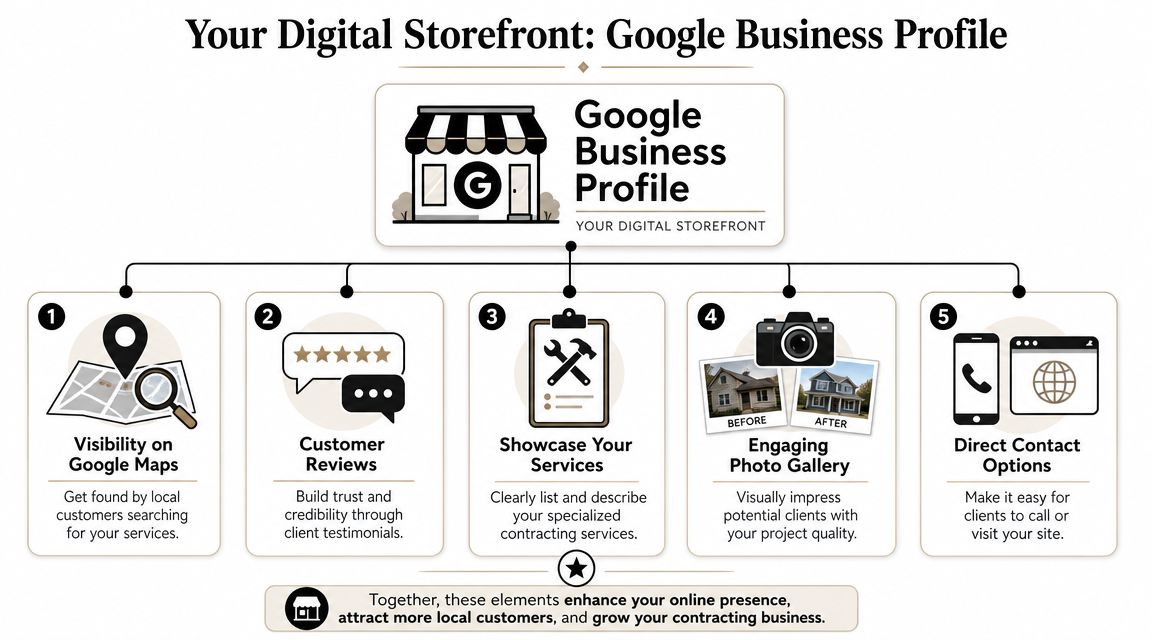
The must-have parts of your profile
Start with the basics. These aren't small details. They are the sign on the building.
| Profile element | What it means in real life | What to do |
|---|---|---|
| Business name | Your storefront sign | Use your real business name consistently |
| Address and service area | Where you work | Make sure location details are accurate |
| Hours | Open or closed sign | Keep holiday and regular hours current |
| Services | Window display | List your real remodeling services clearly |
| Photos | Your project showroom | Upload real work, not generic stock images |
| Reviews | Word-of-mouth at scale | Ask satisfied clients consistently |
A lot of contractors skip the services section or barely touch photos. That's a mistake. Homeowners use those details to decide whether you look active, specialized, and trustworthy.
What matters most on a busy search page
When someone searches “kitchen remodeler near me,” they don't read everything. They scan.
They look for a few simple cues:
- Does this company serve my area
- Do they look legit
- Do they show quality work
- Can I contact them quickly
Your profile should answer those questions fast. Don't write like a brochure. Write like a clear job sign.
A complete profile doesn't just help Google understand your business. It helps a homeowner feel safe enough to take the next step.
Your photos do more work than your tagline
Most remodeling companies talk too much and show too little. Homeowners don't want vague claims about quality. They want evidence.
Upload real project photos. Kitchens. Baths. Additions. Exteriors. Finished details. Wide shots and close-ups. If you have before-and-after sequences, even better. Show your style and the level of finish you're known for.
Use photos to support your market position. If you want larger, design-forward jobs, your profile should look like a premium portfolio, not a random camera roll.
Reviews aren't optional
Reviews are trust bricks. One brick alone doesn't build a wall. But stacked over time, they create something solid.
Ask for reviews right after a happy client moment. Not three weeks later. Not “when things slow down.” Make it part of your closeout process. The easier you make it, the more often it happens.
A strong local presence also depends on keeping your business details consistent across listings and local references. If you want a practical walkthrough for improving map visibility, this guide on ranking higher on Google Maps is worth reading.
Building Your Website for High-Value Leads
Your website should work like a well-built house. It needs a strong foundation, clean layout, and clear rooms with obvious purpose. Most contractor websites fail because they're built like a maze. Pretty homepage. Vague copy. No clear path for a serious buyer.
That won't cut it if you want high-value remodeling leads.
Contractor-focused SEO guidance consistently points to the same foundation: a fast, mobile-first, locally structured website paired with a fully optimized Google Business Profile, with mobile responsiveness, clear navigation, service pages with location-qualified keywords, and page-speed optimization treated as core elements in this contractor SEO guide.
The foundation and the rooms
Here's the simplest way to think about your site.
Technical SEO is the foundation, wiring, and plumbing. If it's broken, the house doesn't function well.
On-page SEO is the room layout. It tells people and Google what each part of the house is for.
If your site loads slowly, looks clumsy on a phone, or makes it hard to find service information, your foundation is cracked. If every service is stuffed onto one generic page, your rooms are unlabeled.
Build separate pages for separate jobs
A homeowner searching for a kitchen remodel isn't looking for a general “services” page. They want a page that speaks directly to kitchen remodeling. Same for bathrooms, additions, whole-home remodels, outdoor living, or basement finishing.
Use dedicated pages such as:
- Kitchen remodeling in your city
- Bathroom remodeling in your city
- Home additions in your city
- Whole-home remodeling in your city
That local structure matters. It tells Google exactly what work you do and where you do it. It also tells the homeowner, “Yes, you're in the right place.”
If one page tries to sell every service in every town, it usually ranks poorly and converts poorly.
Mobile isn't a design detail
A lot of remodeling clients first meet you on a phone. If your menu is annoying, your buttons are tiny, or your photos take forever to load, you're burning good opportunities.
Use a simple checklist:
- Fast pages: Test with PageSpeed Insights and fix obvious speed issues.
- Tap-friendly layout: Buttons should be easy to use on a small screen.
- Short contact paths: Calls, forms, and consultation requests should be easy to find.
- Clear service areas: Don't make visitors guess where you work.
What a high-intent page should include
Not every page needs to be long. But each important service page should answer the basic buying questions.
What do you do
Say the service plainly. Don't hide it behind clever branding.Where do you do it
Name the city, region, or neighborhoods you serve.What kind of client is a fit
Mention the project type and style you specialize in.Why trust you
Use photos, process details, and proof of real experience.What should they do next
Add one clear next step. Call, schedule, or request a consultation.
If you want a practical example of a website built to turn visits into opportunities, this guide on designing a remodeling website that converts visitors into leads is a solid reference.
Content That Attracts Your Ideal Remodeling Clients
A good website structure gives you the frame. Content fills the house with something worth walking through.
Many contractors get lazy. They upload a homepage, a short about page, and a couple of service blurbs. Then they wonder why Google doesn't know what to rank and homeowners don't feel confident enough to reach out.
You don't need endless blog posts. You need the right content in the right places.
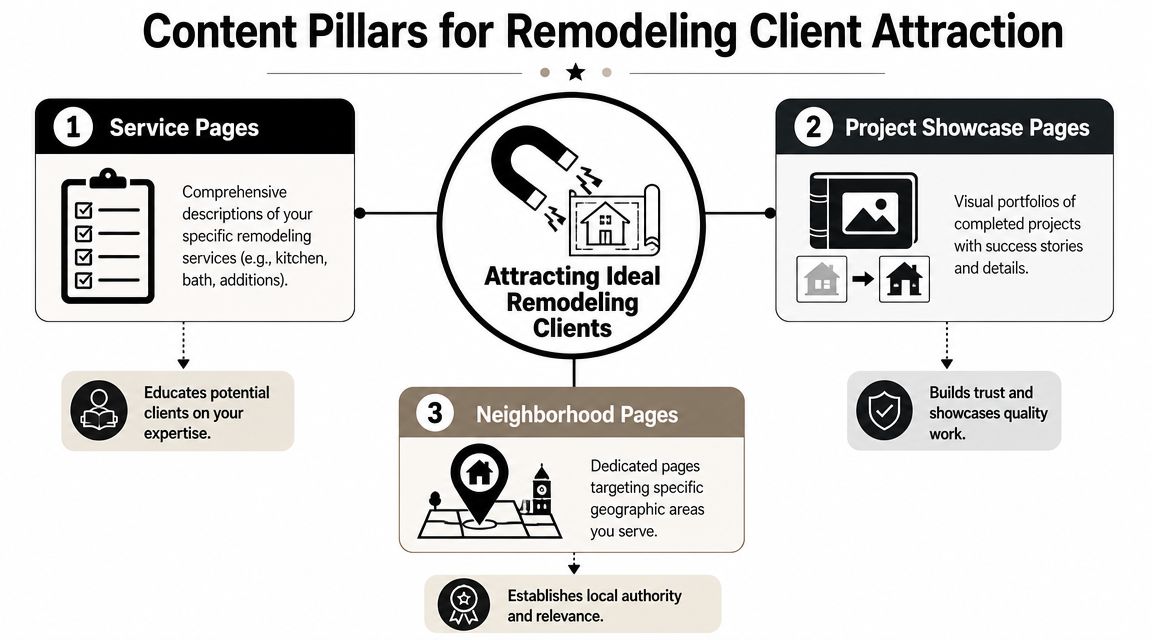
The three pages that do the heavy lifting
For remodeling companies, I like a simple three-part system.
Service pages
These are your trade pages. They tell Google and the homeowner what you do.
A strong service page answers basic questions in plain language. What's included. What kinds of homes you work on. What design problems you solve. What the process feels like. Keep it clean and specific.
Good examples include kitchen remodeling, bathroom remodeling, home additions, aging-in-place renovations, or whole-home remodels.
Project showcase pages
These are proof pages. They show the work.
A project page should feel like a mini job story. Use real photos. Talk about the home, the goals, the constraints, and the outcome. You don't need to write like a magazine editor. Just tell the truth clearly.
Include details like:
- Project type: Kitchen, bath, addition, exterior, or whole-home
- Location: The city or neighborhood
- Homeowner goal: More storage, better flow, aging-in-place, larger entertaining space
- Work completed: The major scope items
- Photos: Real images from the job, ideally in sequence
Neighborhood pages
These are local authority pages. They help you show up where your best clients live.
A neighborhood page isn't a copy-and-paste city page. It should mention the kinds of homes in that area, the remodeling patterns you see there, and the services homeowners in that market often need. If you work in older homes, historic areas, high-end suburban neighborhoods, or golf communities, say so.
Homeowners trust specialists. Local pages help you look like the remodeler who knows their area, not a random company fishing for clicks.
Use the pages together, not alone
Power comes from linking these pages together like rooms in the same house.
A kitchen remodeling service page should link to kitchen project pages. A neighborhood page for a high-value suburb should link to the projects completed there. A project page should link back to the related service.
That creates a simple network:
| Content type | Main job | Best next link |
|---|---|---|
| Service page | Explain the service | Project examples and consultation page |
| Project page | Prove the quality | Related service and nearby area page |
| Neighborhood page | Show local relevance | Matching services and local project work |
Don't write for everyone
If you want premium jobs, your content has to filter. That means speaking directly to the client you want.
Talk about design-build coordination if that's your model. Mention complex remodel planning if that's your lane. Discuss craftsmanship, process, communication, and the types of homes you serve. Generic content attracts generic leads.
Simple wins. Specific wins. Real work wins.
Building Online Trust with Reviews and Links
Your website is what you say about yourself. Reviews, citations, and backlinks are what the internet says about you. Google pays attention to both.
This part of general contractor seo works a lot like reputation in everyday life. If respected people know your name, clients trust you faster. If your business details show up consistently everywhere, you look established. If past customers praise the experience, buyers feel safer calling.
Reviews are digital word-of-mouth
A review is just a recommendation in public. But unlike old-school referrals, it stays visible and keeps selling long after the job is done.
The mistake most contractors make is treating reviews like a favor. They're not. They're a standard part of the closeout process. Ask after the positive moment. Make the request short. Send the link. Follow up once if needed.
Keep your responses human. Don't paste canned replies. Thank people specifically. If someone mentions communication, cleanliness, timeline management, or design help, your response can reinforce those strengths.
Citations confirm you're real
A citation is a mention of your business information on other websites. Think local directories, trade listings, chamber pages, and industry profiles.
These mentions matter because they reinforce the basic facts of your company:
- Name
- Address
- Phone
- Website
- Service category
If those details are inconsistent, you create confusion. Google doesn't like confusion. Neither do homeowners.
Clean citations are like matching permit documents. When every record lines up, trust goes up.
Backlinks act like referrals
A backlink is when another website links to your website. The easiest way to understand it is this. If a reputable local architect, supplier, designer, or publication links to your company, that acts like a professional referral.
Not all links matter equally. A random junk directory isn't the same as a respected local business, an industry association, or a regional publication featuring one of your projects.
Good ways to earn links include:
- Trade partnerships: Ask architects, designers, and suppliers you already work with to link to your site.
- Project features: Submit finished projects to local publications or design blogs.
- Community involvement: Sponsorships, association memberships, and local events can lead to quality mentions.
- Resource pages: Create useful pages that others naturally want to reference, such as process guides or service-area resources.
Trust compounds
You can't fake reputation for long. But you can build it steadily.
Reviews improve buyer confidence. Citations validate your business details. Backlinks reinforce authority. Together, they support the work your website and Google profile are already doing. That's how trust compounds online. One small signal at a time.
Using AI and Modern Workflows to Work Smarter
AI can help your marketing. It can also create a pile of bland nonsense if you hand it the keys and walk away.
Use it like a smart apprentice. Give it a task, check its work, and make sure a real expert signs off before anything goes live. That's the right mindset for contractors.
What AI should do
AI is useful for rough-draft work. It can help you organize ideas faster so your team isn't staring at a blank page.
Good uses include:
- Outlining service pages
- Drafting project summaries from job notes
- Turning voicemail notes into page copy starters
- Suggesting FAQ ideas from real client questions
- Grouping topics for neighborhood pages
Bad uses include publishing generic, unedited copy that could apply to any contractor in any town. Homeowners can smell that instantly.
A simple workflow for project pages
Here's a practical way to use AI without letting quality slip.
Start with real job inputs
Gather photos, scope notes, location, materials, design goals, and one or two details the homeowner cared about.Ask AI for a first outline
Have it organize the story into sections like challenge, work performed, design decisions, and final result.Rewrite with your voice
Add the details only your team knows. Why the layout changed. What structural issue you solved. Why a finish choice mattered.Add proof
Insert real photos, service links, and a next step for the visitor.Review for accuracy
If it sounds like a robot or includes anything you wouldn't say to a client, fix it.
AI should save your team time on first drafts. It should never replace your judgment.
Teach Google your business in plain labels
There's also a technical side to working smarter. Structured data and schema markup help search engines understand the details on your site. Contractor-focused guidance notes that schema on service, location, and contact pages can communicate service type, location, business hours, contact details, ratings, and reviews, which can improve eligibility for rich snippets and increase click-through rates, as covered in this SEO guide for general contractors.
Think of schema like labeling bins in a warehouse. Without labels, people have to guess what's inside. With labels, they find what they need faster.
Add schema to pages that matter most:
- Service pages
- Location pages
- Contact page
- Review-related content where appropriate
Also keep the basics tight. Use HTTPS. Keep site architecture clean. Make navigation logical. If you want a platform option that bundles marketing execution with CRM follow-up, Constructo Marketing offers integrated systems for remodelers that combine local SEO, AI-driven SEO, Google Ads, websites, and a whitelabeled GoHighLevel CRM. That's one model. The bigger point is the system, not the logo on the software.
From Clicks to Contracts: The Complete Lead System
Traffic alone doesn't pay for payroll. Signed projects do.
That's why I don't like treating general contractor seo as a stand-alone tactic. SEO is one part of a lead-closing machine. It brings qualified people in. Then your ads, website, and CRM have to do their jobs.
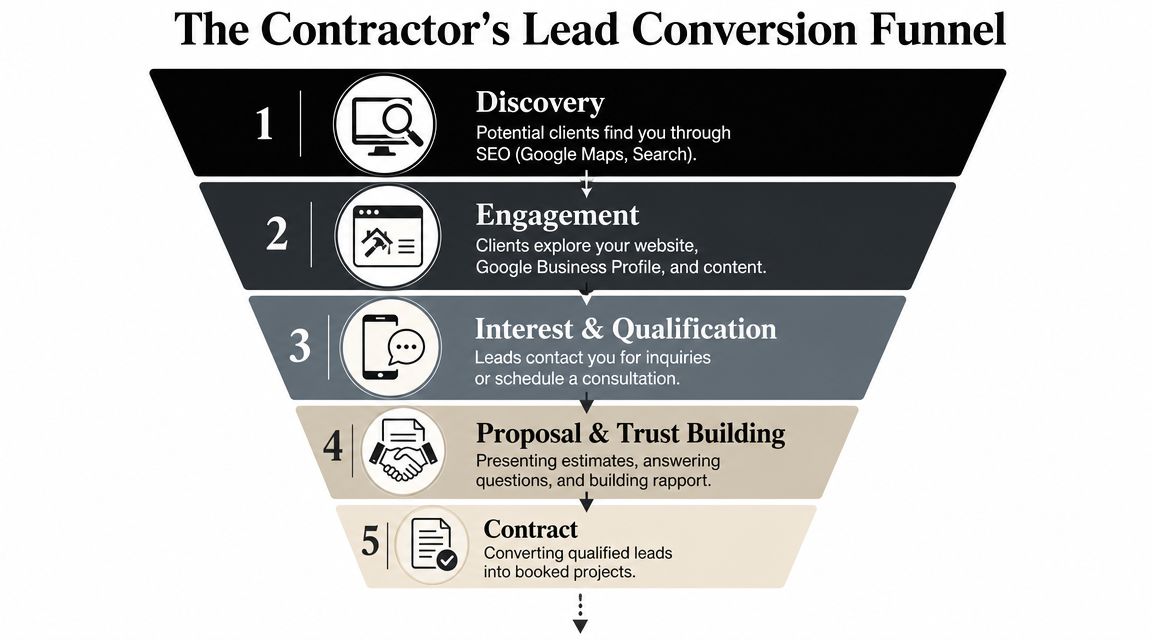
Think like a builder, not a marketer
If you were building a house, you wouldn't stop after excavation and call it done. Same here.
Your lead system needs four connected parts:
| Part | Job in the system | Why it matters |
|---|---|---|
| SEO | Brings in organic demand | Captures homeowners already searching |
| Google Ads | Adds speed and control | Targets priority services and locations |
| Website | Converts attention into inquiries | Qualifies and persuades visitors |
| CRM | Follows up until contact happens | Stops leads from going cold |
Each piece covers a different failure point. SEO gets you seen. Ads let you push where you want more volume. The website shapes the first sales conversation. The CRM makes sure nobody gets ignored.
Where Google Ads fits
Google Ads is the turbo boost. It's not a replacement for SEO. It's the fast lane when you want to target a specific service, zip code, or season.
Maybe you want more kitchen remodel consultations in one suburb. Maybe you want to support a newer service page while organic rankings grow. Ads can do that. But if the landing page is weak and follow-up is slow, paid traffic won't fix the underlying issue.
The CRM is where good leads get saved or lost
This is the part too many remodeling companies overlook. A lead calls after hours. Nobody answers. The form comes in on Friday afternoon. Someone forgets to reply until Monday. The homeowner has already booked another consultation.
A CRM fixes that operational gap. It logs inquiries, assigns follow-up, tracks pipeline stages, and automates simple touches like appointment reminders or missed-call text-backs. That matters because speed and consistency shape close rates.
The lead isn't dead because your marketing failed. It often dies because nobody followed up cleanly.
Build the machine once, then improve it
The goal isn't “more traffic.” The goal is a system that reliably turns local search demand into consultations, estimates, and signed remodeling work.
Start with the order that makes sense:
- First: Tighten your Google Business Profile and website.
- Second: Build service, project, and neighborhood content.
- Third: Layer in Google Ads where you want faster demand.
- Fourth: Run everything through a CRM so follow-up is automatic and visible.
That's how you stop chasing random leads and start building a predictable pipeline.
If you want help building that full system, Constructo Marketing works with remodelers on the pieces that connect visibility to revenue: local SEO, Google Ads, conversion-focused websites, and CRM follow-up. If your goal is more qualified residential leads and fewer missed opportunities, that's the kind of setup worth discussing.