


You're probably in one of two spots right now.
Either somebody keeps telling you, “You need to post more on social media,” and you're already annoyed because that advice is too vague to be useful. Or you already hired someone to “handle your socials,” and what you got back was a few pretty posts, weak captions, and no clue whether any of it helped your remodeling business.
That frustration makes sense. Most social media contracting gets handled like an art project instead of a business function. That's the core problem.
If you hire a tile setter, you expect a scope, a timeline, clear deliverables, and a standard for quality. You should treat social media the same way. Not as magic. Not as “brand vibes.” As a subcontracted service with a job to do.
Table of Contents
- Putting Social Media on a Leash A Guide for Remodelers
- Deciding What You're Actually Paying For
- How to Find and Vet a Social Media Pro
- Building Your Rock-Solid Contract and Scope of Work
- Managing Your New Partner for Real Results
- Quick Answers to Common Questions
Putting Social Media on a Leash A Guide for Remodelers
You don't need more random posting. You need control.
Social media is too big to ignore, but that doesn't mean you should let it run loose inside your business. As of 2025, an estimated 5.24 billion people worldwide use social media, and a 2025 survey reported by Statista found that 81% of marketers cited increased exposure, 73% cited increased traffic, and 65% cited lead generation as benefits of social media marketing, according to Dreamgrow's summary of the data.
That tells you one thing. Visibility matters. It does not tell you to hand your brand over to the first person with Canva and an iPhone.
Why this matters now
Homeowners don't move in a straight line anymore. They hear about you from a friend, search your name, check your website, glance at Instagram, maybe look at Facebook, maybe read reviews, then decide whether you feel real.
That's why sloppy social hurts. A dead profile, bad photos, inconsistent posting, or weird off-brand captions can make a solid remodeler look smaller than they are.
Practical rule: Social media should support your sales process, not become a separate circus you pay for every month.
If a homeowner is considering a kitchen remodel, an addition, or a major bath project, they're not usually hiring you because one reel was clever. They're hiring you because every touchpoint says, “These people do serious work and can be trusted in my home.”
Treat it like a subcontractor
This is the mindset shift. Social media contracting should work like hiring any other trade partner.
You define the job first. Then you agree on the scope. Then you set standards. Then you inspect the work.
Use this simple filter before you hire anyone:
- Business goal first: Are they helping you look credible, book more consultations, support referrals, or stay visible in your market?
- Deliverables second: How many posts, what kind of photos or videos, which platforms, who writes captions, who approves content?
- Measurement third: What happens after somebody clicks? Where do calls, forms, and messages get tracked?
If you skip those three things, you'll buy activity instead of outcomes.
A lot of remodelers don't hate social media. They hate paying for vague work with no finish line. That's fixable. Put the channel on a leash. Give it a job. Make somebody own the process.
Deciding What You're Actually Paying For
Most remodelers start with the wrong question.
They ask, “Can this person get me leads from Instagram?” That's not always the right job for social. For a remodeling company selling bigger projects, social usually works better as a trust layer than a cold lead machine.
Contractor-focused guidance says social often works best as a demand-capture layer that supports credibility after a homeowner has already searched, compared, and narrowed options, and that contractor content tends to perform best when it reinforces local proof, craftsmanship, and reviews rather than trying to create cold demand from scratch, as explained by Contracting Empire's guidance for contractors.
That's the part often overlooked.

Most remodelers pick the wrong goal
If your average project is high-value, the buyer usually doesn't wake up and hand a stranger a big contract because of one post. They research. They compare. They look for proof.
That means social media contracting should often be purchased for one of these reasons:
- Referral validation: A past client or trade partner sends somebody your way, and that homeowner checks your profiles before calling.
- Craftsmanship proof: Your feed shows that you do clean, polished work.
- Brand consistency: Your website, your Google presence, and your social channels all tell the same story.
- Sales support: When your estimator meets with a homeowner, your social presence backs up what was promised in person.
If you ask a social media person for “more leads” without deciding which of those jobs matters most, you're setting both of you up to fail.
What to buy instead
Think like an owner. You're not buying posts. You're buying a specific outcome.
Here's the plain-English version:
| Goal | What social should do |
|---|---|
| Referred prospects are checking you out | Make you look active, trustworthy, and current |
| Homeowners care about finishes and process | Show before-and-after work, details, and progress |
| You want better local credibility | Highlight reviews, team members, project locations, and craftsmanship |
| You want paid traffic to convert better | Give people proof after they click through from ads or search |
This is also why price shopping can get messy. One provider may be selling raw posting volume. Another may be selling strategy, creative direction, approvals, reporting, and coordination with your website and CRM. If you want to find transparent social media costs, compare pricing against scope, not just the monthly fee.
And if you are trying to create demand more directly, that's usually a separate conversation from organic posting. Paid social can play a role there, and this guide to Facebook ads for contractors helps show the difference between running ads and keeping your profiles active.
Social media earns its keep when it removes doubt. That's a better goal for remodelers than chasing vanity numbers.
A clean objective makes hiring easier. It also makes contracts easier, reports easier, and decisions easier. If you know what the job entails, you'll stop paying people for noise.
How to Find and Vet a Social Media Pro
A polished portfolio can fool you.
Some people are good at making feeds look trendy. That doesn't mean they understand a remodeling company, homeowner trust, or how to turn project photos into business assets. You need somebody who can think like an operator, not just a content creator.
Look for business judgment first
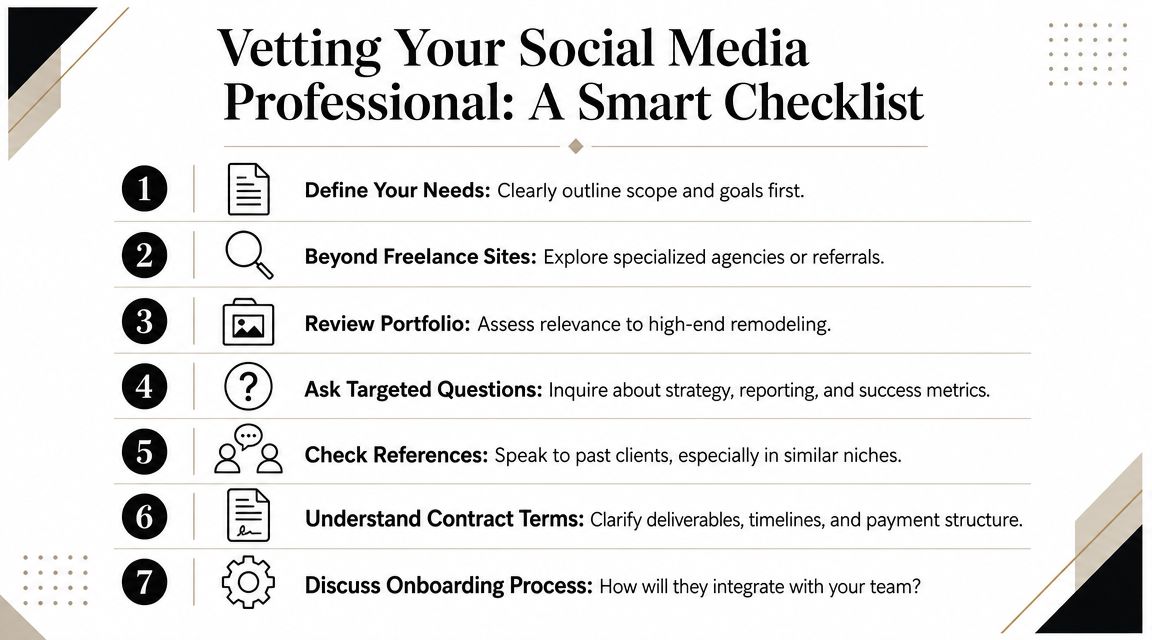
Start with referrals from people who already understand local service businesses. Then look at specialized agencies, niche freelancers, and marketers who've worked with contractors, designers, home service brands, or adjacent trades.
Their best signal is not “aesthetic.” It's process.
Ask them to show you how they think about:
- Content planning: How do they turn jobsite progress, finished photos, reviews, and team updates into a monthly plan?
- Approvals: Who signs off, how far ahead, and what happens if something needs changes?
- Measurement: Can they explain what a good month looks like without hiding behind likes?
- Asset gathering: Do they have a system for collecting photos, videos, and field updates from your team?
If you want your internal photo collection to improve before you even hire help, this piece on Social media photography advice is useful because it gives practical guidance your team can follow on the jobsite.
You should also pay attention to whether they understand the rest of your marketing. Social should not live alone in a box. A provider who understands search, conversion, and local visibility will usually give better advice than someone who only talks about content trends. That's why it helps to understand what a contractor SEO agency does, even if you're focused on social right now.
Questions that expose the real pros
Don't ask, “Can you help with social media?” That question is too soft.
Ask these instead:
Walk me through your first 30 days.
A pro should talk about onboarding, account access, brand review, content collection, and approval flow.How do you measure success for a remodeler like me?
Listen for business answers. Website traffic from social, profile consistency, engagement quality, clicks, form activity, or consultation support. Be cautious if the answer is mostly followers.How do you build a month of content?
They should explain planning, batching, captions, design, posting, approvals, and revisions in simple terms.What do you need from my team?
If they say “not much,” that's not a good sign. Strong social usually needs access to job photos, project details, reviews, and occasional field input.
The right hire makes the process simpler. The wrong hire makes you feel guilty every month for not sending enough material.
Red flags you should not ignore
Some warning signs are obvious. Others are sneaky.
- They promise virality: That's not a business plan.
- They never ask about your goals: Then they're selling a package, not solving a problem.
- They can't explain reporting in plain English: If you can't understand the report, it won't help you.
- They show unrelated work only: A restaurant feed and a remodeling brand are not the same animal.
- They want total creative freedom with no review process: That's how weird captions and off-brand posts happen.
Hire slow. A bad social media contractor doesn't just waste money. They can weaken how your company looks to serious buyers.
Building Your Rock-Solid Contract and Scope of Work
A handshake is not enough here.
If you hire somebody to run social without clear paperwork, you invite confusion. Confusion turns into missed posts, reused content, awkward approvals, and arguments about what was “included.”
Walker Sands notes that major pitfalls in social media work include inconsistent execution and content duplication, and that brands should tailor content by platform rather than reposting identical copy everywhere while tracking results continuously, which is why a structured agreement matters, as outlined in their article on common social media pitfalls.
Your contract and your SOW are not the same thing
Keep this simple.
Your main contract handles the legal relationship. Think payment terms, confidentiality, ownership, termination, liability, and what happens if either side wants out.
Your Statement of Work, or SOW, handles the practical job. It answers what gets done, how often, by whom, on which platforms, with what approval process.
If you mix those together into a vague one-page proposal, you'll regret it.
Here's a simple way to understand it:
- Contract: Rules of the relationship
- SOW: Work to be performed
That separation protects both sides. If you keep the same provider but change the monthly scope later, you can often update the SOW without rebuilding the entire legal agreement.
Key items to lock into writing
Your SOW should be boring. That's a compliment. Boring documents prevent expensive misunderstandings.
Here's a clean template of what to specify.
| Item | What to Specify |
|---|---|
| Platforms | Which channels are included and which are excluded |
| Posting cadence | How often content is posted and what counts as a post |
| Content types | Project photos, reels, stories, graphics, review posts, team features, educational posts |
| Content creation | Who writes captions, who designs graphics, who edits video |
| Asset collection | Who gathers jobsite photos and how files are delivered |
| Approval process | Who approves content, how many revision rounds are included, and approval deadlines |
| Platform customization | How content will be adapted by platform instead of copied word-for-word |
| Reporting | What metrics are included, how often reports are delivered, and in what format |
| Response handling | Whether comments and messages are monitored, and what response times are expected |
| Account access | Who keeps ownership of profiles, logins, and business manager assets |
| Content ownership | Who owns photos, videos, captions, graphics, and edited files after payment |
| Usage rights | Whether you can reuse content on your website, email, ads, and printed materials |
| Confidentiality | How project details, homeowner information, and internal business information are protected |
| Payment terms | Retainer, due date, late terms, out-of-scope rates, and reimbursable costs |
| Termination | Notice period, offboarding steps, final deliverables, and return of access |
Owner's rule: If a task matters to you, put it in writing. If it isn't written down, assume it will be misunderstood.
A few clauses deserve extra attention.
First, content ownership. If they shoot or edit media for you, make sure the agreement says what you own after you pay. Don't assume.
Second, duplication rules. If you don't want the same caption pasted across every platform, say that clearly. It matters because platform-specific execution is part of doing the job properly.
Third, termination and access return. Your accounts, photos, and history should stay under your control. No drama. No hostage situation. No hunting for passwords after a breakup.
For most remodelers, a monthly retainer works better than random project billing because it creates consistency. But the retainer only works if the scope is nailed down. Otherwise, you're paying for a moving target.
Managing Your New Partner for Real Results
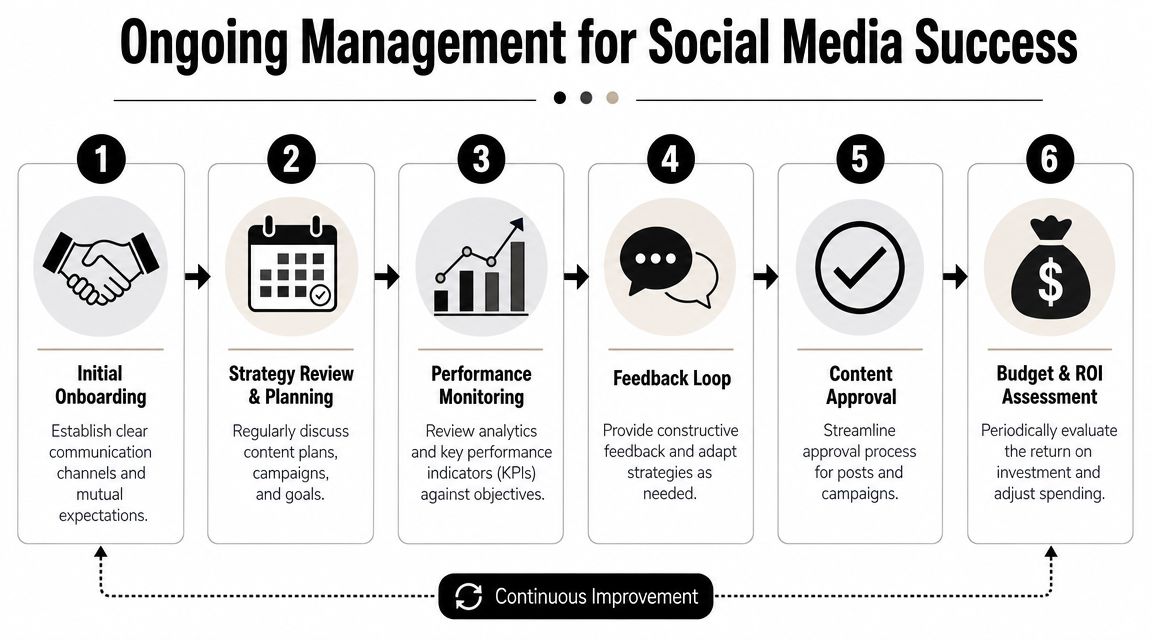
The contract is signed. Good. Now you need a management rhythm.
Many owners drift into one of two bad habits. They either disappear and hope for the best, or they micromanage every caption like it's a change order dispute. Neither works.
What works is a light but steady system.
The first month sets the tone
Business.com summarizes a practical workflow this way: start with business goals and tracking setup, and use UTM parameters on every shared URL so website traffic, form fills, and calls can be attributed back to social. The same 2025 report summary notes that 65% of marketers said they successfully generated leads via social media, which shows measurable outcomes are possible when tracking is in place, according to Business.com's report summary.
That matters because your first month should not focus on “posting a lot.” It should focus on setup.
Use this onboarding checklist:
- Access: Give access to Facebook, Instagram, LinkedIn, Google Analytics, and any scheduling tools they need. Keep ownership on your side.
- Assets: Share logos, brand colors, service descriptions, team photos, jobsite photos, finished project galleries, and review screenshots.
- Goals: Pick the main job. Referral trust, craftsmanship proof, recruiting, local awareness, or support for another campaign.
- Tracking: Add UTM-tagged links to profile buttons, bio links, and campaign URLs so traffic can be tied back to social.
- Approval flow: Choose one decision-maker on your team. Too many approvers slow everything down.
A content calendar makes this much easier. Instead of reacting to posts one by one, review a batch. Approve the next few weeks at once. Keep edits focused on accuracy, brand fit, and tone.
If you want your shared links to look clean when they're posted, it helps to understand how titles, images, and descriptions are controlled. This guide on how to control social media link previews is worth bookmarking because ugly previews make good content look sloppy.
What to ask for every month
A monthly report should be simple enough to read in a few minutes.
Ask for:
- What got published
- Which posts drove clicks
- Traffic from social to key pages
- Form fills or calls tied to social links
- What themes performed best
- What will change next month
That's enough. You do not need a 30-page deck full of jargon.
Don't let a provider hide weak performance behind reach, impressions, and engagement if none of it connects to real business activity.
You should also look at how social supports the rest of your marketing. A strong before-and-after post can be reused in email. A polished project video can help sales appointments. A good jobsite clip can become part of a larger content plan. If your team needs ideas, these video content ideas to attract remodeling clients can help turn everyday project activity into usable assets.
The goal is not constant oversight. The goal is steady accountability. When the system is set up right, social media contracting becomes manageable. You know what's being produced, why it's being published, and whether it's supporting the business.
Quick Answers to Common Questions
What should a remodeler budget for social media contracting
There isn't one magic price. Cost depends on scope.
If you only need basic posting from existing photos, that's one level. If you want strategy, video editing, caption writing, approval management, reporting, and direct coordination with your website or CRM, that's a bigger scope. Don't buy based on price alone. Buy based on clearly defined deliverables.
Can a family member just do it cheap
They can. That doesn't mean they should.
If your nephew is organized, understands your brand, can follow a process, respects deadlines, and can report results, fine. But most “cheap help” falls apart because there's no structure. You still need a scope, approval system, asset process, and written expectations. Family confusion is still confusion.
Which platform matters most
The best platform is the one that matches the job.
If homeowners need to see visual proof, Instagram may matter. If your referrals and community live on Facebook, keep that strong. If trade partners and recruiting matter, LinkedIn may help. The mistake is trying to be everywhere with weak execution.
A remodeler usually does better with a few well-run platforms than a pile of neglected ones.
Social media contracting works when you stop treating it like a mystery. Define the job. Hire carefully. Put it in writing. Measure what matters.
If you want a marketing partner that treats visibility like a system instead of a guessing game, Constructo Marketing is built for remodelers who want qualified local demand, strong tracking, and a business-first approach to growth. They focus on helping contractors become local famous, turn craftsmanship into credibility, and connect marketing to real pipeline instead of vanity metrics.