


Most contractor social media advice is lazy. It tells you to post job photos, stay active, and hope a homeowner magically turns into a signed remodel. That's not a strategy. That's the marketing version of tossing materials in a driveway and calling it a finished kitchen.
If you want social media marketing for contractors to produce real work, you need a system. Good content gets attention. A clear offer gets clicks. A landing page captures the lead. A CRM follows up fast. That's how social stops being a vanity project and starts feeding your pipeline for serious residential jobs.
Table of Contents
- Why Most Social Media Advice for Contractors Is Wrong
- Building Your Foundation for High-Value Leads
- Creating Content That Actually Sells Big Projects
- Using Paid Ads to Target Your Ideal Neighborhoods
- Turning Clicks and Likes into Booked Appointments
- Tracking What Works So You Don't Waste Money
- Your Social Media Is a System Not a Task
- Common Questions About Contractor Social Media
Why Most Social Media Advice for Contractors Is Wrong
The bad advice sounds familiar. “Post every day.” “Do more Reels.” “Boost a few posts.” None of that fixes the underlying problem. Contractors don't need more activity. They need a cleaner path from attention to appointment.
That matters because social isn't optional background noise anymore. In 2025, 58% of consumers discovered new businesses via social media, according to Sprinklr's social media marketing statistics. If a homeowner can discover a remodeler on social before ever searching Google or asking a neighbor, then your social presence has a real job. It has to build trust early.
Social media is the front door. Your lead capture and follow-up system decides whether anyone gets inside.
The usual contractor playbook stops at visibility. Nice project photo. A few likes. Maybe a comment from someone's aunt. Then nothing. That's because a photo by itself doesn't qualify a prospect, collect contact info, or book an estimate.
For high-value residential projects, the target isn't random attention. It's the right homeowner in the right neighborhood, seeing the right proof of work, then moving into a process that feels easy and professional. If your social media doesn't connect to a form, CRM, and follow-up flow, you're not marketing. You're decorating the internet.
Building Your Foundation for High-Value Leads
You wouldn't frame a second story before pouring the slab. Social media works the same way. The contractors who get results don't start by asking, “What should we post today?” They start by deciding who they want more of in the pipeline.
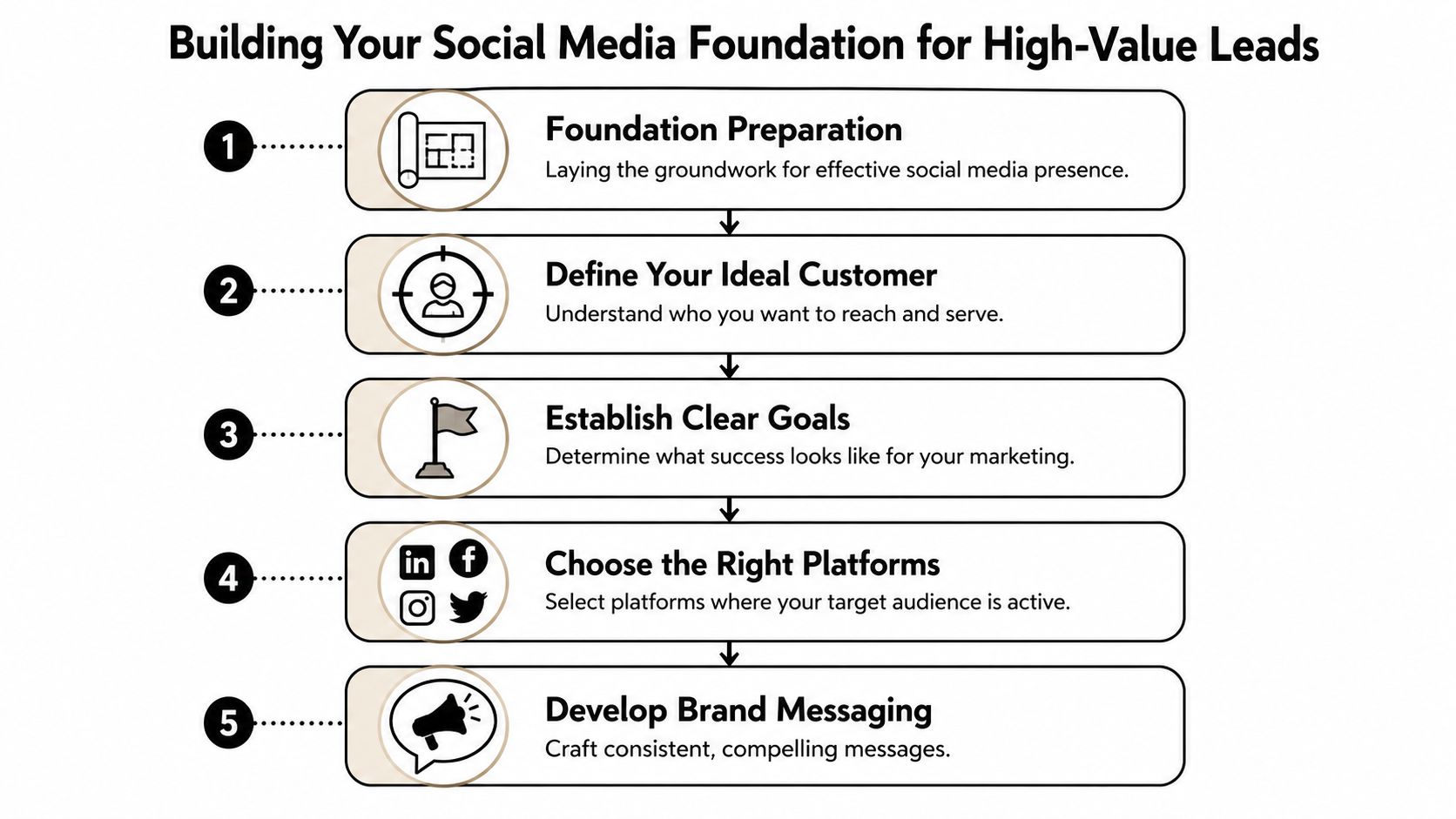
Start with the homeowner, not the platform
If you remodel kitchens, baths, additions, or outdoor living spaces, you probably do not need five social channels. You need one or two that match how homeowners evaluate your work. Visual platforms usually win because people want to see craftsmanship, process, and finished results.
Sprinklr reported that Facebook was the top ROI platform for 28% of marketers in 2025, with Instagram second at 22%. For contractors, that's a useful clue. Mature visual platforms still pull commercial weight, and they fit the way homeowners shop for remodeling help.
Use this filter:
- Facebook for local credibility, longer captions, reviews, business details, and community visibility.
- Instagram for before-and-after posts, short videos, jobsite visuals, and project storytelling.
- Skip the rest for now if you can't maintain them well. An abandoned profile looks worse than no profile.
Make your profiles look like a real business
Your profile should feel like a clean, lettered work truck. Easy to spot. Easy to trust. Easy to remember.
Get the basics right:
- Use the same business name everywhere. Don't call yourself “Smith Custom Homes” on one platform and “Smith Remodeling Group LLC” on another.
- Match your logo and profile photo. People should know they found the right company in one second.
- Write a plain-English bio. Say what you do, where you work, and what kind of homeowner should contact you.
- Point every profile to one next step. That could be a consultation page, estimate form, or project planner.
If your branding feels all over the place, this guide on consistent visual identity for social media is worth reading. The point isn't to look fancy. The point is to look stable, recognizable, and trustworthy.
Practical rule: If a homeowner lands on your profile and can't tell what you build, where you work, and how to contact you in ten seconds, the profile needs work.
One more detail gets missed all the time. Your social profiles should match your Google Business Profile and website. Same service area. Same phone number. Same offer. Mixed signals create doubt, and doubt kills form fills.
Creating Content That Actually Sells Big Projects
Most contractors already have enough content. They just don't organize it. Your jobsite, your team, your process, your finished work, and your happy clients are the raw materials. The mistake is posting random pieces with no pattern.
Construction-specific guidance recommends a mix of project progress photos, behind-the-scenes footage, team spotlights, and client testimonials, and it warns against inconsistency. A fixed posting schedule beats bursts of effort followed by silence, as noted in DOZR's social media marketing advice for contractors.
Post proof, not fluff
Homeowners planning a big remodel want evidence. They don't care about vague inspiration quotes or holiday graphics unless those support a real brand voice. They want to know whether you can do the work and whether working with you feels safe.
The strongest content types are simple:
- Before and after transformations that show clear change
- In-progress jobsite updates that prove your process is organized
- Team spotlights so the company feels human
- Client testimonials that reduce fear
- Short educational posts that explain choices, scope, materials, or common problems
A good post answers one silent homeowner question: “Can I trust these people with my house?”
If you want extra ideas for short-form video, this roundup of video content ideas for remodeling clients gives you usable angles without turning your crew into full-time content creators.
A simple weekly rhythm
You do not need a masterpiece every day. You need a routine your team can maintain.
| Day | Content Theme | Example Post |
|---|---|---|
| Monday | Project progress | Framing, tile, cabinetry, or demo update from an active job |
| Tuesday | Educational tip | Explain why layout, waterproofing, or material selection matters |
| Wednesday | Team spotlight | Quick intro to a project manager, carpenter, or designer |
| Thursday | Testimonial | Screenshot, short client clip, or final reveal with feedback |
| Friday | Before and after | Finished kitchen, bath, addition, or exterior transformation |
That table works because it removes decision fatigue. No more staring at your phone asking what to post.
A few ground rules make this easier:
- Shoot vertical video while you're already on site. Don't overproduce it.
- Batch your content. Grab clips during the week and schedule them later.
- Keep captions simple. Say what the homeowner is looking at, why it matters, and what kind of project you take on.
A clean walkthrough video with a clear explanation usually beats a flashy post with no context.
Consistency matters more than cleverness. The feed should feel alive, not chaotic.
Using Paid Ads to Target Your Ideal Neighborhoods
Organic content builds familiarity. Paid ads let you put your best work in front of the exact households you want more of. This approach resembles direct mail, yet you avoid blanketing every mailbox in town. You're narrowing in on the neighborhoods, homeowner profiles, and project types that fit your business.
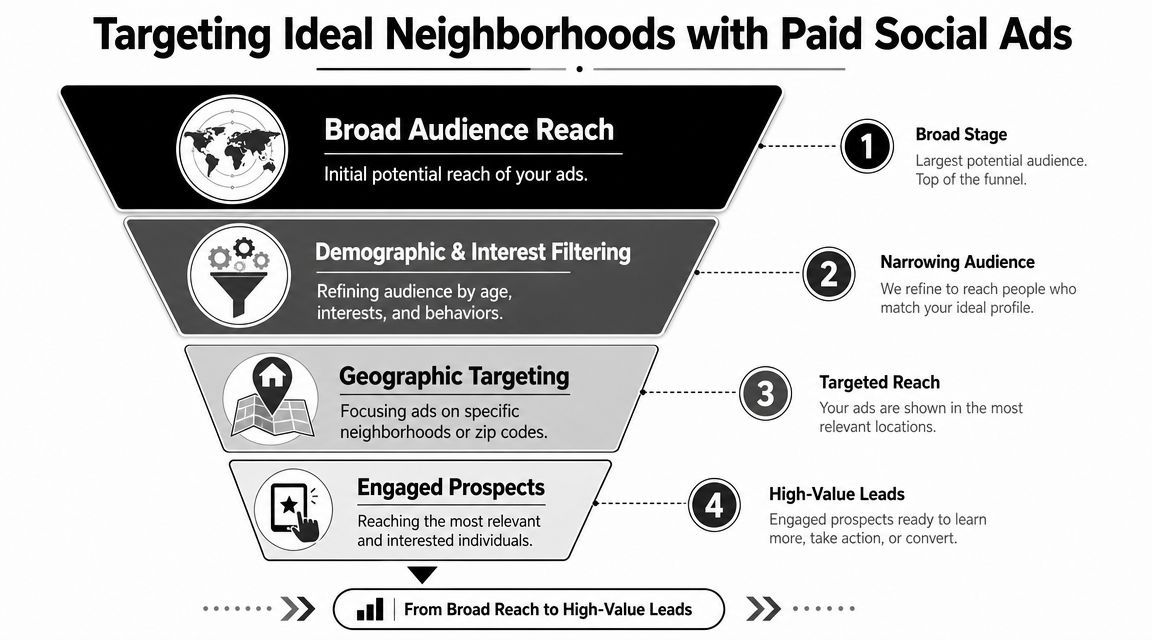
Run ads like targeted direct mail
The best contractor ads are not complicated. One strong project photo or short walkthrough video, one clear local message, and one simple call to action is enough.
Your targeting should follow common sense:
- Choose your service area carefully. Focus on towns, ZIP codes, or neighborhoods where you want jobs.
- Match the ad to the project type. Don't run a luxury kitchen ad to people who are more likely shopping for handyman work.
- Use local language. Name the town or neighborhood when it fits naturally.
- Send traffic to a dedicated landing page. Don't dump paid traffic onto your homepage and hope people figure it out.
If you want a deeper tactical breakdown, this guide to Facebook ads for contractors covers the moving parts in more detail.
A simple ad recipe
Keep the structure plain.
Visual: one polished before-and-after image, or a short video walkthrough
Headline: Dream Kitchen Remodels in [Your Town]
Primary text: We design and build high-quality remodels for homeowners who want a better layout, better finishes, and a smoother process. See recent work and request a consultation.
Button: Get a Free Consultation
That works because it does three jobs at once. It shows the work. It names the location. It invites the next step.
Don't overstuff the ad with details. The ad's job is to earn the click. The landing page and follow-up process do the heavier lifting.
A common mistake is chasing broad reach. Broad reach sounds good in reports. It's useless if the wrong people are clicking. A smaller, tighter audience usually makes more sense for remodelers who want fewer junk leads and more serious conversations.
Turning Clicks and Likes into Booked Appointments
Most social media marketing for contractors falls apart at this stage. The content works well enough to earn attention. The ad gets the click. Then the lead sits in an inbox, a DM thread, or a contact form notification nobody sees until dinner.
That gap is expensive.
A major weakness in contractor social advice is the failure to connect visibility to lead capture operations. A primary challenge involves how to route social traffic into a CRM, respond fast, and measure booked estimates, especially for $75K–$300K remodels where speed-to-lead and qualification matter more than social reach, as explained in TrebleHook's construction social media guide.
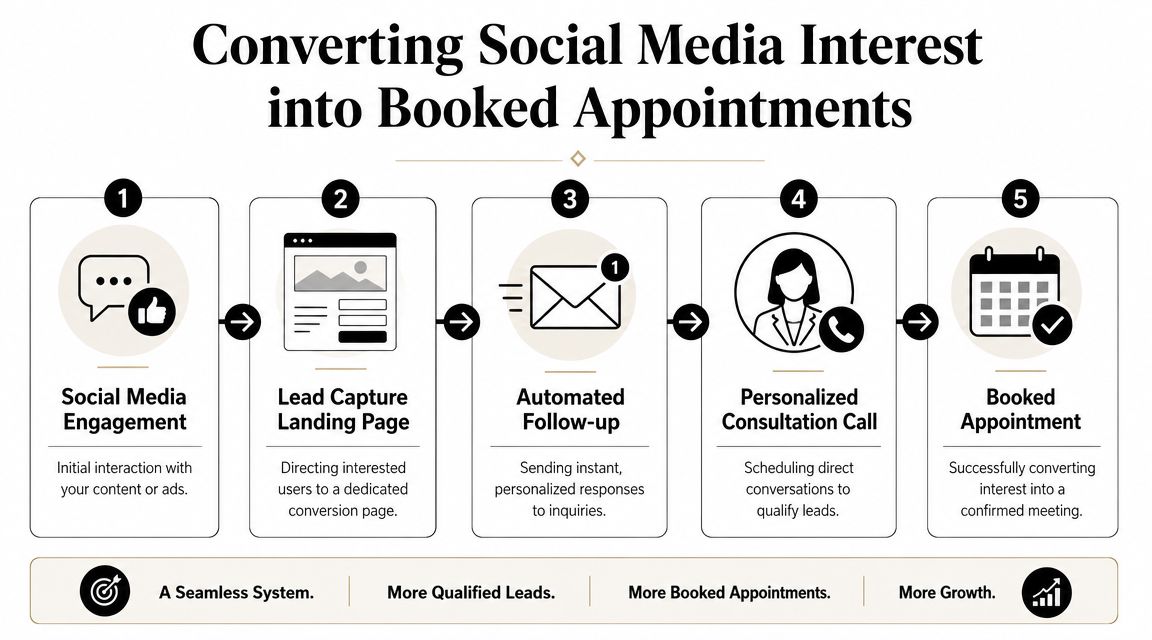
Your CRM is the missing piece
Think of a CRM like GoHighLevel as a digital office manager. It doesn't replace your sales process. It makes sure the ball doesn't get dropped while your team is on site, in estimates, or dealing with change orders.
A solid setup does four things:
- Captures every lead from forms, ads, and landing pages
- Responds immediately with a text or email
- Assigns the lead to the right person on your team
- Tracks the outcome so you know whether social produced an appointment, an estimate, or nothing useful
Without that, social traffic leaks everywhere.
The workflow that keeps leads from going cold
The handoff should feel almost automatic.
- A homeowner clicks an ad or social post.
- They land on a focused page with one offer, one form, and clear proof of work.
- They submit the form with project details.
- The CRM sends an instant reply confirming receipt and inviting the next step.
- Your team follows up fast by text or phone and qualifies the lead.
- The lead gets tagged and tracked so you can see whether that campaign produced a booked consultation.
That's the machine.
Here's what matters on the landing page:
- Clear project fit: say what kind of work you take on
- Strong visuals: show finished projects that match the offer
- Simple form fields: don't ask for a life story
- One call to action: consultation, project planner, or estimate request
And here's what matters in follow-up:
- Reply fast
- Ask smart qualifying questions
- Offer a clear next step
- Keep everything in the CRM
If you're comparing platforms or trying to understand the setup, this overview of CRM software for builders is a practical starting point.
Fast follow-up does more than improve response. It signals professionalism before the first call even starts.
A contractor who replies quickly looks organized. A contractor who sends a clean confirmation text, logs the lead correctly, and books a next step looks like someone who can manage a renovation without chaos. That impression matters.
Social media should not be your sales process. It should be the front end of a process that captures interest, qualifies fit, and moves the right homeowner into a real conversation.
Tracking What Works So You Don't Waste Money
You already know how to read a job for profitability. Marketing needs the same discipline. If you can't tell which posts, ads, or campaigns are producing leads, then you're guessing with your budget.

For lead-focused campaigns, the highest-value KPIs are Click-Through Rate, social-referred website traffic, leads or sign-ups, and revenue, according to Venveo's construction social media guidance. That's the scorecard that matters.
Watch business metrics, not ego metrics
Likes are fine. Comments are nice. Neither tells you enough by itself.
Watch these instead:
- CTR tells you whether the ad or post is strong enough to earn action
- Social-referred traffic tells you whether people are visiting your site
- Leads or sign-ups tell you whether the page converts
- Revenue tells you whether the whole chain is producing business
That's why your ad platform and CRM need to work together. One shows you who clicked. The other shows you what happened next.
A simple review rhythm
Use a monthly or quarterly review. Don't obsess every hour. Look for patterns.
Ask:
| Question | What to check |
|---|---|
| Are people clicking? | CTR and landing page traffic |
| Are the right people converting? | Form fills and booked calls |
| Which content pulls best? | Project type, format, and offer |
| Which campaigns deserve more budget? | Leads and revenue tied to source |
Don't reward the ad that gets attention. Reward the ad that produces qualified conversations.
If a campaign gets plenty of clicks but weak leads, the problem might be the targeting, the message, or the page. If traffic is solid and leads are weak, tighten the offer and simplify the form. If leads come in but no appointments get booked, the problem is usually follow-up.
Your Social Media Is a System Not a Task
Treating social media like a chore is why most contractors get mediocre results. Post. Forget. Post again. Hope something happens. That cycle wastes time.
The better model is simple. Create proof-of-work content. Run targeted local ads when you want more reach. Send every click to a landing page built to capture leads. Push every lead into a CRM that follows up fast and tracks outcomes.
That's a system. Systems scale better than motivation.
When those parts work together, social media stops being a side job for someone in the office. It becomes one piece of a lead-generation machine that supports bigger projects, cleaner follow-up, and a steadier pipeline.
Common Questions About Contractor Social Media
A few practical questions usually come up right away.
| Question | Answer |
|---|---|
| How much time does this take each week? | Less than most contractors think if you keep it simple. Capture content during real jobs, batch it once a week, and use a repeatable posting schedule. |
| Should I spend money on ads right away? | Not always. Start with a clean profile, solid proof-of-work content, and a working lead capture process. Add ads when you're ready to push more qualified traffic into that system. |
| Should I do it myself or hire help? | Do it yourself if you can stay consistent and you already have someone who can manage follow-up. Hire help if posting is sporadic, leads are slipping through the cracks, or you want a tighter system tied to revenue. |
The mistake is waiting for perfect conditions. Start with the basics. Clean profiles. Better content. One landing page. One CRM workflow. Then improve from there.
If you want help building a real lead-generation system instead of just posting pretty project photos, Constructo Marketing helps remodelers turn visibility into booked opportunities. They focus on the parts that matter for serious residential work: local demand, conversion-focused websites, CRM automation, and follow-up that keeps good leads from going cold.