


You do great work. Your projects look sharp, your clients are happy, and your crews know what they're doing. But when a homeowner in the exact neighborhood you want to work in searches Google for a remodeler, your company doesn't show up where it should.
That's the problem local SEO keywords solve.
For a remodeling business, keywords aren't nerd stuff. They're the words people type when they want a kitchen redone, a primary bath rebuilt, or a whole-home remodel planned by someone they trust. If you pick the right words, Google connects you to the right jobs. If you pick the wrong ones, you attract cheap leads, DIY browsers, and people nowhere near ready to sign a real contract.
If you want better local visibility, more qualified calls, and a pipeline built around serious residential projects, you need to get your local SEO keywords right.
Table of Contents
- Why Your Best Customers Cannot Find You Online
- What Local SEO Keywords Are in Plain English
- How to Find Your Money-Making Keywords
- Choosing Keywords That Attract Six-Figure Projects
- Where to Put Your Keywords to Get Found
- How to Know If Your SEO Is Actually Working
- Stop Being Invisible and Start Winning Locally
Why Your Best Customers Cannot Find You Online
A lot of remodelers think they have a website problem. Usually, they have a keyword problem.
You may have a beautiful site with project photos, polished copy, and a solid reputation. But if your pages don't use the same local phrases homeowners use when they search, Google has no clear reason to put you in front of them. That means the company doing average work but better local targeting can outrank you.

Google shows local options first
Local visibility matters because Google gives a lot of space to local results. A Moz-cited study found that 33% of searches returned a Google local pack from a sample of 10,000 keywords, and Moz also reports that 69% of people say at least half of their searches have local intent in Moz's local search analysis.
That matters for you because a homeowner rarely searches like a marketer. They don't sit there thinking, “I need a firm with superior organic optimization.” They type things like:
- Service plus place like “kitchen remodeler in Hinsdale”
- Immediate need like “home addition contractor near me”
- Neighborhood language like “bathroom remodeler in Old Town”
- Project-specific searches like “design build remodeler for historic home renovation”
If your site only talks in broad terms like “quality craftsmanship” and “full-service renovation,” you're too vague. Google can't confidently match you to a local searcher with a clear project in mind.
Keywords are digital job site signs
Think of local SEO keywords like yard signs at the exact intersections where your ideal clients drive. Put the sign in the wrong spot, and nobody relevant sees it. Put it in the right neighborhood with the right message, and the phone rings.
Practical rule: If you want to win work in specific towns and neighborhoods, your site has to say those places clearly and naturally.
The strongest remodelers don't just chase “more traffic.” They aim for visibility in the exact areas where higher-budget homeowners live, plan projects, and compare firms.
That's also why your reputation signals matter alongside keyword targeting. Reviews reinforce local trust and local relevance, which is worth understanding in this guide on how Google reviews help SEO.
What Local SEO Keywords Are in Plain English
Most local SEO advice is too abstract. Let's keep it simple.
A keyword is just a search phrase. A local SEO keyword is a search phrase with place and intent baked into it. It tells Google what the homeowner wants and where they want it.
Think like a contractor not a marketer
On a job site, you don't grab random hardware and hope it works. You choose the right fastener for the right material. Keywords work the same way.
A broad term like “remodeler” is loose. It doesn't tell Google much. A phrase like “kitchen remodeling contractor in Glenview” is tighter. A phrase like “design build kitchen remodeler Glenview” is tighter still, and often closer to a serious buyer.
The value of this has grown fast. SOCi reports that average Google 3-pack or local pack presence for top competitive keywords increased from 23.8% in 2022 to 33.4%, and the same source cites that 46% of Google searches are local in SOCi's local SEO statistics roundup.
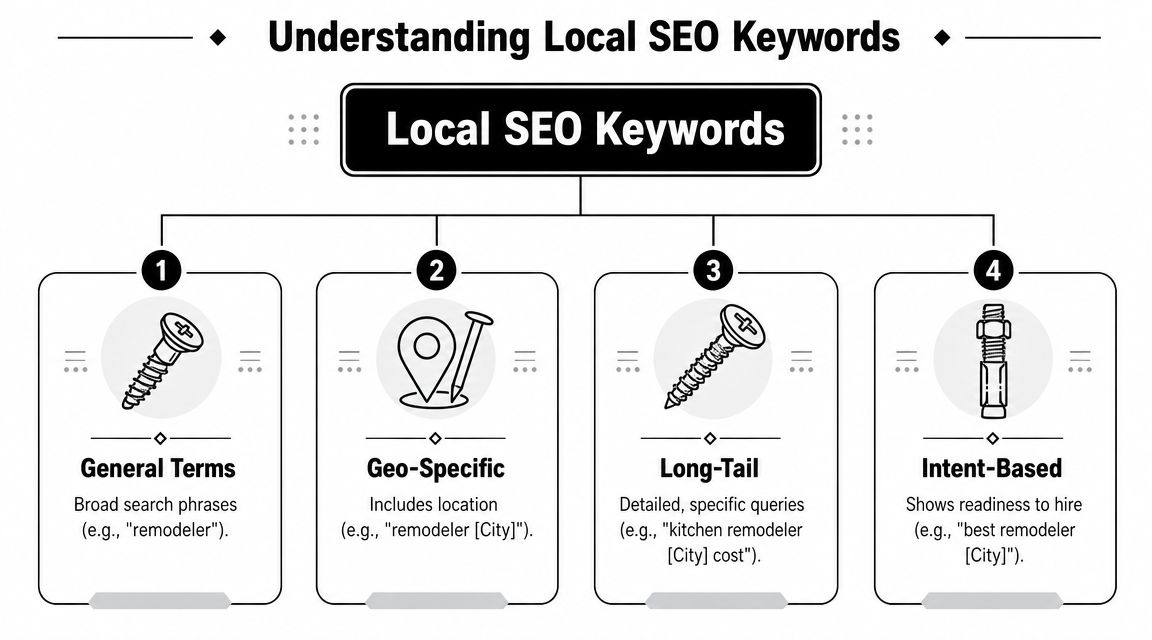
The four keyword buckets that matter
Here's the easiest way to sort your keyword ideas.
| Keyword Type | Example | Homeowner Intent |
|---|---|---|
| General Terms | remodeler | Browsing, early research, low clarity |
| Geo-Specific | kitchen remodeler in Naperville | Looking for a provider in a place |
| Long-Tail | contractor for finishing a basement with a wet bar | Specific project need, better fit |
| Intent-Based | best design build remodeler in Winnetka | Comparing firms, closer to contact |
The best local SEO keyword strategy for a remodeler usually pulls from four buckets:
- General terms are broad. They can help Google understand your category, but they don't filter out weak leads very well.
- Geo-specific terms do the heavy lifting. These combine service plus city, suburb, or neighborhood.
- Long-tail terms sound more like how real people talk. They often reveal a defined scope or higher-consideration project.
- Intent-based terms show buying behavior. Words like “best,” “contractor,” “company,” and “design build” often signal someone is moving toward a decision.
A homeowner searching “kitchen ideas” is gathering inspiration. A homeowner searching “kitchen remodeling contractor in Elmhurst” is looking for somebody to hire.
That's the difference that matters.
How to Find Your Money-Making Keywords
You don't need expensive software to build a strong local keyword list. You need a repeatable process and a little discipline.
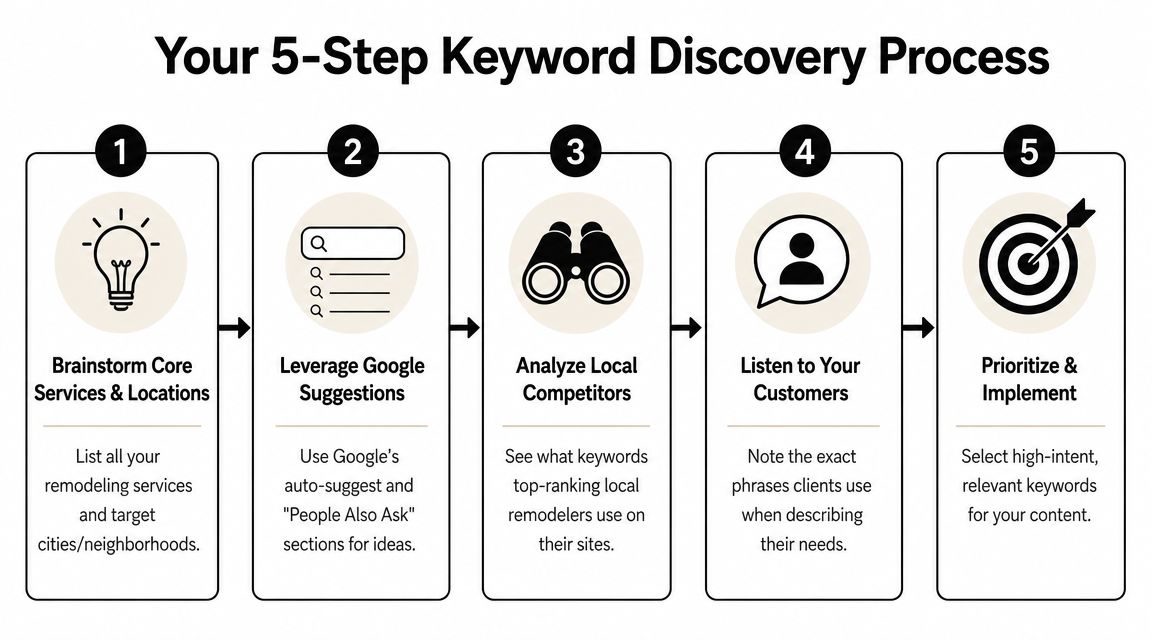
Start with a seed list
Portent's guidance is the right starting point. Build a seed list from your services and target geography, then validate it with Google Search Console and Google Keyword Planner in your market using Portent's local keyword workflow.
Your seed list should come from three buckets:
Services
- kitchen remodeling
- bathroom remodeling
- whole home remodeling
- home additions
- basement finishing
- outdoor living
Places
- city names
- affluent suburbs
- neighborhood names
- districts
- nearby landmarks people use
Modifiers
- contractor
- company
- design build
- near me
- custom
- luxury
Put them together in plain combinations. Don't overthink it yet.
Examples:
- kitchen remodeling contractor in Highland Park
- design build firm in Lake Forest
- bathroom remodeler near downtown Naperville
- whole home renovation contractor Winnetka
Use Google and your own data
Open Google and start typing your seed phrases. Watch what autocomplete suggests. Then look at the related searches and People Also Ask areas. Google is showing you real language from real searchers.
Next, check your own assets:
- Google Search Console shows the queries already bringing clicks to your site.
- Google Keyword Planner helps estimate demand in a city, county, or similar local area.
- Google Trends helps you compare phrasing and spot regional differences.
- Google Business Profile insights can reveal language people use to find your listing, especially local phrasing by area and intent.
Many remodelers miss easy wins by guessing what homeowners search instead of checking what homeowners already typed.
Study the remodelers already showing up
Search your target phrases and inspect the firms that rank in the map pack and organic results. You're not copying them. You're reading the market.
Look for patterns:
- Are they using “design build” more than “remodeling contractor”?
- Do they build separate pages for each town?
- Are they targeting neighborhoods instead of only city names?
- Do their project pages mention specific communities, architecture styles, or home types?
If three top competitors all have a page for “kitchen remodeling in [town],” and you don't, that's not a coincidence.
One more place to mine good keywords is your sales pipeline. Read inquiry emails, estimate requests, and intake notes. Pay attention to the nouns people use. Homeowners often tell you the exact phrase that should be on your site.
You'll hear things like:
- “We want to rework the first floor.”
- “We need a better primary bath layout.”
- “We're looking for a design-build team.”
- “We want to stay in this neighborhood and add space.”
That language is gold because it comes straight from the buyer.
Choosing Keywords That Attract Six-Figure Projects
More keywords do not mean better SEO. Better keywords mean better SEO.
A lot of remodelers waste time chasing broad phrases that pull in homeowners who are years away from hiring anyone. If your company is built for larger residential projects, you should filter for intent, complexity, and local fit.
Stop chasing traffic and chase buyer intent
An experienced local SEO practitioner says many local service businesses can capture about 80% of relevant search volume with roughly 20 to 40 well-chosen keywords, and the recommendation is to map a few primary terms plus close variants to specific local pages in this local keyword mapping guide.
That's the right mindset for a remodeler.
You do not need a giant spreadsheet stuffed with every phrase under the sun. You need a short list of terms tied to the work you want more of.
Here's how I'd judge a keyword for a remodeling company targeting premium projects:
- High value if it includes a serious service like kitchen remodel, addition, whole home remodel, or design build.
- Better value if it includes a target town, neighborhood, or service area you want.
- Best value if it suggests hiring intent, such as contractor, company, firm, or design build.
- Lower value if it sounds educational, inspirational, or DIY-focused.
Compare these side by side:
| Lower-Value Keyword | Stronger Keyword |
|---|---|
| home renovation ideas | whole home remodel contractor in [city] |
| bathroom inspiration | bathroom remodeling company [city] |
| kitchen trends | kitchen remodeler near [neighborhood] |
| basement decor ideas | basement finishing contractor [city] |
Map each keyword to the right page
This part is where many contractor sites fall apart.
Do not point every keyword at your homepage. That's lazy and weak. A homeowner searching for a kitchen remodel in a specific town should land on a page about that exact service in that exact place.
Use a simple map like this:
- Homepage for your brand and broad core identity
- Service pages for kitchen remodeling, bathroom remodeling, additions, and whole-home remodeling
- City pages for the markets you want most
- Project pages for real completed jobs in recognizable neighborhoods
- Blog posts for support topics, planning questions, and local project insights
If you want six-figure work, your keyword choices should reflect six-figure projects. That means fewer “ideas” phrases and more “hire-ready” phrases.
Where to Put Your Keywords to Get Found
Once you've picked the right phrases, placement matters. Not stuffing. Placement.
Google and homeowners both need clear signals. Your site should say what you do, where you do it, and which page covers which topic. Your Google Business Profile should reinforce that same story, but it shouldn't mirror your website word for word.
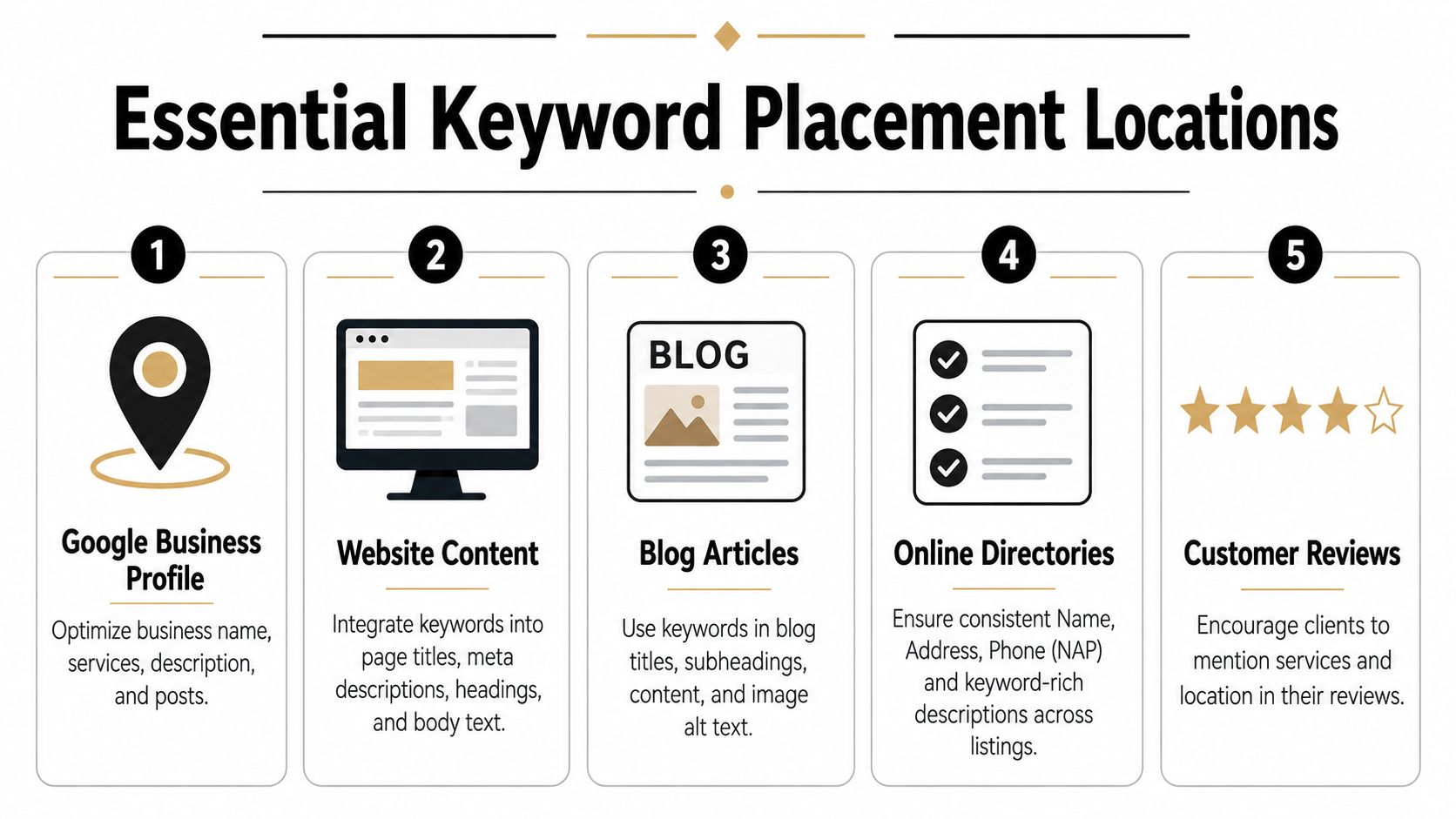
Your website needs clear keyword placement
Put your main keyword in the spots that carry the most weight:
Page title
Example: Kitchen Remodeling in Hinsdale | [Brand Name]Main heading
Example: Kitchen Remodeling in HinsdaleOpening paragraph
State the service and place in normal English right away.Subheadings
Mention the service type, project style, process, and local area naturally.Body copy
Use related phrases without forcing them.Image alt text
Describe the image accurately, with location where relevant.Internal links
Link service pages, city pages, and project pages together with clear anchor text.
If you want a broader framework for local pages and site structure, this guide on optimizing your remodeling website for local search is worth reading.
Your Google Business Profile needs its own keyword plan
Your website and Google Business Profile are connected, but they're not the same thing.
Newer local SEO guidance stresses that Google Business Profile query data can show the exact phrases people use to find your listing, including neighborhood and district language, in this explanation of GBP query-based keyword research. That matters because many remodelers optimize their site for one set of terms and ignore how people discover them in Maps.
Use those GBP insights to tighten up:
- Business description with your main services and local service area language
- Services section with clear service naming
- Posts about recent local projects, seasonal offers, or planning advice
- Photo captions and updates that reflect real projects and places
- Review prompts that encourage natural mentions of service and location
Your GBP often surfaces neighborhood language before your website does. Pay attention to it.
Simple templates you can use
Here are plain-English templates that work.
Service page opening
“We provide kitchen remodeling in [City] for homeowners who want better layout, better storage, and a finished space that fits the rest of the home.”
City page opening
Homeowners in [City] hire our team for bathroom remodels, additions, and whole-home renovations designed around how they live.
Project post title
“Whole-Home Remodel in [Neighborhood] for a Growing Family”
Google Business Profile post
“Just wrapped a primary bathroom remodel in [Area]. This project included a walk-in shower, custom vanity, and improved storage for a busy family.”
That's enough. Clear beats clever every time.
How to Know If Your SEO Is Actually Working
Rankings can be useful, but they're not the scoreboard. Revenue is.
A remodeling company doesn't need more impressions from random searchers. It needs more qualified inquiries from homeowners in the right locations with the right projects.
Track leads not vanity metrics
Start with the signals that tie directly to business outcome:
- Google Business Profile actions like calls, direction requests, and website visits
- Google Search Console queries that show which local searches earn clicks
- Contact form submissions from service and city pages
- Phone calls from people who found you through Google
- Sales notes showing which towns and project types are coming in
If keyword work is doing its job, the pattern becomes obvious. You start seeing better-fit inquiries from the places you targeted. Not just “more traffic.”
A practical way to support this is to keep your local presence clean and complete. This Google Business Profile optimization checklist for remodelers helps with the basics that influence visibility and lead quality.
Build a simple scorecard
Don't build some bloated dashboard nobody uses. Keep one sheet. Review it monthly.
Track:
- your top service pages
- your top city pages
- the search queries driving clicks
- calls and form fills tied to those pages
- the quality of leads by project type and location
The best SEO report for a remodeler is simple: Which pages brought in real opportunities from the neighborhoods you care about?
If a city page gets visits but no leads, the issue may be offer, copy, trust signals, or page match. If a page gets leads but they're poor quality, the keyword targeting is probably too broad. If a page gets good leads, build more assets around that pattern.
That's how SEO becomes a lead system instead of a guessing game.
Stop Being Invisible and Start Winning Locally
Local SEO keywords are not complicated. They're just the words your best prospects use when they need somebody like you in a specific place.
For a remodeling company, that means you need to stop thinking in generic marketing language and start thinking like the homeowner who's ready to improve a home they care about. They search by project. They search by town. They search by neighborhood. They search by trust.
Your job is to line up your website, your Google Business Profile, and your pages so Google can match you to those searches fast and clearly.
The remodelers who win locally usually aren't the ones with the fanciest slogans. They're the ones who make it easy for Google and the homeowner to understand three things right away:
- what they do
- where they do it
- why they're the right fit
Do that well and your company stops being the best-kept secret in town. It starts showing up where serious homeowners are already looking.
That's the shift. Less hope. More visibility. Better leads. Better jobs.
If you want help turning this into a real lead engine, Constructo Marketing helps remodelers become local famous in the exact markets they want to dominate. They focus on the systems that matter for serious residential contractors, including Local SEO, Google Maps visibility, conversion-focused websites, Google Ads, CRM automation, and lead tracking built for $75K to $300K projects.