


You're probably in this spot right now. A homeowner in your city types “kitchen remodeler near me” or “bathroom remodeler [your town]” into Google. You do great work. Your jobs look better than half the companies showing up. But the calls go to someone else because Google puts their name in front of the homeowner first.
That top map section is where a lot of the action happens. If you're a remodeler, the Google 3 Pack isn't some SEO vanity trophy. It's the digital version of having your showroom on the busiest road in town, with your trucks parked out front and your best project photos in the window. When you show up there, more of the right people find you at the exact moment they're ready to talk.
Most remodeling companies don't lose local search because they're bad builders. They lose because their digital foundation is crooked. Their Google Business Profile is half-finished, their reviews come in randomly, their business info doesn't match across the web, and their website doesn't clearly tell Google which cities they serve. The good news is that this is fixable.
Table of Contents
- What Is the Google 3 Pack and Why Should Remodelers Care
- Your Digital Storefront Mastering Your Google Business Profile
- Building Trust Online Your Reputation and Review Strategy
- Getting Your Name Around Town Citations and Your Website
- Becoming the Go-To Expert in Your Town
- Advanced Plays to Protect Your Top Spot
What Is the Google 3 Pack and Why Should Remodelers Care
A homeowner in your target area searches “kitchen remodeler near me” on a Tuesday night. Before they reach the regular website results, Google shows a map and three local businesses. That block is the Google 3 Pack.
Datapins explains in its guide to Google Local Map 3-Pack SEO that these are organic local listings tied to map-based searches, not paid ads. For a remodeler, that placement puts your company in front of someone who already has intent. They are not killing time. They are comparing options, checking reviews, and deciding who makes the short list.
That is why this space matters.
A strong spot in the 3 Pack can drive calls, site visits, direction requests, and quote inquiries without forcing the prospect to dig through ten blue links first. For service-area remodelers, that matters even more. You may not have a showroom on Main Street, but Google still needs to understand where you work, what projects you take on, and whether your business looks established in the towns you serve.
Why this spot carries so much weight
The 3 Pack sits at the top of the local buying process. It works like the sign out front, the yard sign on a finished project, and the referral from a neighbor, all in one view.
Homeowners use it to answer a few fast questions:
- Are you close enough to serve their area?
- Do you look credible at a glance?
- Can they call or click without extra steps?
- Do your reviews suggest you can handle a high-trust, high-ticket job?
If your company shows up there, you start the conversation with an advantage. If you do not, a competitor gets that first look.
Practical rule: If you want better local visibility for trades, treat the Google 3 Pack like prime jobsite frontage. It gets seen first, and first impressions shape who gets the call.
Why remodelers feel the pressure more than other local businesses
Remodeling is not an impulse buy. A homeowner is weighing budget, timeline, disruption, design taste, and trust. Google knows that, so it tends to reward businesses that look local, clear, and dependable.
That creates a different challenge for remodelers than for a walk-in business. Many remodeling companies are service-area businesses. You may work across several towns without a staffed office in each one. So your visibility depends on whether Google can connect your profile, your service areas, and your website to the searches happening in those towns.
Competition is tighter, too. National franchises, design-build firms, and aggressive local shops are all trying to claim those same map spots. If your local signals are weak, you can do good work for years and still get buried.
The good news is that this is fixable. The Google 3 Pack is not random. It usually comes down to whether your digital storefront is clear, complete, and tied to the places you want to win. If you want a practical starting point, use this Google Business Profile optimization checklist for remodelers.
Your Digital Storefront Mastering Your Google Business Profile
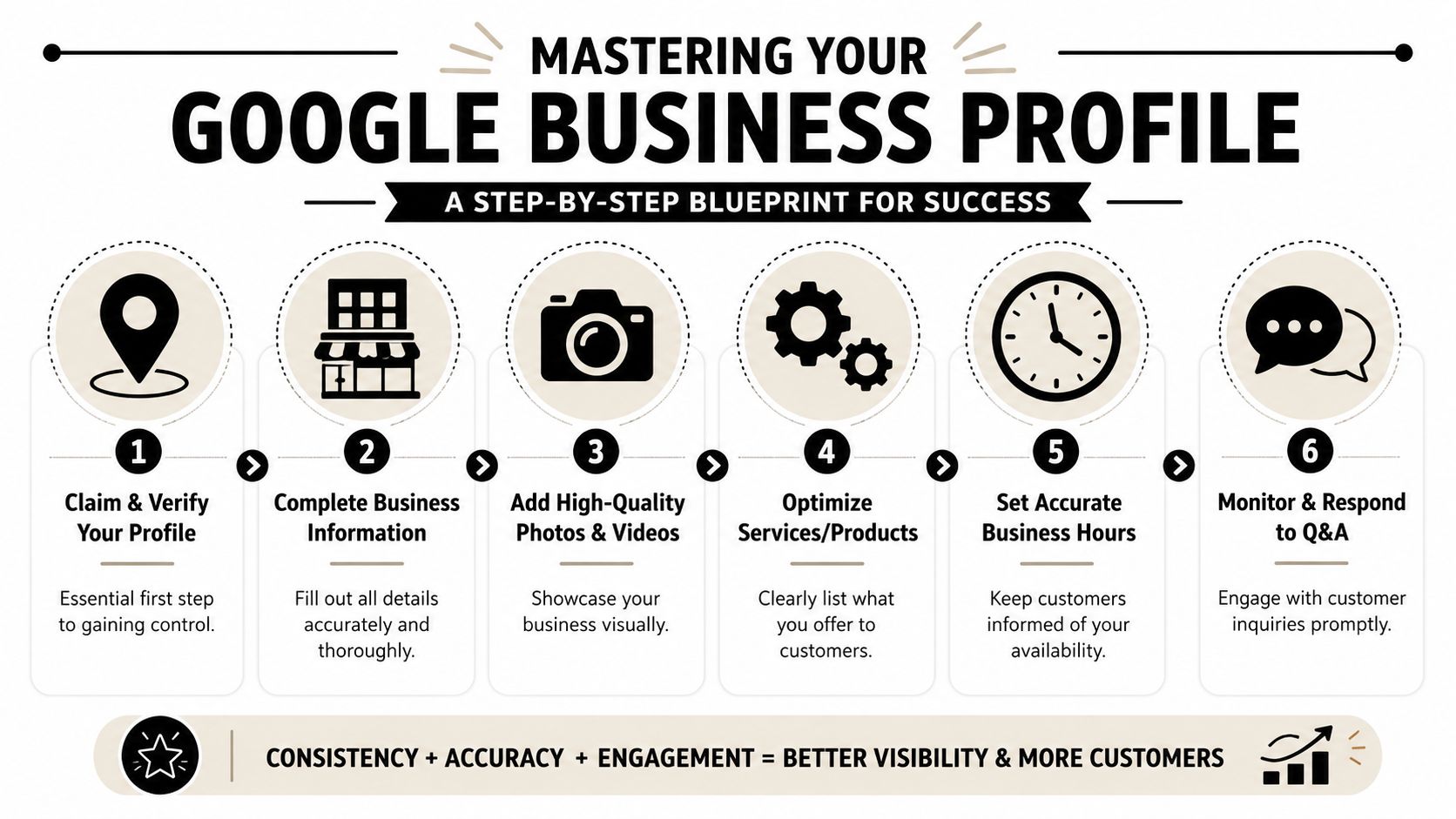
Your Google Business Profile, or GBP, is your digital storefront. If the Google 3 Pack is the sign on the busy road, GBP is the front door, display window, and business card all rolled into one. A weak profile makes even a great company look unfinished.
Start with control, then fill in every field
A solid workflow starts with claiming and verifying your Google Business Profile, then completing every field, aligning your NAP data across the web, and monitoring weekly performance metrics. Rush Analytics recommends that sequence in its Google 3 Pack guide because Google's local rankings are driven by relevance, prominence, and distance.
That sounds technical, but it's simple. Google wants to know three things:
| What Google asks | What it means for a remodeler |
|---|---|
| Relevance | Does your profile clearly match the service the homeowner wants? |
| Prominence | Do reviews, mentions, and business details make you look established? |
| Distance | Are you actually close enough to serve that searcher? |
If your profile is half-empty, Google has less confidence. If your phone number is wrong, hours are missing, or services are vague, homeowners lose confidence too.
Choose the right category and show real work
Category choice matters more than most remodelers think. Pick the category that most closely matches your core service. Don't get cute. Don't go broad when a more accurate fit exists.
Then build the profile like you'd prep for a client walk-through:
- Add complete business information: Name, phone, website, hours, service area, and business description.
- List real services: Kitchen remodeling, bathroom remodeling, home additions, basement finishing, outdoor living, or whatever you sell.
- Upload project photos: Before-and-after shots, clean finish photos, in-progress craftsmanship, and team photos.
- Keep Q&A watched: If questions sit unanswered, leads go cold.
For extra practical tips on setup and field-level optimization, Roman Sydorenko breaks down useful details in this guide on Google Business Profile optimization.
A remodeler's profile should look like a company trusted with a six-figure project, not like a side business that installed one backsplash last summer.
Treat your profile like a living jobsite, not a one-time setup
Too many contractors “set it and forget it.” That's like framing a house and never coming back to finish the drywall, trim, or punch list.
Update your profile with fresh photos. Review your services. Check for incorrect edits. Answer questions quickly. Make sure the linked website page is still the right one.
A simple working checklist helps. Constructo Marketing has a practical Google Business Profile checklist for remodelers addressing the pieces owners often miss.
Here's what usually works well for higher-value remodeling leads:
- Project-focused photos: Not stock images. Real kitchens, baths, additions, and exterior upgrades.
- Specific descriptions: “Design-build kitchen remodeler serving [city]” is stronger than “general contractor.”
- Accurate hours and contact details: If homeowners call and hit dead ends, you lose trust fast.
What doesn't work well is stuffing keywords everywhere, choosing categories that don't match your business, or uploading random photos with no sign of quality control.
Building Trust Online Your Reputation and Review Strategy
A lot of remodelers still treat reviews like a nice bonus. They're not a bonus. They're modern word of mouth.

Reviews are today's word of mouth
Years ago, a neighbor said, “These guys did our kitchen. Call them.” Now that same trust check happens on Google, in public, at scale.
Semrush notes in its Google 3 Pack overview that some of the highest-value local signals are review growth with active responses, because Google looks at public reputation signals like review rating and review count alongside relevance and proximity.
That means two things are true at once:
- You need new reviews on a steady basis.
- You need to answer them so both Google and future homeowners see an active, trustworthy business.
A simple review system that doesn't feel awkward
The best review systems are boring. That's a compliment. They happen the same way every time.
Try this process:
- At the right moment: Ask when the client is happy. Final walk-through is ideal.
- By the right person: The project manager or owner usually gets the best response.
- With the right ask: Keep it short and direct. Thank them, then send the review link.
- With one reminder: If they don't respond, follow up once. Don't chase them five times.
A remodeler doesn't need a clever script. Just something natural: “If you're happy with the work, would you mind leaving us a Google review? It helps other homeowners feel comfortable reaching out.”
If you want a deeper breakdown of why review signals matter for search, this piece on whether Google reviews help SEO is worth reading.
Why your responses matter as much as the review itself
A response isn't just for the reviewer. It's for the next homeowner who's comparing you against two other companies.
Here's the difference:
| Weak approach | Better approach |
|---|---|
| Ignore positive reviews | Thank the client and mention the project type or experience |
| Get defensive on negative feedback | Stay calm, acknowledge the issue, offer to resolve it offline |
| Use the same canned reply every time | Write short, human responses that sound real |
One simple habit: respond to every review, even if it's brief. Silence looks like indifference.
For remodelers, negative reviews are especially important to handle well. Homeowners know construction has moving parts. They don't expect perfection. They do expect professionalism when something goes wrong.
What works is a calm, specific response. What doesn't work is arguing in public, blaming the client, or pretending the review doesn't exist.
Getting Your Name Around Town Citations and Your Website
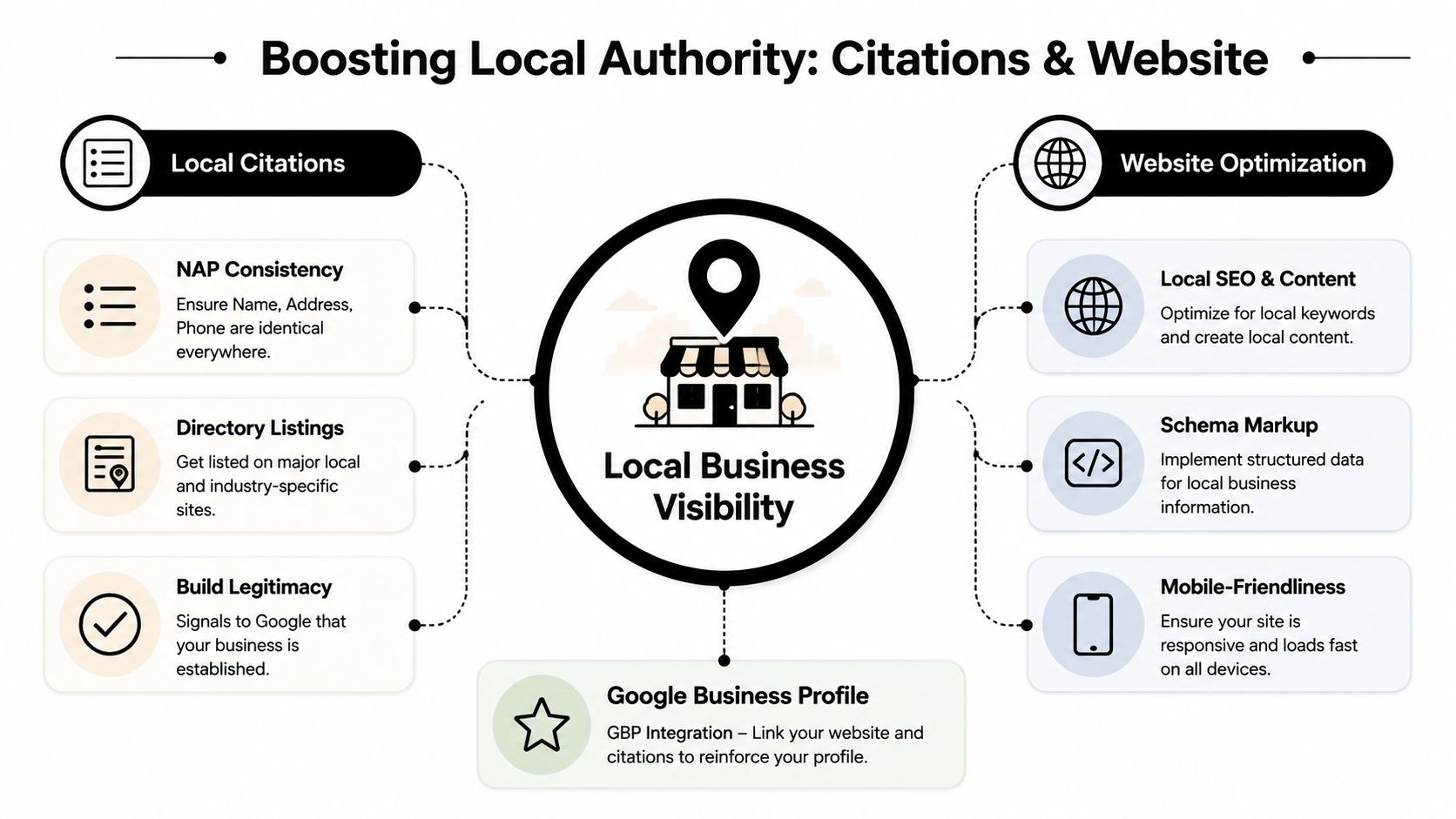
Google doesn't trust a business just because the business says it exists. It looks for matching signals across the web. That's where citations and your website come in.
Citations are your digital phonebook listings
A citation is a mention of your business details on sites like Yelp, Houzz, Angi, Apple Maps, Facebook, and similar directories. Think of them like old-school phonebook listings, except Google uses them to cross-check whether your business information is consistent.
Your NAP means name, address, and phone number. For local search, consistency matters. If one listing shows Suite 200, another drops the suite, and a third uses an old tracking number, Google gets mixed signals.
Keep an eye on:
- Business name: Use the same real business name everywhere.
- Address or service setup: Don't mix storefront details with service-area-only details.
- Phone number: Pick the primary number you want associated with the business.
- Website URL: Link to the right main site or location page.
Service area pages help Google understand your territory
Remodelers run into a real challenge. Many don't operate from a public showroom. They work out of an office, warehouse, or home office and serve clients at the client's location.
Seoprofy notes in its guide on the Google 3 Pack for service-area businesses that businesses serving customers at their location should use service areas in Google Business Profile rather than a hidden address. It also points out that a key challenge is structuring service-area pages and citations so you can win demand in specific cities and suburbs.
That's the part most generic local SEO advice skips.
Don't try to rank “everywhere.” Rank where you can actually sell, staff, and deliver profitably.
What good local pages look like for a remodeler
A service area page is not a thin page with the city name swapped out twenty times. Homeowners can smell that. Google can too.
A useful page for “Kitchen Remodeling in [City]” should include:
- What you do in that city: Kitchens, bathrooms, additions, aging-in-place work, or design-build services.
- What homeowners there care about: Older housing stock, permit realities, neighborhood styles, lot constraints, or common layout issues.
- Proof of local fit: Project photos, local testimonials if available, and clear service descriptions.
- A real next step: Call, consultation form, or schedule request.
If you're building out those pages, it helps to start with the right local SEO keywords for remodelers so each page targets a real search pattern instead of a guess.
Also pay attention to site basics. Fast mobile pages, structured data, and location-specific content support local visibility. If the site is slow or confusing on a phone, your Google 3 Pack traffic won't convert well even if you win the click.
Becoming the Go-To Expert in Your Town
A homeowner in your market searches for a remodeler, taps your Google listing, and lands on your site. That next minute decides a lot.
If the site reads like a yard sign with a few service names slapped on it, trust drops fast. If it shows real work, explains how you solve common remodeling problems, and sounds familiar with the homes in that area, you feel like the safer hire.
That is how two remodelers with similar crews and similar services end up with very different lead quality.
Two remodelers, two very different outcomes
One company has a basic site. It says “Kitchen Remodeling, Bathroom Remodeling, Home Additions” and leaves the homeowner to fill in the blanks.
The other company has pages that show completed projects, explain budget ranges, walk through process, and answer the questions people ask before they ever book a consultation. For a remodeler, that difference matters because homeowners are not buying a simple service. They are hiring someone to open up walls, manage disruption, protect their home, and guide a large purchase without surprises.
Here's the practical split:
| Remodeler A | Remodeler B |
|---|---|
| Lists services only | Shows real project stories |
| Generic homepage copy | Explains work in local terms |
| Few updated photos | Uses fresh photos from completed jobs |
| Sounds interchangeable | Sounds like a known specialist |
The second company does not need clever branding. It needs proof that it has done this work before and can do it well again in this town.
Content that earns trust before the first call
Good local visibility gets you the visit. Useful content helps you win the call.
Remodeling is a high-friction purchase. Homeowners worry about cost overruns, timeline slips, permits, design regret, and whether the crew will communicate well once demo starts. If your site answers those concerns in plain language, you remove guesswork before your sales process even begins.
The strongest pages usually address questions like these:
- How much does a bathroom remodel cost in this area?
- How long does a kitchen remodel usually take?
- What permits are common for this kind of project?
- What problems show up in older homes here?
- Is it smarter to remodel now or wait until before a sale?
The remodeler who teaches earns more trust than the one who keeps repeating “quality craftsmanship.”
Project stories do this especially well. Show the starting condition. Explain the constraint, bad layout, aging plumbing, low ceiling height, tight footprint, or historic home detail. Then show the plan, the trade-offs, and the finished result. That sounds more like an expert and less like a brochure.
What to publish when you hate “marketing”
A lot of remodelers hear “content” and picture a blank screen and a wasted afternoon.
That is not the job.
The job is to document the work you already do and answer the questions you already hear in the field, at estimate meetings, and during design conversations. If your team can explain a change order, a layout fix, or why a permit was needed, you already have material worth publishing.
Start with a simple mix:
- Project spotlights: One finished kitchen, bath, addition, basement, or whole-home project at a time.
- Local FAQs: Short answers to homeowner questions you hear every month.
- Photo galleries with captions: Explain what changed, what problem it solved, and what the homeowner chose.
- Process pages: Show how planning, design, estimating, selections, scheduling, and construction work in your company.
For service-area remodelers, this is one of the best ways to build local authority without a storefront. Your Google Business Profile is your digital storefront. Your content is the walk-through portfolio and the conversation a homeowner has with you before they ever reach out.
Done well, that content helps Google understand your specialties and service area. It also helps a homeowner decide you are worth calling.
Advanced Plays to Protect Your Top Spot
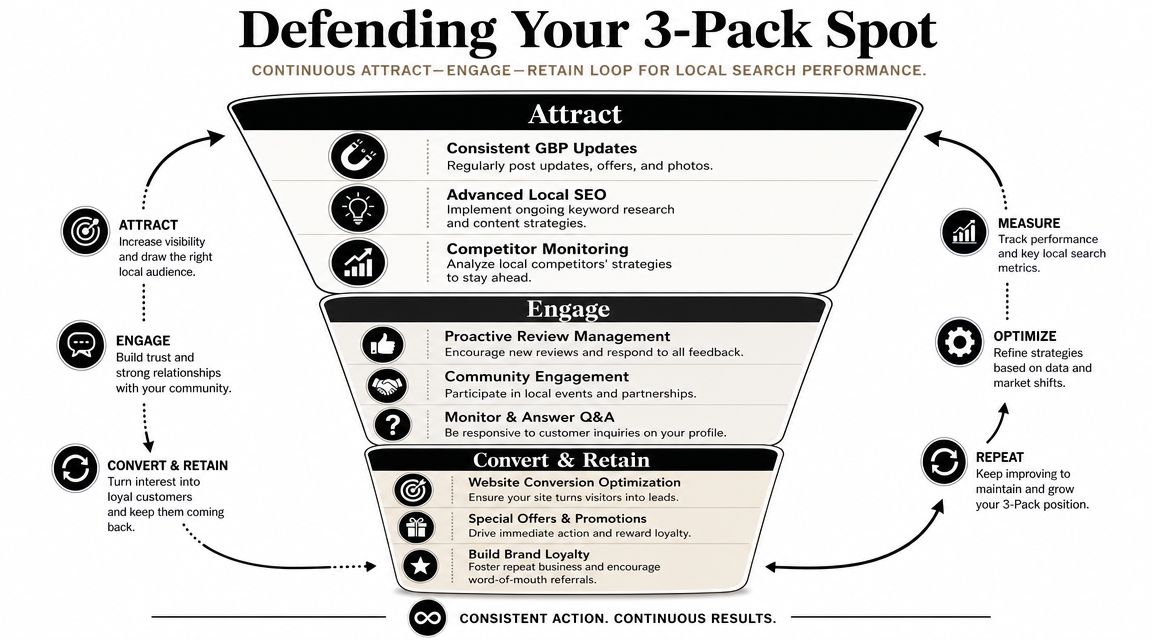
A remodeler can do the hard work to reach the Google 3 Pack, then lose ground because a competitor answers leads faster, piles up fresh reviews, or shows stronger proof across the web.
That is why this stage is less about getting found and more about protecting the position you earned.
Go from defense to offense
Once the basics are working, add a second layer. The goal is simple: keep your pipeline steady even when rankings shift, seasonality hits, or a new competitor starts spending hard in your market.
Paid search can help with that. Google Ads and Local Service Ads put you in front of the same homeowners who are searching for kitchen remodelers, bathroom remodelers, additions, and whole-home work in your service area. Organic search builds long-term visibility. Paid traffic helps cover gaps, protect branded searches, and keep lead flow from getting too dependent on one channel.
That trade-off matters. Paid leads cost money up front, and not every click is worth having. But if your schedule has openings, or if you are trying to break into a nearby town where you do not rank well yet, paid traffic can buy time while your local SEO catches up.
For remodelers who want SEO, paid traffic, website performance, and lead handling managed together, Constructo Marketing offers that support for this niche. The value is not just visibility. It is making sure the homeowner who finds you can take the next step without friction.
Track the numbers that matter
Do not run local search like a vanity project. Run it like a job costing sheet.
You need a short scorecard your team can review every week:
- Calls from Google Business Profile: Are homeowners using the listing to contact you?
- Form submissions from local pages: Are service and city pages producing real inquiries?
- Booked appointments: Are leads becoming estimate meetings or consultations?
- Closed jobs by source: Which channel brings profitable remodeling work?
Rush Analytics recommends monitoring local rankings, inquiry volume, local search traffic, and revenue attribution as part of a recurring workflow. For a remodeler, the bigger point is simpler. Track what leads to signed projects.
If impressions rise but qualified consultations stay flat, the problem is somewhere in the chain. Sometimes the Google Business Profile is showing for broad searches that do not match your services. Sometimes the website does not build trust fast enough. Sometimes the issue is operations. Slow follow-up, missed calls, and weak screening can waste good demand.
Build for where local search is heading
The Google 3 Pack is still important, but Google no longer relies on one source to decide who deserves visibility. Google's AI Mode has been described as pulling from a business's website, Google Business Profile, and third-party sources like Yelp and Facebook in this Google AI Mode explainer video.
For remodelers, that means your digital storefront has to match the rest of the jobsite signs around town. If your website says one thing, your profile says another, and your third-party listings look neglected, Google gets a messy signal. Homeowners do too.
Use this standard:
| Stronger move | Weaker move |
|---|---|
| Keep your website, GBP, and third-party listings aligned | Focus only on GBP and ignore the rest of the web |
| Earn reviews steadily and respond like a real business owner | Chase bursts of activity and let reviews sit |
| Publish local project proof with useful detail | Rely on generic service pages with stock language |
| Check rankings by device and by service area | Assume one report reflects your whole market |
Your website, GBP, reviews, and directory listings should tell the same story about where you work, what you do, and why a homeowner should trust you.
That is how remodelers hold position. A top spot in the Google 3 Pack is less like winning an award and more like keeping a clean, active showroom. It takes upkeep, consistency, and proof that the business behind the listing is the one a homeowner should call.