


Energy efficient home upgrades are not a side dish. They are one of the best ways to sell a larger, more profitable remodel.
Plenty of remodelers still pitch efficiency as a list of products. Windows. HVAC. Solar. That amateur framing drags the conversation straight to price. Clients do not buy a premium scope because you offered a higher SEER rating or thicker insulation. They buy because you connected comfort, operating cost, noise control, durability, and resale value to the remodel they already want.
That shift matters in the field and at the kitchen table. The U.S. Department of the Treasury reported that more than 3.4 million American families claimed over $8 billion in tax credits for clean energy and energy efficiency upgrades on their 2023 returns, showing that homeowners are already spending real money on these projects and using incentives to do it better. Treasury's 2025 report on clean energy tax credits lays out the scale.
Use that to your advantage.
A remodeler who can explain why the back bedroom is always freezing, why the bonus room never dehumidifies, and why a pretty kitchen will still feel bad if the house leaks and the equipment is wrong, wins bigger scopes. A remodeler who cannot explain that gets stuck bidding line items against cheaper competitors.
Energy efficiency is not a green add-on. It is a sales tool. It helps you justify better design decisions, expand project scope, and position your firm as the contractor who solves the whole problem instead of replacing parts.
Table of Contents
- Why Energy Efficiency Is Your New Sales Superpower
- Explaining the House as a System to Homeowners
- The Big Three Upgrade Categories and Their Real Costs
- How to Prioritize Upgrades for the Best ROI
- Helping Clients Fund Bigger Projects with Incentives
- A Step-by-Step Plan for Energy-Smart Remodels
- Positioning Your Firm as the Go-To Efficiency Expert
Why Energy Efficiency Is Your New Sales Superpower
If you want to win bigger jobs, stop talking about products first. Talk about outcomes.
A homeowner rarely wakes up wanting “air sealing” or “duct sealing.” They want the bonus room to stop cooking in summer. They want lower utility bills. They want the new addition to feel as comfortable as the old part of the house. They want the remodeled kitchen to perform like a premium space, not just look like one.
That's where energy efficiency becomes a sales weapon.
Bigger scopes start with deeper problems
When you diagnose comfort, operating cost, moisture risk, and system mismatch, you create a much larger and more defensible project. A basic remodeler sells cabinets, tile, and fixtures. A sharp remodeler sells the room, the shell around it, and the systems that make it work.
That changes the conversation from “Why are you higher?” to “Why didn't the other guy mention any of this?”
Use energy efficient home upgrades to justify:
- Larger project scope because the remodel addresses hidden performance issues, not just finishes
- Better sequencing because clients can see why one improvement affects the next
- Higher trust because you sound like an advisor, not a salesperson
- Cleaner margins because bundled work beats fragmented change orders and patch jobs
Practical rule: If your proposal only talks about appearance, you're easy to compare on price.
Efficiency sells premium thinking
High-end clients don't mind paying for intelligence. They hate paying for guesswork.
When you explain why a project should include insulation upgrades, duct corrections, HVAC right-sizing, window performance, or electrical prep for future electrification, you're showing command. You're telling the client you know how the whole house works. That's what justifies a premium fee.
You also create follow-on work. A kitchen remodel can turn into a panel upgrade, ventilation improvement, window package, insulation scope, and mechanical redesign. Not because you forced it. Because you connected the dots.
That's the point. Energy efficiency isn't a side topic for “green” clients. It's a way to sell harder-to-compare work.
Explaining the House as a System to Homeowners
Most clients get lost when contractors start throwing around terms like envelope, latent load, infiltration, and duct leakage. That's your fault, not theirs.
Keep it simple. Explain the house like it's a body.
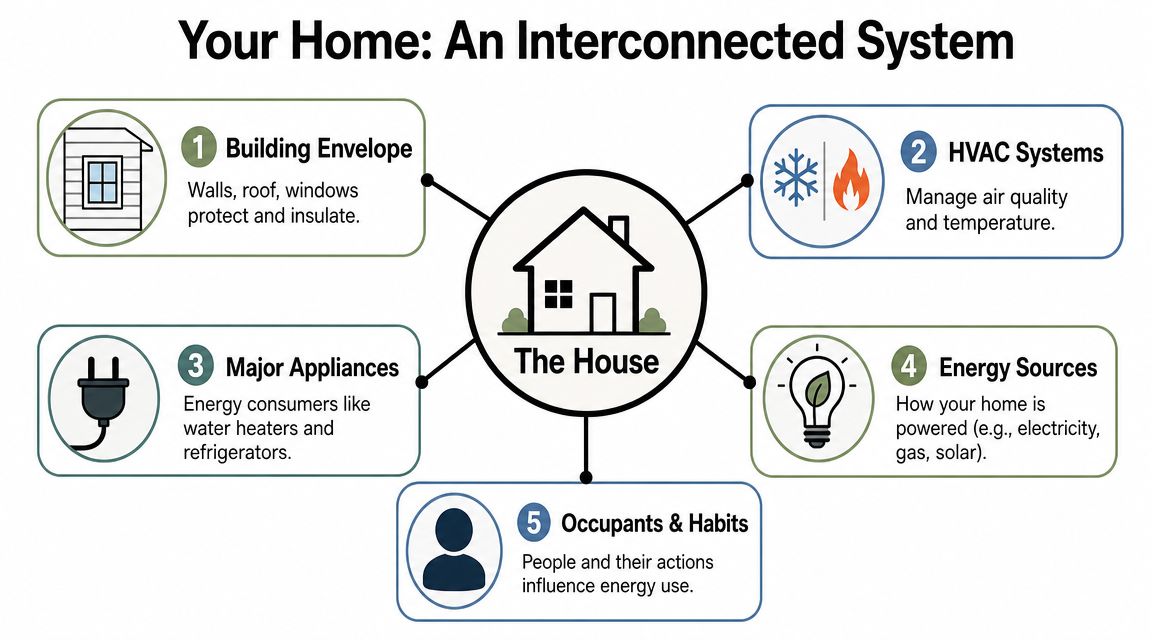
Use the body analogy
The building envelope is the skin. It separates inside from outside. If the skin has holes, the body struggles.
The HVAC system is the lungs. It heats, cools, and moves air. If the skin leaks, the lungs work too hard.
The ductwork is the circulatory system. It carries conditioned air where it needs to go. If that system leaks or is poorly laid out, rooms don't get what they need.
A lot of homeowners instantly understand this. If the skin is full of gaps, buying bigger lungs doesn't solve the problem. It just means the body works harder.
That's why envelope work comes first. A high-performance building envelope should be upgraded before HVAC replacement because air leakage forces mechanical systems to run longer. Duct sealing alone can improve HVAC efficiency by 20% or more, and whole-home envelope optimization can enable up to 50% lower energy use when paired with efficient HVAC equipment, according to this building envelope and HVAC efficiency overview.
Give clients a simple script
Use language a child could follow:
- If air gets out, your money gets out.
- If hot or cold sneaks in, your equipment has to chase it.
- If rooms aren't balanced, the house won't feel good no matter how pretty it looks.
- If you replace equipment first, you may buy the wrong size system.
That script works in a kitchen consult, an addition consult, or a whole-home remodel meeting.
For window conversations, don't wing it. If a client asks what performance numbers mean, hand them Moore Construction Co.'s window guide. It gives you a clean way to explain U-factor without turning the meeting into a science lecture.
If you want your marketing to carry this same simple, educational tone online, study how to package complex topics into clear homeowner language with these types of content for content marketing.
A remodeler who can explain a house simply sounds more credible than a contractor who hides behind jargon.
The Big Three Upgrade Categories and Their Real Costs
Stop selling energy upgrades as a pile of products. Sell them as three investment categories that control comfort, operating cost, and project scope. Clients grasp that structure fast, and your proposals get easier to price, defend, and expand.
Category one is the envelope
The envelope is the shell. Air sealing, insulation, windows, exterior doors, weatherstripping, and duct sealing all sit here.
This category drives more value than many remodelers admit. The U.S. Department of Energy says 43% of a home utility bill goes to heating and cooling, air sealing can cut household energy use by 5% to 30% per year, and storm windows can reduce heat loss through windows by 25% to 50% in the right conditions, according to DOE guidance on why energy efficiency matters.
That is why envelope work sells.
It lowers the load, improves comfort, and gives every other upgrade a better shot at performing as promised. If you want to win larger remodels, stop treating insulation and air sealing like cheap add-ons. Put them near the center of the scope, where they belong.
Category two is the mechanical stack
This category includes HVAC equipment, ventilation, duct modifications, controls, and water heating.
Clients like equipment because they can see it. Remodelers like equipment because it is easy to price. That combination creates bad projects. A high-end system installed in a leaky house is still serving a broken load profile, and the client ends up paying for excess capacity, uneven comfort, and callbacks you did not need.
Sell mechanical upgrades as performance equipment selected for the actual house, not as trophy appliances. That framing separates a serious remodeler from a box-swapping contractor.
Category three is electrification and renewables
This category covers heat pumps, heat pump water heaters, solar, EV-readiness, panel upgrades, and related electrical work.
These upgrades can raise project value fast. They can also burn budget if you pitch them before the shell and distribution system are under control. The right sequence turns electrification into a premium upsell instead of a messy detour.
If you need a homeowner-friendly resource that reinforces whole-home thinking, this guide on how to maximize home energy savings supports the point that upgrades work better together than in isolation.
Energy upgrade cost vs savings snapshot
Use a table like this in your proposal. Keep pricing specific to your market, trade partners, and install standards. Clients do not need fake precision. They need a clear planning framework tied to outcomes.
| Upgrade Category | Typical Project Cost Range | Potential Annual Savings | Primary Benefit |
|---|---|---|---|
| Building envelope | Varies by scope, house size, and existing conditions | Air sealing can cut energy use by 5% to 30% per year (Source: DOE, as cited above) | Comfort, lower drafts, reduced load |
| High-efficiency mechanical systems | Varies by equipment, duct changes, controls, and install complexity | Qualitative only. Savings depend on the house and proper sequencing | Better comfort delivery, lower operating strain |
| Electrification and renewables | Varies by panel capacity, product selection, roof conditions, and local requirements | Savings depend heavily on utility rates, existing fuel type, equipment choice, and whether envelope work was done first | Fuel switching, operating savings, future readiness |
A lot of remodelers lose margin because they price these categories as disconnected line items instead of one coordinated scope. Fix that before you chase bigger jobs. Strong estimating, clean phase costing, and better production tracking make it far easier to sell integrated projects in the $75,000 to $300,000 range. Start with this remodeler's guide to construction job cost accounting.
How to Prioritize Upgrades for the Best ROI
The right order is simple. Seal. Insulate. Condition.
If you ignore that order, you force the client to buy around problems instead of fixing them.
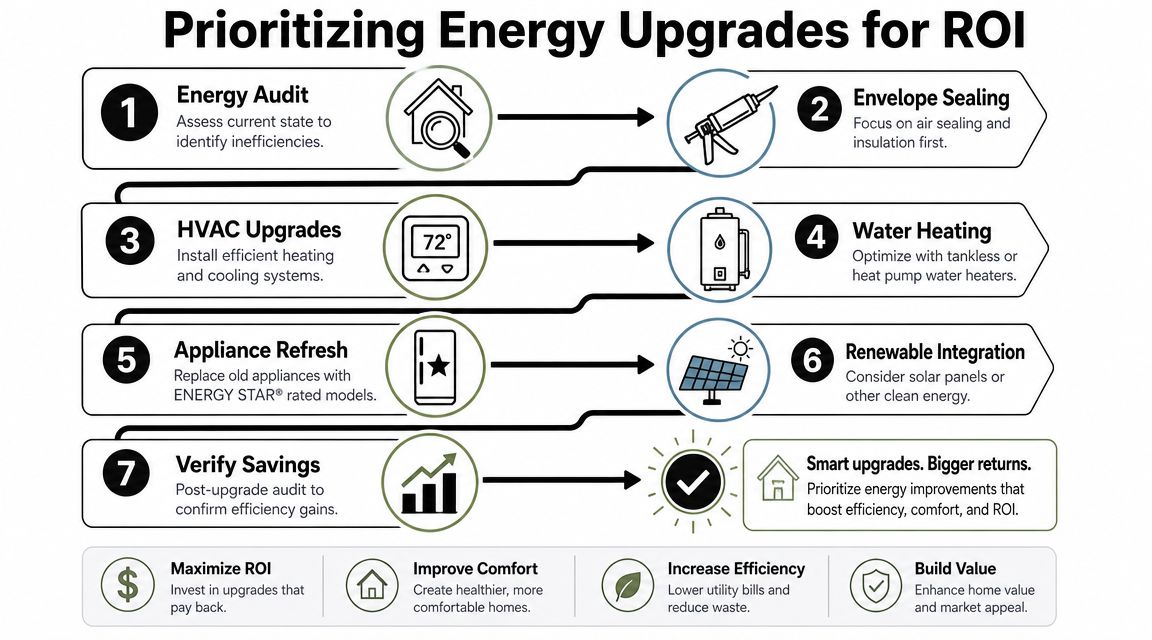
Follow seal insulate condition
Start with the places where the house loses control. Attic bypasses. Rim joists. Penetrations. Duct leakage. Poor insulation continuity. Sloppy transitions between old and new construction.
Then improve insulation where it will help. After that, size and select the equipment.
That order isn't contractor folklore. It's the logic behind good home performance work. DOE and NYSERDA both emphasize reducing the load first through air sealing and insulation before equipment replacement. New York program materials also show at least $2,500 for certain air sealing and insulation packages, while whole-home heat pump rebates average $7,000–$9,000 plus a state tax credit up to $5,000, which you can see in DOE guidance on efficient home design.
Sell the master plan not the single item
Homeowners often ask for one product because that's the only thing they know how to ask for. New windows. Bigger AC. Smart thermostat. Heat pump.
Your job is to zoom out.
Use a phased roadmap:
- Audit first so you know where the waste is
- Fix the shell so the house stops bleeding energy
- Correct delivery with duct and airflow improvements
- Upgrade equipment after the load drops
- Add controls and future-ready electrical work where it makes sense
- Layer in renewables only after the house is ready
Don't let the client buy a bigger engine for a car with flat tires.
Small control upgrades can still support the plan. If you need a practical example for clients who ask about controls, this roundup of smart thermostats for Canadian homes is a helpful reference point. It works best when you frame thermostats as tuning tools, not miracle cures.
The remodeler who presents this sequence looks organized, disciplined, and honest. The remodeler who jumps straight to equipment looks like a salesperson chasing a commission.
Helping Clients Fund Bigger Projects with Incentives
Contractors who treat incentives as back-office admin leave money on the table. The better move is to use them in the sales conversation to justify a better scope, a better outcome, and a bigger contract.

Use incentives to expand scope
Bring incentives into the discussion early, while the client is still deciding what kind of project this will be. If you wait until the end, rebates feel like a coupon. If you introduce them up front, they help support a larger, more coherent plan.
The federal government still offers tax credits for qualifying home efficiency upgrades through 2032, including credits that can cover part of eligible envelope, equipment, and electrification work. The IRS lays out the current rules for the Energy Efficient Home Improvement Credit on its guidance for homeowners claiming energy tax credits.
That changes the sales math.
A client who stalls at a higher project number may move ahead once you show how credits, utility rebates, and state programs can reduce the net cost of doing the job correctly. This matters most on projects in the $75,000 to $300,000 range, where performance upgrades can turn a basic remodel into a whole-house plan with better margins and fewer callbacks.
Don't let rebates drive bad decisions
Rebates can help fund smart work. They can also push clients toward dumb purchases if you let the incentive set the scope.
Consumer Reports makes the point clearly. Lower-cost improvements such as air sealing, insulation, and duct work often deserve attention before major equipment replacement because they can cut the load and improve the value of later upgrades, as explained in this Consumer Reports discussion of big home energy upgrades that pay off.
Use that in the sales meeting:
- Show net cost, not sticker price so the client sees the actual budget range after eligible credits and rebates
- Bundle related work so funding supports a house strategy instead of a random product list
- Flag scope risks early so panel upgrades, ventilation fixes, and duct corrections do not surprise the client later
- Separate guaranteed incentives from possible ones so your proposal stays credible
- Assign someone on your team to track program rules because expired offers and missed paperwork kill trust fast
Good remodelers do not chase rebate dollars. They use available incentives to sell a better project, protect the sequence, and get clients to yes on work that actually improves the house.
A Step-by-Step Plan for Energy-Smart Remodels
You don't need a separate business unit to sell energy efficient home upgrades. You need a repeatable process.
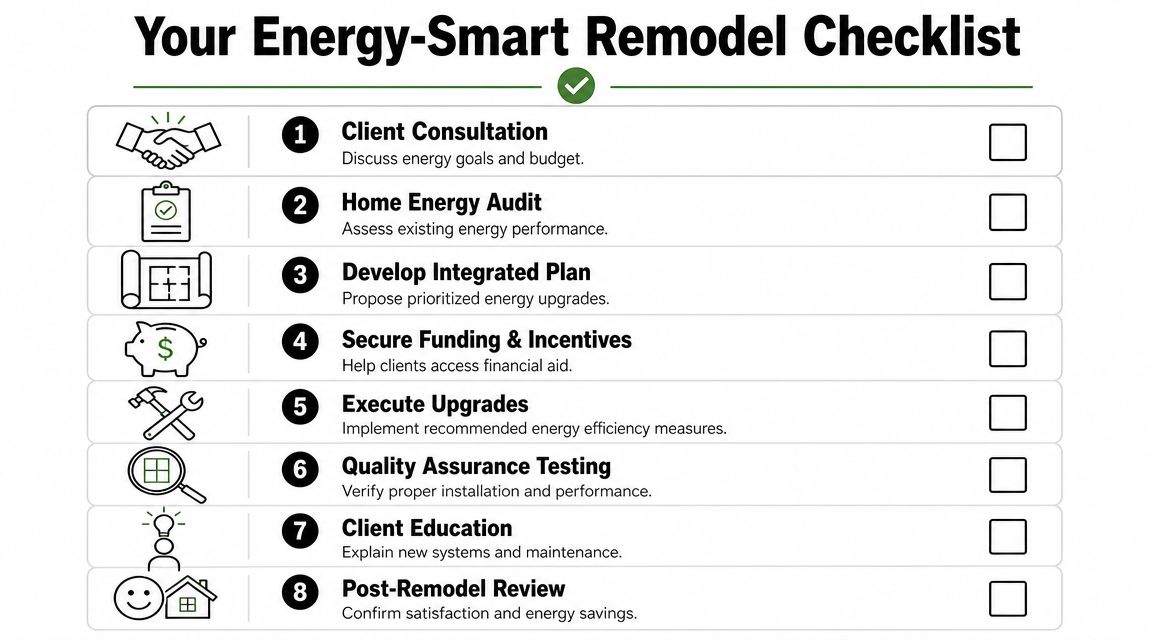
Build the workflow into your process
Start in the first meeting. Ask where the house feels bad. Ask which rooms are uncomfortable. Ask what the utility bills feel like. Ask whether the client plans to stay long term.
Then move through a simple field process:
Consult and diagnose
Tie the remodel wish list to comfort and performance complaints. If they're remodeling a second floor, addition, or older home, treat that as a cue to ask deeper questions.Get an energy assessment
Bring in the right testing and evaluation before final scope lock. Guessing is lazy.Create a phased plan
Split the work into “do now,” “do next,” and “prepare for later.” Clients buy phased logic much faster than they buy contractor brain dump.Coordinate the trades
Insulation crews, HVAC contractors, electricians, and window installers all affect performance. If they work in silos, your result suffers.
Verify the work
Many remodelers lose credibility when they promise performance, then verify nothing.
Close the loop:
- Inspect installation details around penetrations, transitions, and insulation continuity
- Confirm system setup so controls and equipment operate as intended
- Educate the client on how to use the systems they just paid for
- Review the finished project with comfort and performance in mind, not just aesthetics
A pretty project that still feels drafty is a referral killer.
The win isn't finishing the job. The win is delivering a house that feels better the first week the client lives in it.
Positioning Your Firm as the Go-To Efficiency Expert
Most remodelers market features. Better firms market judgment.
If you can explain the house as a system, prioritize upgrades in the right order, and help clients think through incentives and scope, you stop sounding like a commodity contractor. You sound like the person who can lead the project.
Build your authority into every touchpoint
Put this language everywhere clients meet you:
- Website copy should talk about comfort, operating cost, durability, and smarter sequencing
- Sales calls should include your seal-insulate-condition logic
- Project photos should show not just finishes, but the hidden work that makes the remodel perform
- Proposals should present phased options and explain why the order matters
If your website still reads like every other remodeler's site, fix that. A strong digital presence should pre-sell your expertise before the first call. This guide on how to turn your website into your best salesman is worth studying because that's exactly what your site should do.
The payoff is simple. Better clients. Better trust. Bigger scopes. Less price shopping.
Energy efficiency is not a side service. It's one of the clearest ways to prove your firm thinks at a higher level.
If you want more of the right homeowners finding your company online, Constructo Marketing helps remodelers become the obvious choice for larger residential projects. They focus on making contractors “Local Famous” with SEO, Google Ads, conversion-focused websites, CRM automation, and practical coaching built for firms chasing serious growth, not cheap leads.