


Most advice about local seo for contractors is built for cheap leads, not serious remodeling jobs.
You've heard the usual junk. Post more on social media. Write a few blogs. Sprinkle in keywords. Maybe boost a Facebook post and hope a homeowner with a real budget shows up. That's not a system. That's noise.
If you're a high-value remodeler, your buyer behaves differently. They aren't hunting for the cheapest bid. They're looking for a nearby company they can trust with their house, their money, and months of disruption. That decision often starts on Google, not Instagram. Nearly 50% of all Google searches are looking for local information, which is exactly why local search matters so much for contractors serving a defined market, according to Optuno's contractor local SEO breakdown.
That changes the job.
Local SEO isn't about “getting more traffic.” It's about showing up when a homeowner types the kind of search that means they're ready to move. Things like kitchen remodeler in your city, home addition contractor near me, or bathroom renovation company nearby. Those are not browsing searches. Those are shopping searches.
For high-end remodelers, there's another problem most guides ignore. Many of you don't run a public showroom. You're a service-area business. You serve the right neighborhoods, but you don't want your address blasted across the internet. On top of that, Google's AI Overviews can now shove local businesses down the page by answering the question before the searcher even clicks. So the old playbook is getting weaker.
The fix is simple to understand, even if it takes discipline to build. You need to become local famous. Not internet famous. Not viral. Local famous. The company homeowners keep seeing in Maps, in reviews, in project photos, in city pages, and in local partnerships until hiring you feels like the safe choice.
Table of Contents
- Why Most Marketing Advice for Contractors is Wrong
- Your Digital Storefront on Google Maps
- Building Your Website Like a Model Home
- A System for Trust Reviews and Local Mentions
- Show Off Your Work with Local Content and Links
- From Clicks to Contracts The Complete Growth System
Why Most Marketing Advice for Contractors is Wrong
The biggest lie in contractor marketing is that attention equals demand.
It doesn't. A lot of marketing gets you seen by people who were never going to hire you. A funny reel might get views. A boosted post might get likes. None of that means a homeowner is ready to hand you a big remodeling project.
High-value jobs come from intent. The person who searches for a contractor in a specific city is much closer to hiring than the person scrolling photos while waiting in line for coffee. That's why generic “be everywhere” advice wastes time. Contractors don't need more random eyeballs. They need the right searches, in the right towns, tied to the right services.
Cheap attention vs buying intent
Here's the simplest way to think about it.
| Type | What it looks like | What it usually means |
|---|---|---|
| Low-intent attention | Social likes, broad blog traffic, random website visits | People are looking around |
| High-intent demand | Service + city searches, map views, calls, estimate requests | People need a contractor now |
Most agencies sell the first one because it's easy to show charts. Good local seo for contractors focuses on the second one because it leads to jobs.
Practical rule: If a tactic doesn't help you show up for a real service in a real place, it probably won't help you win premium projects.
What actually works
The right local strategy is boring in the best way. It's repeatable. It creates visibility where buyers are already looking. It helps you look established before your salesperson ever picks up the phone.
That means four things matter more than almost everything else:
- Map visibility: Your Google Business Profile has to look alive, accurate, and trustworthy.
- Service pages by location: One generic page won't carry a remodeling company in a competitive market.
- Proof: Reviews, project photos, and detailed job examples beat fluff copy every time.
- Follow-up: If someone calls and nobody answers, your SEO didn't fail. Your process did.
A contractor doesn't need internet magic. You need a clean storefront, a clear message, and a way to catch every lead that comes in.
Your Digital Storefront on Google Maps
If your website is your office, your Google Business Profile is your street sign.
For many homeowners, it's the first thing they see. Before they read your About page. Before they click your portfolio. Before they fill out a form. They see your reviews, your photos, your hours, your category, and the little trust signals that tell them whether you're real.
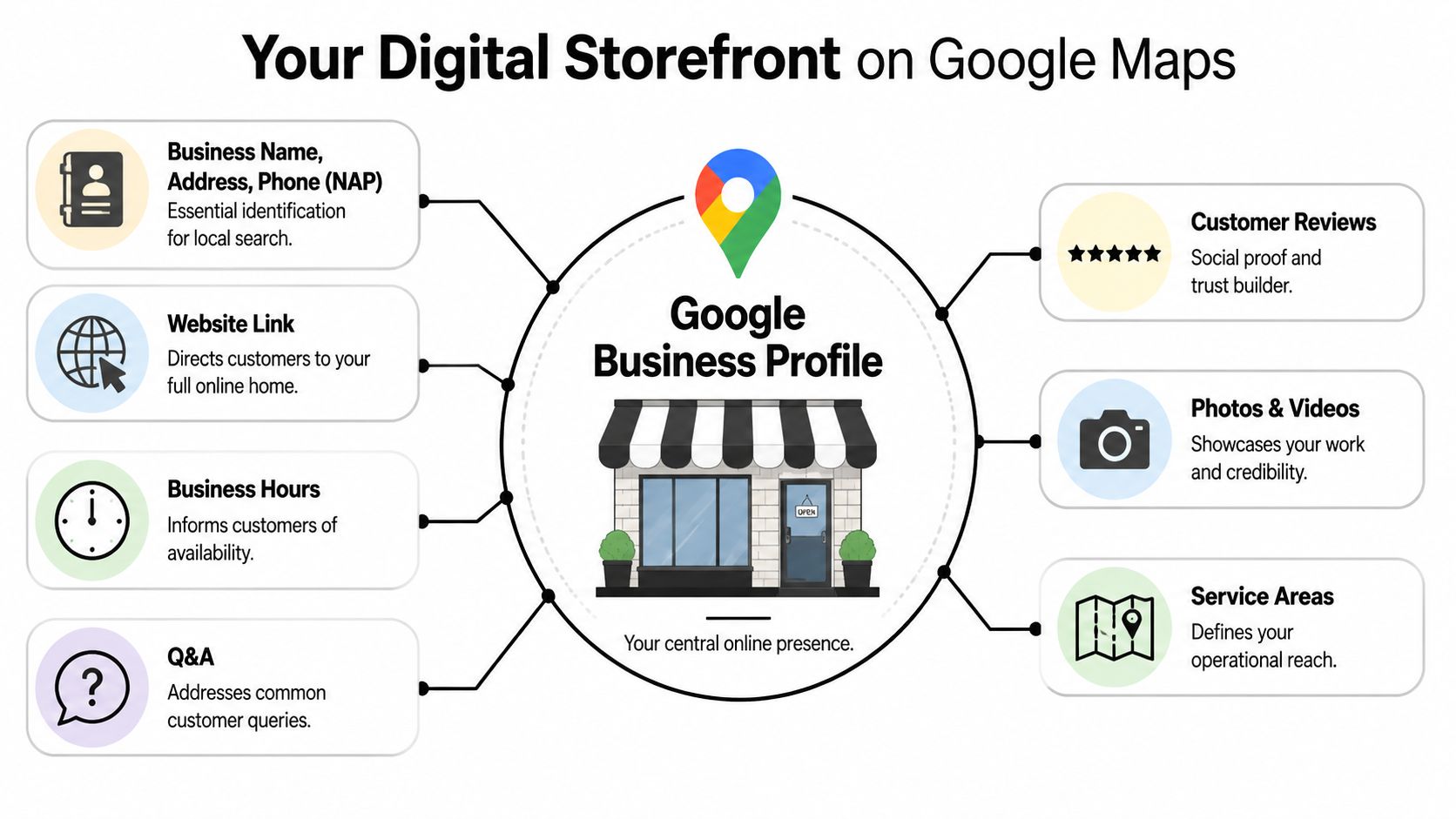
Your Google Business Profile is the front sign
A sloppy profile is like a crooked sign on a muddy lot. People assume the business behind it is sloppy too.
Contractor-focused guidance is clear on one point. Your business name, address, phone number, service areas, and category selection need to match exactly across your Google Business Profile, website, and directories, because inconsistent information can weaken trust and local visibility, as explained by Contractor Growth Network's local SEO guidance.
That sounds technical, but it's not. It's the same idea as giving the lumber yard, the inspector, and the homeowner the same jobsite address. If each one has a different version, somebody shows up at the wrong place and the job gets messy.
If you need a practical setup guide, this Google Business Profile checklist for contractors is a useful reference.
What a strong profile actually needs
A lot of contractors “set up” their profile once and then ignore it. Bad move. Google wants signs that the business is active and real.
Use this checklist:
- Choose the right primary category: Don't get cute. Pick the category that most closely matches the core work you want more of.
- Upload real project photos: Not stock images. Real kitchens, baths, additions, exteriors, crews, and jobsite progress.
- Write a plain-English business description: Say what you do, where you do it, and who you help.
- Set service areas correctly: List the places you serve. Don't pretend you cover half the state if you don't.
- Keep hours accurate: Wrong hours make you look careless.
- Answer questions quickly: The Q&A area can shape trust before a prospect ever calls.
- Update it regularly: Fresh photos, posts, and review activity make the profile feel alive.
The best Google profile doesn't look “optimized.” It looks maintained.
For remodelers chasing bigger jobs, photos matter more than many realize. A homeowner may not understand title tags or citations, but they know the difference between polished custom work and bargain-bin contractor photos. Your profile should make the buyer feel, “These people do the kind of work we want.”
If you're a service-area business without a public showroom, your profile setup needs extra care. I'll deal with that directly in the reviews and citations section, because that's where most contractors get tripped up.
Building Your Website Like a Model Home
Your website should work like a model home. Every room has a purpose. Every hallway leads somewhere. Nothing is there by accident.
Most contractor websites are built like a junk drawer. One services page. A few nice photos. A contact form buried in the footer. That setup doesn't help Google understand what you do, and it doesn't help homeowners feel confident about hiring you.
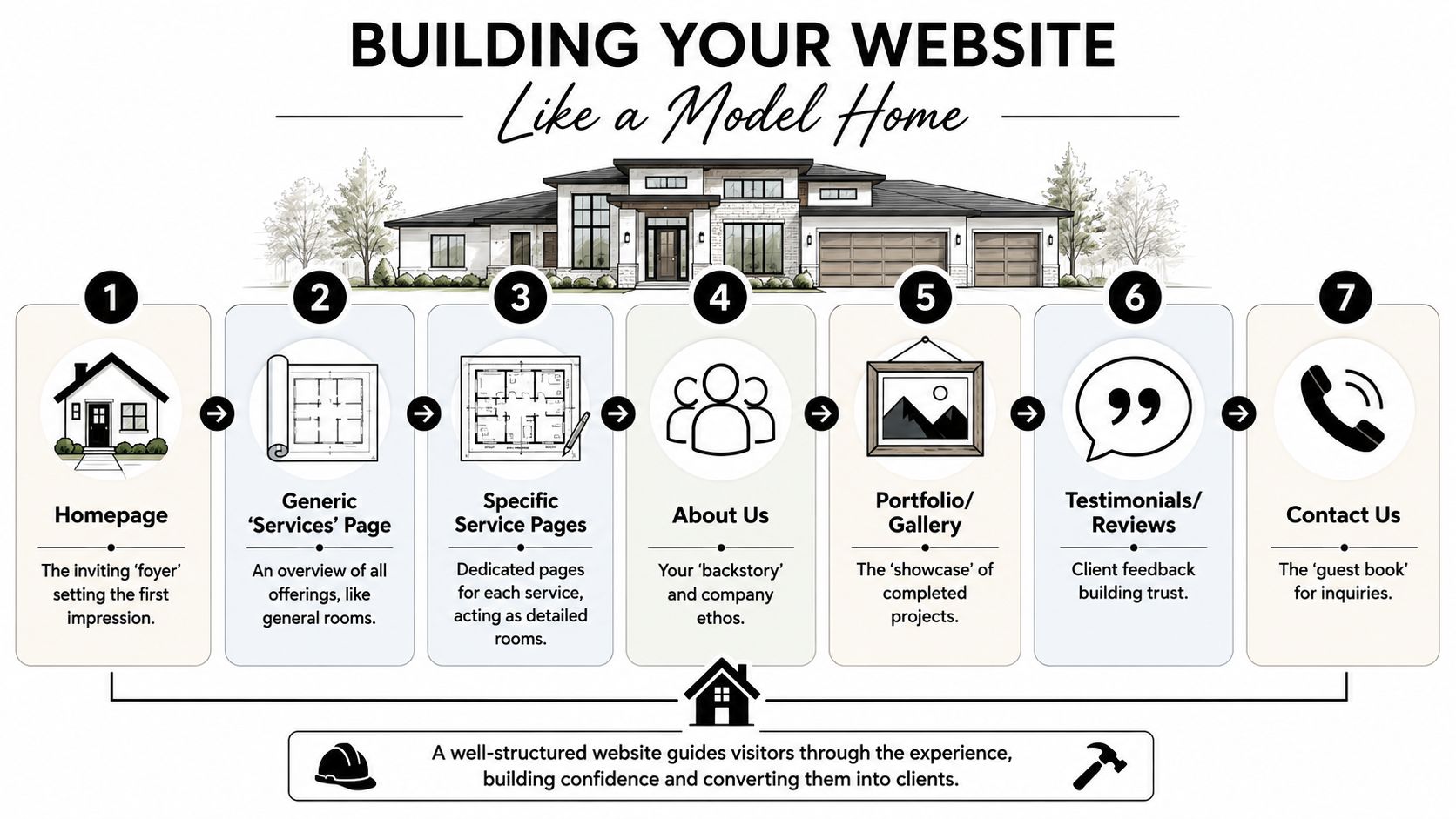
Stop using one catch-all services page
If you want to rank for kitchen remodeling, bathroom remodeling, additions, and whole-home renovations in multiple cities, you can't dump everything on one page and hope Google sorts it out.
Contractor SEO works better when the site is built around high-intent search patterns like service + city, and when schema markup helps search engines understand your business and service intent, according to Gushwork's contractor local SEO guide.
That means your website should have pages like these:
- Kitchen Remodeling in [City]
- Bathroom Remodeling in [City]
- Home Additions in [City]
- Whole Home Remodeling in [City]
- Outdoor Living Contractor in [City]
Each page is like a staged room in a model home. A kitchen buyer wants to walk into the kitchen, not a giant warehouse full of every possible option. Same online.
A smart remodeling site also links pages together in a clean way. Blog posts should point to service pages. Service pages should point to location pages. Project pages should point back to the service they represent. That path helps search engines and humans move through the site without getting lost.
If you're reworking your site structure, this guide on designing a remodeling website that converts visitors into leads can help you think through the layout.
Use simple labels so Google understands the house
Schema markup sounds fancy, but the simplest explanation is this. It's a label maker.
You're putting labels on the parts of your site so Google can understand them more clearly. This is your business name. This is your phone number. This is a review. This is a service. This is a frequently asked question.
That matters because Google's job is sorting information. If your site is clearly labeled, it's easier for Google to match you to the right local search.
Here's what belongs on a high-performing page:
| Page element | Why it matters |
|---|---|
| Clear service headline | Tells visitors and Google what the page is about |
| City mention in natural language | Reinforces local relevance |
| Project photos | Shows proof of craftsmanship |
| Short explanation of process | Reduces buyer anxiety |
| Review snippets | Adds trust at the decision point |
| Click-to-call button | Makes mobile action easy |
| Simple form | Lowers friction |
Build for action, not admiration
A beautiful site that doesn't produce calls is just decoration.
Your pages should push visitors toward a next step. Call. Book. Request a consultation. Start a form. Gushwork's guidance also highlights tracking microconversions like click-to-call and booking starts, which is the right way to think about contractor sites. Don't obsess over traffic alone. Pay attention to actions that signal buying intent.
Your website isn't there to impress other marketers. It's there to move a homeowner one step closer to talking with your team.
One more hard truth. If your homepage does all the talking and your service pages are thin, your site is upside down. The money pages should carry the most weight.
A System for Trust Reviews and Local Mentions
Trust doesn't magically appear because you bought a new logo.
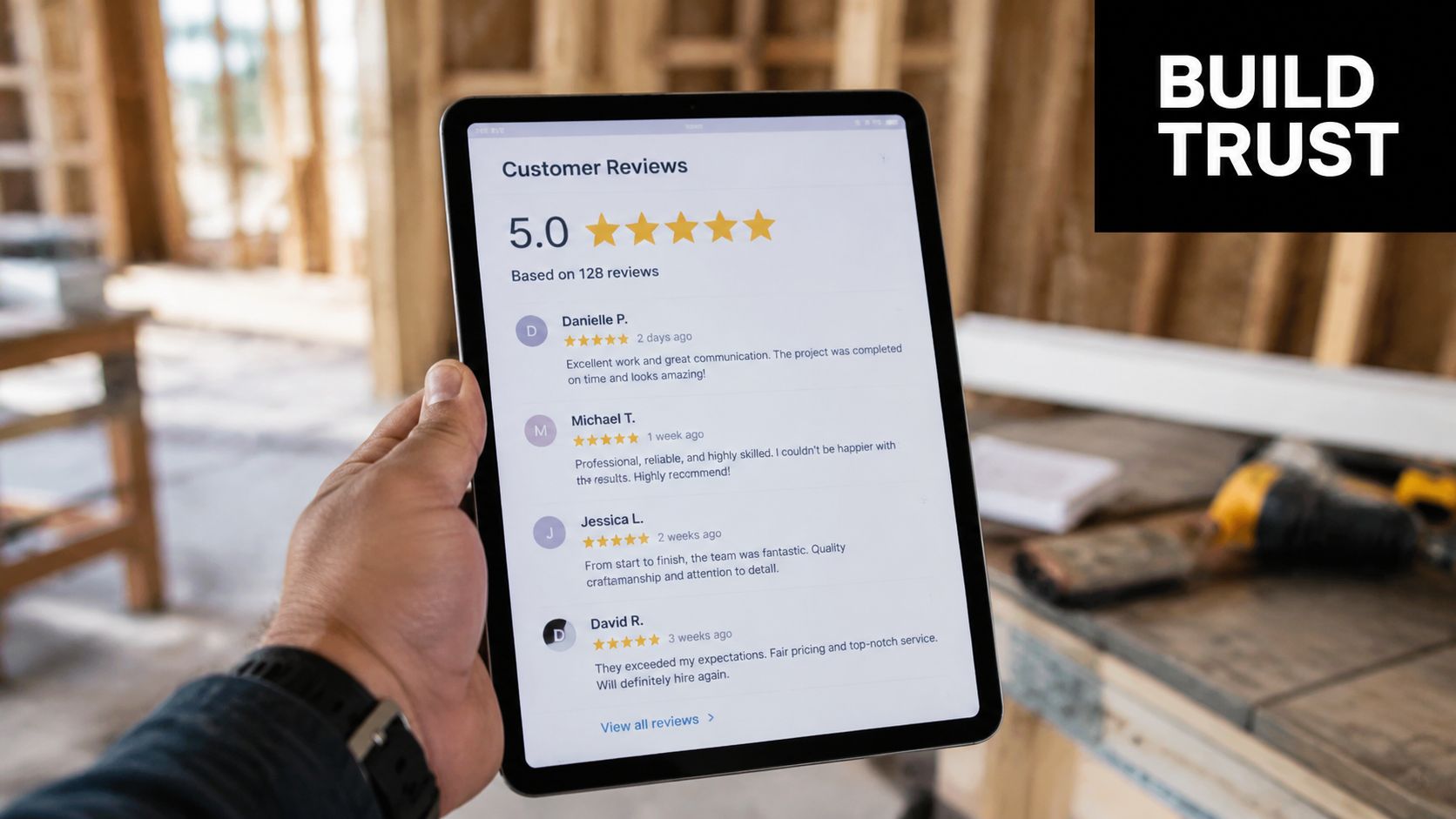
In local search, trust is built from two things homeowners can see. First, your business shows up consistently across the web. Second, past clients say good things about working with you. That's citations and reviews. Together, they tell Google and the homeowner the same thing. This contractor is real.
Citations are your digital phone book entries
A citation is just a business listing. Yelp. Houzz. Angi. Local chambers. Industry directories. Think of them like modern phone books.
The important part is consistency. Your business details should match across those platforms. Same business name. Same phone. Same website. Same service area details.
When these listings are messy, you create confusion. When they line up, you build confidence.
A clean citation setup usually includes:
- Core directories: Google, Yelp, Houzz, Angi, and major local listings relevant to your market.
- Industry fit: If you specialize in design-build remodeling, your listings should reflect that, not vague handyman language.
- Matching details: Don't let one site show Suite A, another show Ste A, and another show no suite at all if you can avoid it.
The service-area business problem nobody explains well
Generic advice struggles.
Many remodelers are service-area businesses. They don't want a public address on every directory listing. That's understandable. But when your address is hidden, directories can get suspicious or incomplete, and that can create ranking problems.
Moz has noted that many local SEO guides fail to explain how service-area businesses that hide their address maintain consistency across directories, and that listings without a public address can trigger a verification shadow that harms local rankings, as discussed on Moz.
That doesn't mean you should start guessing. It means you need a clear policy and you need to apply it the same way everywhere you can.
Use common sense:
- Decide your official business details once: Name, phone, website, service area wording, and category.
- Use the same format everywhere: Don't improvise from one directory to the next.
- Follow each platform's rules: Some directories handle service-area businesses better than others.
- Avoid fake offices: A made-up location can create bigger problems than a hidden one.
If you operate without a showroom, the goal is simple. Be consistent enough to look legitimate without exposing more than you need to.
Reviews should be a process not a favor
Most contractors ask for reviews when they remember. That's too random.
You need a repeatable review system. Ask every happy client at the right moment, in the same way, every time. Usually that means once the project is complete, the punch list is wrapped, and the client is feeling relief and pride.
A workable review system looks like this:
- Pick the trigger: Final walkthrough, project completion, or first big reveal.
- Send the request fast: The longer you wait, the lower your odds.
- Make it easy: One direct review link. No scavenger hunt.
- Coach your team: PMs and designers should know when and how to ask.
- Reply to reviews: A thoughtful response shows you're paying attention.
If you want a deeper look at the connection between reputation and visibility, this article on whether Google reviews help SEO is worth reading.
A review request system should feel like cleanup at the end of a job. It happens every time because that's part of finishing well.
Show Off Your Work with Local Content and Links
Most contractors hear “content marketing” and think of boring blog posts nobody reads.
That's the wrong picture. Your best content is the work itself.
Your best content is finished projects
Every completed job can become a local SEO asset if you package it the right way. Not with fluffy marketing copy. With proof.
Turn one remodel into multiple pieces of content:
- A project page: Show the city, the scope, the photos, and the homeowner problem you solved.
- A before-and-after gallery: Let the work do the talking.
- A short write-up: Explain what changed, what mattered, and what made the project special.
- A service connection: Link that project back to the service page it supports.
- A local angle: Mention the neighborhood or market naturally when relevant.
That kind of content helps in two ways. Homeowners get confidence. Search engines get context.
If you do high-end outdoor work, local materials and design references also matter. For example, a resource like Paving Supplies outdoor tile options can help inspire content around patio upgrades, pool surrounds, or outdoor kitchen finishes when you're building out outdoor living pages.
Local links work like referrals
A backlink is just a referral in website form.
When a local architect, interior designer, cabinet maker, or material supplier links to your site, that sends a strong trust signal. It's the digital version of someone respected in town saying, “Yes, these are good people.”
You don't need weird link schemes. You need real relationships turned into visible mentions.
Good local link opportunities often come from:
- Trade partners: Designers, suppliers, fabricators, and specialty subcontractors.
- Community groups: Chambers, local events, neighborhood organizations.
- Project features: A partner highlights a finished job and links to your case study.
- Vendor pages: Some manufacturers or suppliers list trusted installers or local pros.
Results from local SEO usually start showing up in 3 to 6 months, which is why this channel should be treated as a medium-term system, not an instant fix, according to GoMarketing's guide for home service contractors.
That timeline is healthy. It forces patience and consistency. The contractors who win aren't always the loudest. They're the ones who keep publishing proof, collecting mentions, and making each project pull double duty as both delivery and marketing.
From Clicks to Contracts The Complete Growth System
Contractors do not need more clicks. They need more signed remodeling jobs from homeowners who can afford the work.
That sounds obvious, but plenty of marketing plans still stop at rankings, traffic, and form fills. For a high-value remodeler, those are only early signals. The true test is simple. Did the right homeowner reach out, get a fast response, book a consultation, and move toward a contract?
Traffic is not the goal
The goal is booked consultations with serious local homeowners.
For service-area remodelers, that matters even more. You may not have a public showroom. You may work by appointment only. You may serve several towns without having a storefront in each one. So your online presence has to do the job your physical location cannot. It has to prove you belong in the markets you want and make it easy for people to contact you.
That means your marketing and sales process have to work as one system. Google search creates the opportunity. Your website and Google Business Profile turn that attention into calls and forms. Then your team has to answer, qualify, and keep the lead moving before the homeowner calls the next contractor.
Here's the basic growth stack:
| Stage | What needs to happen |
|---|---|
| Search visibility | You appear for local, high-intent searches tied to the services and towns you want |
| Conversion | The homeowner calls, fills out a form, or requests a consultation |
| Follow-up | Your team responds fast, confirms fit, and keeps the conversation moving |
| Sales process | The lead gets qualified, scheduled, and advanced toward a signed contract |
Weak follow-up kills expensive leads. A missed call from a whole-home remodel prospect is not a small mistake. It is a revenue leak.
The AI Overview problem changes the game
Google's AI Overviews are a problem for remodelers because they can answer broad questions before a homeowner ever reaches the map pack or your website. That hurts contractors with thin service pages, vague copy, and no local proof.
The fix is not more generic SEO busywork. The fix is better evidence.
Publish detailed project pages with scope, location, budget range, materials, and before-and-after photos. Build service pages that speak to how people buy remodeling services in your market. Show reviews that mention the type of work and the towns you serve. Keep your business data consistent. Give Google and homeowners something specific to trust.
A combined system also becomes critical here. SEO builds long-term local visibility. Paid search can cover the gaps while organic rankings mature. A CRM keeps leads from going cold after the first call or form submission. For remodelers who want those pieces connected, Constructo Marketing offers contractor-focused local SEO, Google Ads, websites, and CRM automation in one system.
What to track every week
Do not stare at traffic charts and call that management.
Track the points where money is won or lost:
- Calls from Google Business Profile: Are map views turning into real conversations?
- Form submissions by service page: Which pages attract serious prospects instead of tire-kickers?
- Booked appointments: How many inquiries become actual consultations?
- Missed calls: How many opportunities died because nobody answered?
- Close rate by lead source: Which channel brings the best-fit remodeling projects?
- Review velocity: Are new trust signals still showing up consistently?
If you cannot trace a lead from search to signed contract, your marketing system is incomplete.
For high-end remodelers, this is how you become local famous. Not by chasing vanity metrics. By showing up in the right towns, earning trust fast, and running a tight intake process when the homeowner reaches out.
If you want help building that system, Constructo Marketing works with remodelers that need local SEO, Google Ads, conversion-focused websites, and CRM follow-up tied together so more qualified homeowners turn into booked consultations and signed projects.