


You're good at remodeling. Your crews know how to solve ugly structural problems, calm nervous homeowners, and turn rough sketches into beautiful finished spaces. But your lead flow still feels like a roller coaster. One month it's referrals and easy wins. The next month the phone goes quiet, some marketing rep promises magic, and you end up paying for clicks from people who want a cheap repair instead of a real remodeling project.
That doesn't mean your business is weak. It usually means your advertising home improvement system is sloppy, incomplete, or aimed at the wrong job.
A lot of contractors treat advertising like a scratch-off ticket. Run some Google Ads. Boost a Facebook post. Maybe buy leads. Then hope. That's backwards. Advertising should work more like a build schedule. You need a plan, the right materials, a clean handoff, and a final inspection. If one part is bad, the whole thing feels bad.
Table of Contents
- Your Advertising Is Broken Not Your Business
- Start with Your Marketing Blueprint
- Choosing the Right Tools for the Job
- How to Budget for High-Value Projects
- Crafting Ads That Homeowners Actually Trust
- Turning Clicks Into Contracts with a Simple System
- The Final Walkthrough for Your Advertising
Your Advertising Is Broken Not Your Business
I've seen this pattern over and over. A remodeler does clean work, has happy clients, and gets praised on every job site. But the pipeline still depends on word of mouth, and word of mouth is moody. It shows up when it wants to.
Then the owner tries ads. The agency sends reports full of impressions, clicks, and jargon. Meanwhile, the leads are junk, the phone team misses inquiries, and the owner starts thinking, “Maybe advertising just doesn't work for my kind of business.”
That's the wrong diagnosis.
The market is there. The U.S. home improvement advertising market is projected at $9.2 billion in 2024, and digital channels like online video and search are growing 3.1% year over year while traditional media shrinks, according to BIA's home improvement advertising report. That tells you two things. First, homeowners are still spending attention and money in this category. Second, the fight has moved online.
Practical rule: If your sales process depends on referrals alone, you don't have a system. You have leftovers from past jobs.
Think of advertising like framing a house. If the walls are out of square, the cabinets, trim, and tile all fight you later. Marketing works the same way. If you target the wrong homeowner, use the wrong channels, or send traffic to a generic site, every dollar after that gets harder to earn back.
The fix isn't more hustle. It's a better build.
A reliable advertising home improvement system has four parts. A clear blueprint. The right tools. Trust-building creative. A follow-up process that catches every lead. When those pieces line up, marketing stops feeling like gambling and starts acting like a pipeline.
Start with Your Marketing Blueprint
Before you swing a hammer, you look at plans. Advertising deserves the same respect. Most wasted ad spend happens because the owner skipped the blueprint and jumped straight to buying traffic.
Define the project before you spend a dollar
Start with the kind of work you want. Not “home improvement.” Not “general remodeling.” Be specific. Kitchen remodels. Bathroom remodels. Additions. Outdoor living. Full design-build renovations. If you want higher-ticket projects, say that clearly and build your plan around it.
Then define the homeowner. Simple questions work best:
- Where do they live: Which towns, zip codes, or neighborhoods fit your service area and price point?
- What do they care about: Speed, craftsmanship, design help, communication, cleanliness, financing, or one point of contact?
- What do they fear: Getting ghosted, change-order chaos, budget creep, delays, and crews tearing up the house.
Next, define the business goal. Don't say “get more leads.” That's lazy. Say, “I want more consultations for kitchens and primary baths in the areas where we already have crews.” That gives your ad platform a real target.
If you need help organizing the strategy before launching campaigns, this guide on marketing strategy for construction business is a useful starting point. It helps connect positioning, service mix, and lead generation so your ads aren't running without direction.
A bad blueprint doesn't get fixed by better tools.
Write the plain-English offer
A lot of contractors hide behind vague lines like “quality work” or “trusted service.” Homeowners scroll right past that. Your offer should sound like something a real person would say at the kitchen table.
Try this format:
Who you help
Homeowners planning a major kitchen, bath, or whole-home remodel.What you do
Design-build remodeling with one team managing planning, construction, and communication.Why they should care
Fewer surprises, clearer timelines, cleaner job sites, and a finished space that looks like the photos they saved.
For local visibility work, AI-assisted tools can also support content planning, business profile optimization, and neighborhood targeting. A practical overview is available in AI Tools for Local SEO, especially if you're trying to simplify the tech side without turning into a full-time marketer.
If your blueprint is weak, every ad after that leaks money. If your blueprint is sharp, the rest gets much easier.
Choosing the Right Tools for the Job
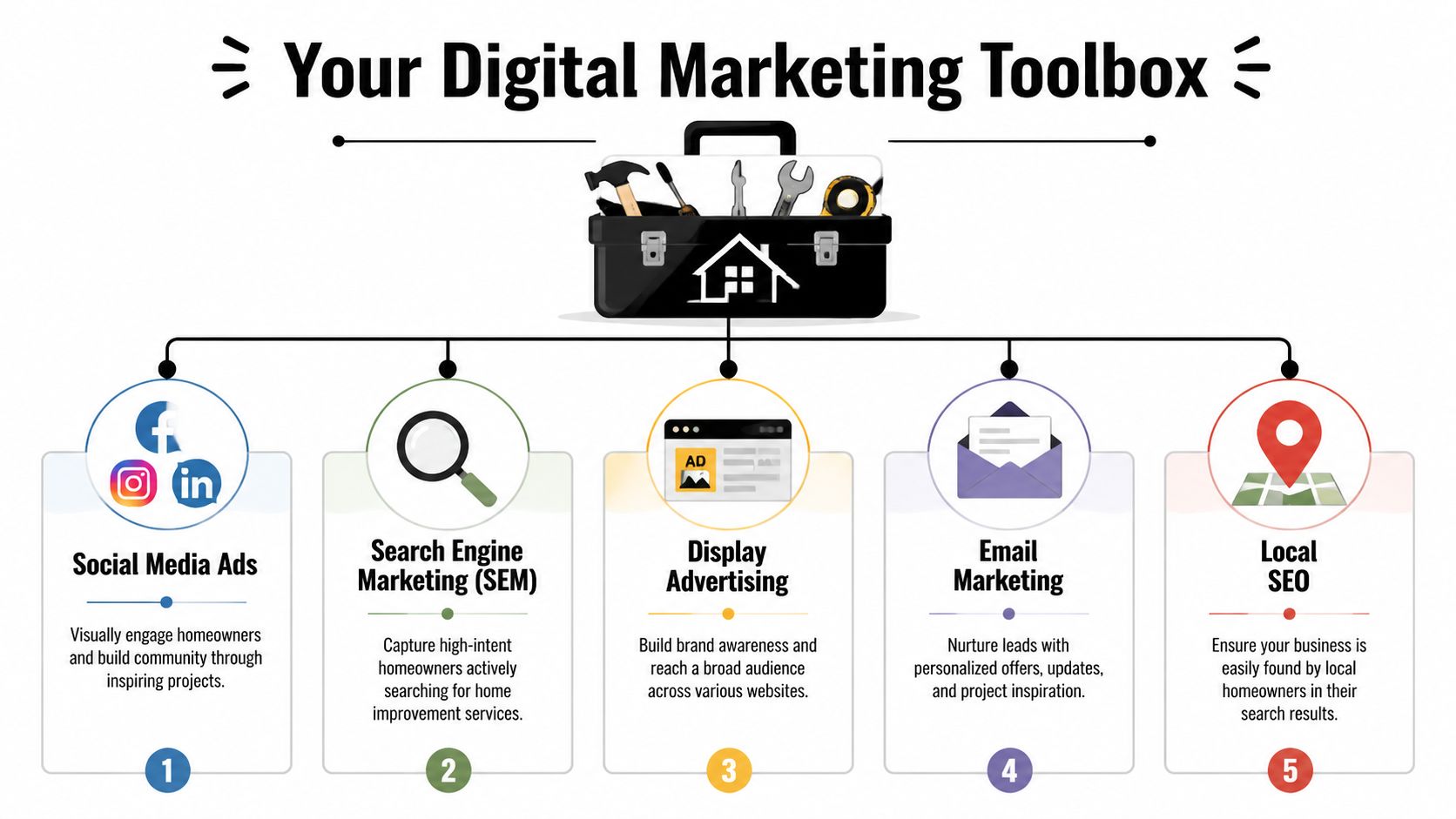
A good contractor doesn't use a framing nailer for finish trim. Advertising works the same way. Each channel has a job. The mistake is treating every platform like it should do everything.
Your permanent sign on Main Street
Your Google Business Profile and Local SEO are your permanent sign on Main Street. They help nearby homeowners find you when they search for the exact service they need. This isn't flashy. It's foundational.
When someone types “kitchen remodeler near me” or “home addition contractor,” your map presence, reviews, service pages, and local relevance do the heavy lifting. If those assets are weak, paid traffic gets more expensive because homeowners don't trust what they find after they click.
Local SEO also helps every other channel. When a homeowner sees your ad, then checks your reviews and map listing, your credibility either rises or falls right there.
Your megaphone and your showroom
Google Ads are your megaphone. You use them when you want to show up the second someone asks for help. For high-intent searches, that matters a lot.
One option deserves special attention. Google Local Services Ads can achieve a 31% lead-to-customer conversion rate, nearly three times higher than the typical 10% to 12% seen on standard Google Search ads, according to this Google Ads setup guide for home improvement companies. If you're chasing serious local intent, LSAs should usually be one of the first tools you test.
Social media ads are different. They're your digital showroom. Homeowners aren't always ready to call when they're scrolling Instagram or Facebook, but they are judging taste, quality, and professionalism. Strong before-and-after photos, short project videos, and simple educational content help them remember you when the project becomes real.
Use paid social to stay visible in your service area and to warm up homeowners who are still collecting ideas. Use search when they've moved from dreaming to shopping.
Your follow-up machine
Remarketing and CRM-backed follow-up are what keep leads from leaking out of the bucket. Most homeowners don't hire the first company they notice. They visit a site, leave, compare, ask a spouse, get busy, then come back later.
That's why retargeting matters. It puts your brand back in front of people who already showed interest. And that's why a CRM matters even more. If someone calls after hours, fills out a form, or asks about a consultation, you need a system that tracks it and triggers the next action.
If you're sorting out that operational side, this overview of CRM software for builders is worth reading. It explains how builders use automation, lead tracking, and follow-up to keep opportunities organized instead of buried in texts, missed calls, and sticky notes.
Here's the simple toolbox view:
- Local SEO: Builds long-term visibility where homeowners already search.
- Google Ads and LSAs: Capture active demand right now.
- Social ads: Show the quality of your work and keep your brand in the neighborhood.
- Remarketing: Follows up with people who didn't decide the first time.
- CRM automation: Makes sure your team responds like professionals every time.
You don't need every tool on day one. You do need the right ones for the job you're trying to win.
How to Budget for High-Value Projects
Most budgeting advice for contractors is nonsense. “Spend a percentage of revenue” sounds neat, but it ignores the kind of work you want, the market you serve, and how your sales process works.
For higher-value remodeling, budget from the goal backward.
The broader market is large enough to justify a serious plan. The home renovation market is projected to reach $593.8 billion in 2025, and 48% of homeowners are planning projects with a median spend of $15,000, based on these home improvement marketing statistics. That doesn't mean every lead is worth chasing. It means there is real demand, and you need a multi-channel budget that matches your target jobs.
Stop guessing and work backward
Think like an estimator.
If you want one additional high-value project, ask:
- What type of project do I want more of
- How many qualified consultations do I usually need to close one
- What am I willing to pay for a qualified lead
- What support pieces need funding too, like photography, landing pages, CRM follow-up, and review generation
This method changes the conversation. Advertising stops being “money I hope comes back” and becomes “money assigned to a specific production goal.”
Don't budget like you're buying lottery tickets. Budget like you're buying opportunities to bid the right jobs.
A simple way to think about it is this. Revenue goal first. Lead need second. Channel mix third. If Google Ads brings in demand now but local SEO builds future demand, both can deserve budget. They just serve different stages of the pipeline.
Sample marketing budget to land one 100K project
| Metric | Your Numbers (Example) | Calculation |
|---|---|---|
| Target project value | $100K project | Start with the type of job you want |
| Close rate from qualified consultations | Use your real numbers | Count past consultations versus signed jobs |
| Qualified leads needed | Based on your close rate | Work backward from one signed contract |
| Cost per qualified lead | Use channel averages from your own data | Divide spend by qualified leads |
| Landing page and creative support | Monthly fixed cost | Add page design, photos, video, and copy |
| CRM and follow-up tools | Monthly fixed cost | Add software and automation cost |
| Total campaign budget | Lead cost + support cost | This becomes your working budget |
That table is basic on purpose. It should fit on a whiteboard. If you can't explain your budget in plain English, it's too complicated to manage.
The main point is simple. Tie spend to a specific project target. Then review the pipeline often enough to see if the math still makes sense.
Crafting Ads That Homeowners Actually Trust
Most contractor ads look the same. A logo. A truck. A stock kitchen. Some generic line about quality and service. That kind of ad doesn't win serious remodeling work. It blends into the noise.
For high-value jobs, your ad is a model home. It should let the homeowner feel your standards before they ever talk to you.

Your ad is a model home
Homeowners hiring for a major remodel aren't just buying labor. They're buying confidence. They want to know your team won't wreck the house, disappear for days, or hand them a surprise bill after demolition.
So stop writing ads that sound like every other shop in town.
Use real project photos. Use real spaces. Show your finish quality, layout improvements, storage solutions, tile work, lighting, cabinetry, and trim details. If you have video, even better. A short walkthrough from a completed project often says more than a paragraph of ad copy.
Then write copy like a calm professional, not a discount flyer. Speak to the pains homeowners feel:
- Mess and disruption: Explain how you protect the home and communicate schedules.
- Fear of bad communication: Show that one team manages updates and next steps.
- Uncertainty about quality: Highlight the craftsmanship visible in your portfolio.
- Decision fatigue: Make your process easy to understand.
What homeowners need to see
Trust comes from proof, not slogans.
A strong ad usually includes:
- Finished work they can picture in their own home
- A simple promise they understand
- A clear next step, such as book a consultation or request a project review
- Reviews and reputation signals
If you're building review strength to support your ads, this article on whether Google reviews help SEO is useful. Reviews don't just help ranking. They help a nervous homeowner feel safer contacting you.
Show craftsmanship first. Explain process second. Ask for the call third.
Offline events can help too, especially if you're meeting homeowners at expos or community events. If you use branded handouts or booth items, this roundup of best giveaways at trade shows can help you choose something people will keep instead of toss in the first trash can they see.
One more thing. Don't lean on gimmicks unless your market already expects them. Serious remodeling clients usually respond better to professionalism, clarity, and visible quality than to cheap offers and loud promotions.
Turning Clicks Into Contracts with a Simple System
A lead is not a sale. It's a hand raised in a noisy room. If you don't respond fast, answer clearly, and guide the next step, that hand drops and hires someone else.
That's why so many ad campaigns “fail” even when the traffic was fine. The problem isn't always the ad. Sometimes the handoff is broken.
Build a landing page for one job
If you run Google Ads, don't dump traffic onto your homepage and hope people figure it out. That's like sending a homeowner to a warehouse and saying, “Somewhere in here is the kitchen display you asked about.”
A dedicated landing page fixes that. Using a dedicated, relevant landing page for Google Ads can boost conversion rates by 25% to 50%, and sending ad traffic to a generic homepage often wastes 30% to 40% of the ad budget due to high bounce rates, according to this guide on Google Ads mistakes for home improvement contractors.
The page should match the ad exactly. If the ad says “Bathroom Remodels in [City],” the page should say the same thing and show bathroom work in that market. Not kitchens. Not roofing. Not your entire company history.
A good landing page has:
- One service focus
- One market focus
- One clear call to action
- Real project visuals
- Trust signals, such as reviews, awards, or process clarity
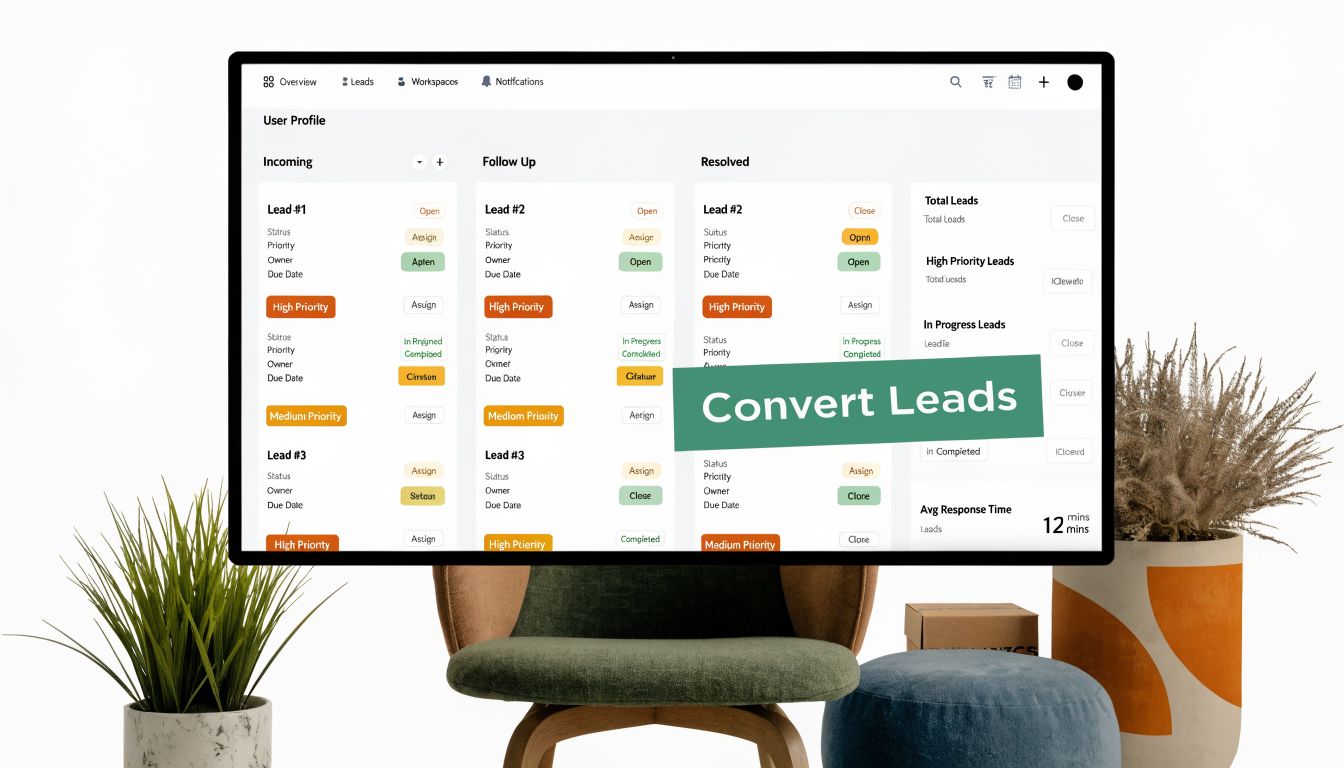
Use a CRM like a project manager
Your CRM is the project manager for your leads. It makes sure nothing gets forgotten, delayed, or dropped.
This doesn't need to be fancy. It needs to be consistent.
When someone calls and nobody answers, the system should text back. When someone fills out a form, the system should send a confirmation and assign follow-up. When someone books a consultation, the system should remind them. When someone goes cold, the system should re-engage them.
One practical setup some remodelers use is a combined stack of Google Ads, landing pages, and a CRM platform such as GoHighLevel. Constructo Marketing offers that kind of integrated setup for remodelers, including lead tracking and automated follow-up inside one system.
Keep the workflow simple:
- Lead comes in
- System acknowledges it fast
- Team qualifies the project
- Consultation gets booked
- Follow-up continues until the homeowner decides
The contractor who follows up clearly and consistently often beats the contractor with the prettier ad.
That's not glamorous. It is profitable.
The Final Walkthrough for Your Advertising
Every remodel ends with a walkthrough. You inspect the details, fix the misses, and make sure the finished product matches the promise. Your advertising needs the same discipline.
Too many owners look at likes, clicks, or raw lead counts and think they're measuring performance. They're not. Those are activity metrics. You need business metrics.
Use a punch list not vanity metrics
Focus on the numbers that tell you whether the system is helping the company.
Track things like:
Qualified leads
Not every inquiry matters. Count the ones that fit your service area, budget, and project type.Consultations booked
This shows whether your team and follow-up process are turning interest into real sales conversations.Show rates
If people book and disappear, your confirmation process is weak.Signed contracts
This is the score that matters most.Cost per qualified lead and cost per signed job
These tell you if your channels are healthy or bloated.
You don't need a giant dashboard to start. A simple weekly review works if you're honest about what happened.
Keep what works and cut what doesn't
If one campaign brings the right kind of homeowner, keep feeding it. If another brings time-wasters, shut it down or tighten the targeting. If a page gets traffic but no calls, fix the message or the layout. If leads come in but nobody follows up fast, that's an operations issue, not an advertising issue.
Look for cause and effect. Bad lead quality can come from broad targeting. Weak close rates can come from poor qualification. Missed calls can make a good campaign look bad. The point is to inspect the whole chain, not blame the first visible piece.
A clean advertising home improvement system should answer five questions every month:
- Which channel brought qualified homeowners
- Which message got them to respond
- Which pages converted them
- How quickly did your team follow up
- How many signed jobs came from that spend
That's your final walkthrough. Tighten the screws. Replace the weak parts. Keep improving the build.
If you want help building a cleaner lead system for high-ticket remodeling work, Constructo Marketing works with remodelers on Local SEO, Google Ads, websites, and CRM follow-up built for qualified local demand. If your current marketing feels random, they can help turn it into a system you can manage.