


You’re probably getting leads right now. The problem is they’re the wrong leads.
One person wants a “small update” and has a tiny budget. Another wants a full kitchen but disappears after asking for a ballpark. A third lives an hour outside your service area and expects luxury work at bargain pricing. Your pipeline looks busy, but your estimator is wasting time, your sales process gets clogged, and the jobs you want keep slipping by.
That’s where demographic geographic psychographic and behavioral segmentation stops being marketing jargon and starts becoming a filter. It's like sorting a pile of mixed jobsite material. If you don’t separate what matters, you can’t build efficiently. Same with leads.
If you want more $75K to $300K remodeling projects, you need a better way to decide who to target, where to show up, what message to use, and which leads deserve fast follow-up. If you’re also looking at broader high-conversion lead systems for contractors, that’s smart. Just don’t bolt lead generation onto a sloppy targeting strategy and expect good jobs to appear.
A lot of remodelers make the same targeting mistakes that drain budget and time. This breakdown of costly marketing mistakes remodelers keep making is worth reviewing if your current marketing feels noisy but inconsistent.
Table of Contents
- Stop Attracting the Wrong Remodeling Clients
- The Four Buckets for Sorting Your Best Customers
- Who They Are and Where They Live Demographics & Geographics
- Why They Remodel and How They Act Psychographics & Behaviors
- An Action Plan for Google Ads SEO and Your CRM
- Your Remodeling Segmentation Starter Checklist
- From Guessing About Leads to Predictable Growth
Stop Attracting the Wrong Remodeling Clients
A remodeler I’d worry about isn’t the one with no leads. It’s the one with a calendar full of bad appointments.
He’s driving to houses that don’t fit his price point. He’s writing estimates for people who were never going to buy. He’s answering “just curious” form fills while the serious homeowner in the right neighborhood hires someone else because the follow-up was slow. That business owner isn’t losing because of craftsmanship. He’s losing because his marketing is aimed at everybody.

The fix isn’t more random ad spend. It’s better sorting.
You need four buckets. Demographic tells you who the homeowner is. Geographic tells you where they live. Psychographic tells you why this project matters to them. Behavioral tells you what they’re doing right now that signals intent.
Practical rule: If your marketing can’t separate a tire-kicker from a serious homeowner, your pipeline will stay noisy.
Most remodelers already use pieces of this without realizing it. They know certain neighborhoods produce better projects. They know some homeowners care about legacy and design, while others only ask about price. They know the lead who studies the gallery, reads service pages, and replies quickly is different from the one who sends one vague message at midnight and vanishes.
The mistake is leaving that knowledge in your head instead of building it into your website, ads, and follow-up process.
The Four Buckets for Sorting Your Best Customers
Think like a builder not a textbook
You don’t need a marketing degree to use segmentation. You need a clean way to organize customer information so you can make better decisions.
Imagine a toolbox. You don’t throw a framing nailer, level, and trim saw into one pile and hope for the best. You sort tools by what they do. Customer data works the same way. If you dump everything into one bucket, you get muddy marketing.
This infographic makes the idea simple.
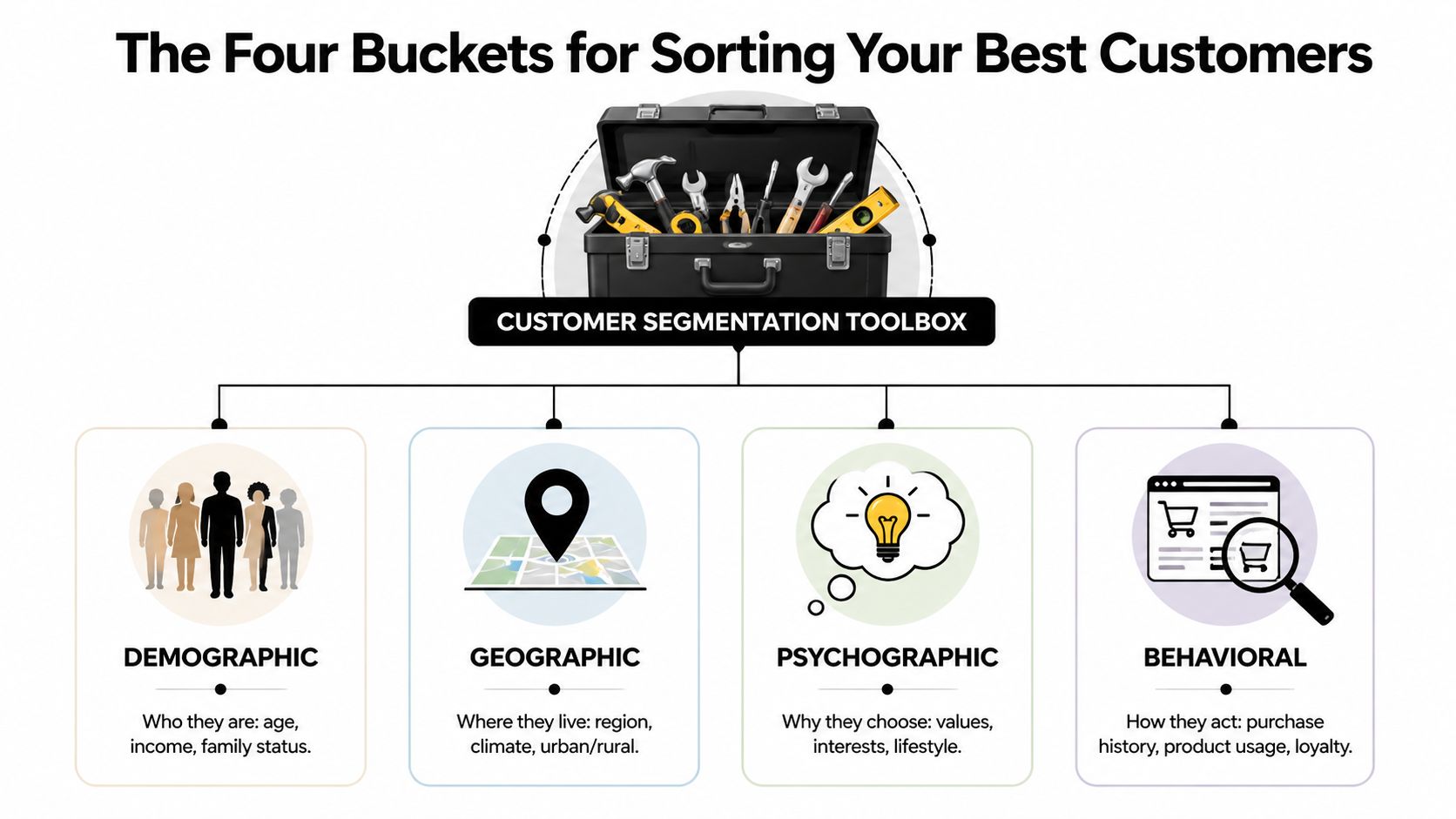
Here’s the plain-English version:
- Demographic means basic facts about the customer. Age, income, family stage, homeowner status.
- Geographic means location. ZIP code, neighborhood, suburb, city edge, climate, even lot style.
- Psychographic means internal drivers. What they care about, how they want to live, what kind of result feels worth paying for.
- Behavioral means actions. Searches, page visits, form fills, repeat visits, missed calls, and reply patterns.
One bucket doesn’t beat the others. They work together.
A homeowner can look perfect on demographics and geography, then still be a bad fit if their behavior shows weak intent. Another can come from the right area and browse the right pages, but you won’t close them if your message doesn’t match their values.
The simple table you should use
| Segmentation Type | What It Tells You (The Simple Version) | Example for a High-End Remodeler |
|---|---|---|
| Demographic | Who they are | Homeowner, later-career professional, strong household income, established family stage |
| Geographic | Where they live | Affluent suburb, older home neighborhood, high-value ZIP code, serviceable radius |
| Psychographic | Why they choose | Wants a forever home, cares about craftsmanship, loves entertaining, values design and legacy |
| Behavioral | How they act | Searches for local remodelers, visits kitchen portfolio pages, downloads a guide, responds to follow-up |
Use the table like a pre-qualifying lens. If a lead matches only one bucket, stay cautious. If they match all four, move fast.
The biggest miss I see is remodelers stopping at demographics. They say, “Our client is homeowners with money.” That’s not wrong. It’s just lazy. It doesn’t tell you which neighborhood pages to build, what ad copy to write, or which CRM triggers should fire when a lead visits your additions portfolio twice.
When you sort customers the right way, your message gets sharper. Your sales team wastes less time. Your marketing starts attracting better-fit homeowners instead of just generating names.
Who They Are and Where They Live Demographics & Geographics
A homeowner in your city searches “kitchen remodeler near me.” They have a nice house, decent income, and live 40 minutes outside your real service area. Another lead lives in the exact neighborhood where you’ve already closed three six-figure projects this year. Treat those two leads the same, and you waste budget, sales time, and follow-up.
Demographics and geographics fix that fast. They give you the first hard filters for deciding who belongs in your pipeline and which neighborhoods deserve your attention.
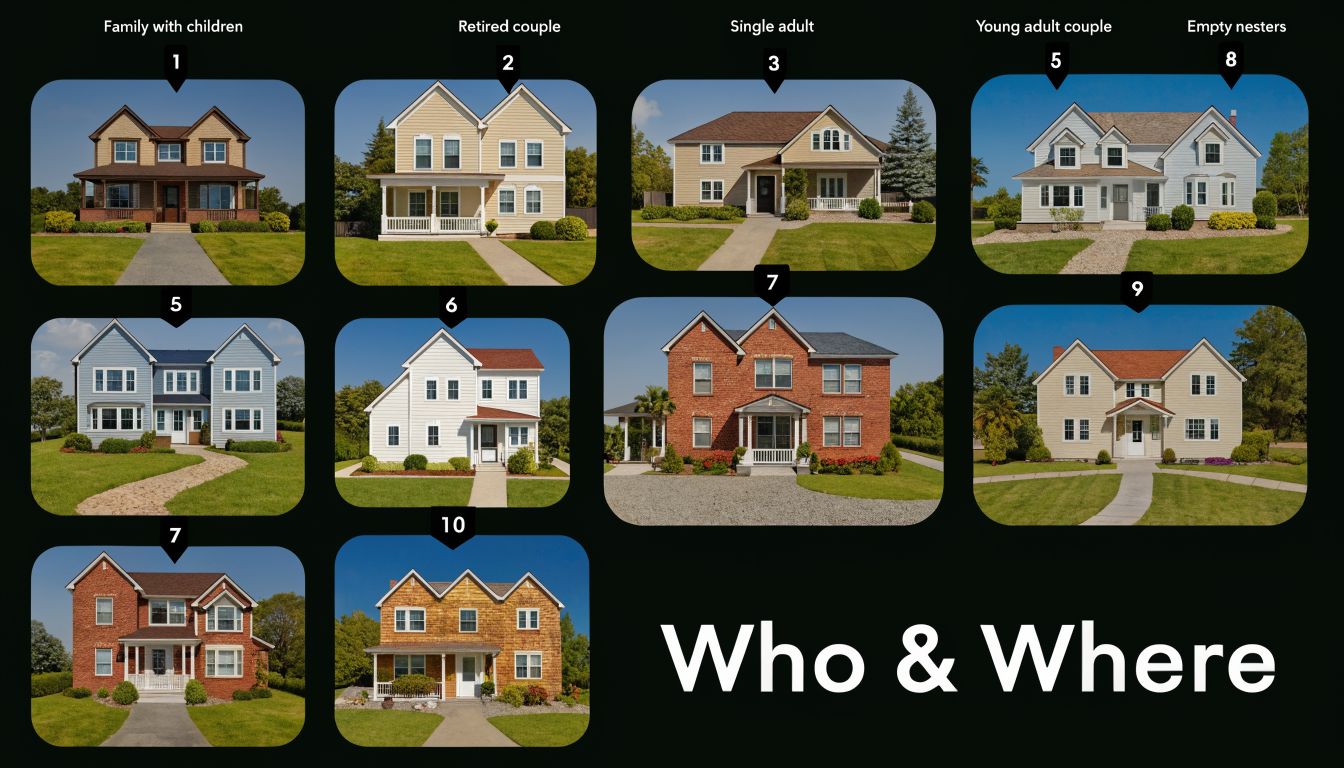
Start with facts you can verify. Homeownership, age range, likely household income, ZIP code, home age, and property value trends all matter because they help you spot where larger remodeling budgets are more common. For remodelers chasing $75K to $300K residential work, that beats blasting ads across an entire metro and hoping the right people self-select.
The strongest use of this data is geo-demographic clustering. It combines location with traits such as income level, homeownership, and life stage so you can focus on areas that look like your past profitable jobs. Analysts at CleverTap’s segmentation analysis describe this broader idea well. Segmenting by demographic and geographic traits gives marketers a clearer way to tailor offers and messaging instead of treating every prospect the same.
For remodelers, the takeaway is simple. Your service area should not be a circle on a map. It should be a shortlist of neighborhoods and ZIP codes where project size, home type, and homeowner profile line up with your margins.
Location data also gets sharper when you read it the way investors and valuation teams do. This article on optimizing real estate valuations is useful because it shows how geospatial analysis improves property-level decision making. That same mindset helps you choose where to run Google Ads, where to build location pages, and where not to spend a dollar.
What this means for your local targeting
Stop using “greater metro area” as your market definition. That phrase usually means you have not looked at your closed-job data closely enough.
Use this playbook instead:
- Pull your last 20 to 30 qualified opportunities and mark the ZIP codes, neighborhoods, and average project values.
- Group wins by area so you can see which pockets consistently produce kitchens, additions, and whole-home remodels in your target range.
- Match home type to offer. Older homes in established suburbs may justify additions and whole-home renovations. Higher-value move-up neighborhoods may respond better to kitchens, primary suites, and aging-in-place work.
- Build or refine location pages for the areas that already produce revenue. If your site is weak locally, fix that with this guide to optimizing your remodeling website for local search.
- Set Google Ads geography tighter than your truck radius. Bid harder where your best-fit homeowners live and cut low-fit areas that eat budget.
- Tag leads in your CRM by location quality so your team can prioritize follow-up by both project type and neighborhood fit.
Here’s the difference in practice:
| Filter | Weak approach | Better approach |
|---|---|---|
| City targeting | Target the whole metro | Target selected suburban pockets with proven job value |
| Messaging | “We do remodeling” | Speak to the homes, budgets, and project types common in that area |
| Budget use | Spread evenly | Put more budget into ZIP codes tied to profitable projects |
If your best jobs keep clustering in the same neighborhoods, act on that pattern. Build pages for those areas. Write ad copy for those homeowners. Route those leads through your CRM with priority tags. That is how demographics and geographics stop being theory and start producing better projects.
Why They Remodel and How They Act Psychographics & Behaviors
Psychographics tells you the reason behind the project
At this juncture, remodelers either get smart or stay generic.
Demographics tell you a homeowner might afford the job. Psychographics tell you why they’ll move forward. In luxury and upper-mid-market remodeling, that difference matters. A homeowner isn’t always buying cabinets, tile, or square footage. They’re buying a better way to live in the house they plan to keep.

A luxury remodeler targeting $75K–$300K residential projects might focus on homeowners aged 45-64, a group that controls 40% of U.S. household wealth as of 2023, according to Contractor Growth Network’s segmentation breakdown. But that same source makes the bigger point. Demographics explain only 20-30% of purchase variance, which means age and income alone don’t tell you enough. Layering in psychographics such as craftsmanship, legacy, and long-term home value creates a much more useful customer profile.
That’s the difference between boring copy and copy that lands.
A weak message says, “We offer premium remodeling services.”
A stronger message says the kind of thing your best clients already believe:
- They want a forever home
- They care about detail and finish quality
- They want the house to reflect who they’ve become
- They’d rather do it right once than cheap twice
Behavior shows you who is raising their hand
Psychographics explain motive. Behavior shows momentum.
A homeowner who types “luxury kitchen remodeler near me,” studies your project gallery, returns to your website, and fills out a contact form is telling you something with actions. That lead deserves different treatment than someone who bounces after ten seconds.
Here’s what behavior can include for a remodeler:
- Search intent such as local high-end remodeling phrases
- Website path like repeated visits to kitchens, additions, or financing pages
- Conversion actions such as form fills, phone calls, or cost guide downloads
- Follow-up response including how fast they reply, whether they book, and whether they re-engage after a missed call
Good behavioral signals don’t replace good sales. They help your team know where to spend energy first.
This is also where many companies overcomplicate things. You don’t need a giant data warehouse to start. You need to watch what people click, what pages they revisit, and what actions tend to show up before better jobs close.
If demographics tell you who could buy, behavior tells you who might buy now.
An Action Plan for Google Ads SEO and Your CRM
You don’t need more theory. You need operating instructions.
Recent 2025 data shows remodelers using hybrid geo-behavioral segments, such as combining ZIP code with recent home value searches, achieve 2.5x higher close rates on projects over $200K. The same source says only 25% of marketing guides address this multi-layering, and missing it leads to an estimated 40% wasted ad spend, according to Lumen Learning’s segmentation overview.
That’s the whole game. Stop treating leads like one big pile. Build small systems that sort them.
Google Ads
Google Ads should not be your “show ads everywhere and hope” machine.
Use segmentation like this:
Limit geography first
Target the ZIP codes and service pockets that fit the type of projects you want. Don’t open the map too wide just because Google suggests it.Write ads for the homeowner mindset
One ad can speak to design-forward kitchen transformations. Another can speak to major additions for families staying long term. Different motives need different words.Send traffic to matching pages
If the ad is about luxury kitchens in a specific area, don’t dump people on your homepage. Send them to a page that matches the service and location.Watch behavior after the click
If one neighborhood campaign brings more serious page engagement and better consultation requests, push harder there.
If you want a plain-English refresher on behavioral segmentation, that resource is worth reading because it helps connect user actions to campaign decisions without drowning you in theory.
Local SEO
Most remodelers handle SEO like a list of service pages and some city names stuffed into headings. That’s weak.
Local SEO gets stronger when you layer all four buckets into the page.
A solid page might target:
- A specific neighborhood or affluent suburb
- A service like kitchen remodels, additions, or outdoor living
- A psychographic angle such as timeless design, entertaining, aging in place, or sustainability
- Behavioral proof like project galleries, FAQs, and strong next-step calls
Try building pages that feel like they belong to the neighborhood they target. Not fake hyper-local fluff. Real relevance.
Examples:
- Historic home renovations in an established neighborhood
- Outdoor living design for homeowners who host often
- Kitchen remodels for families staying in place long term
CRM rules that help you close better jobs
A lot of money leaks out under such circumstances. Good lead generation falls apart when the CRM treats every inquiry the same.
If your current setup is loose, review your options for CRM software for builders. The right system helps you tag, score, and route leads based on fit and intent instead of leaving follow-up to memory.
Here’s a starter framework:
| CRM Signal | What it suggests | What you should do |
|---|---|---|
| Lead from a target ZIP code | Better location fit | Raise priority |
| Visited gallery or high-value service pages more than once | Stronger interest | Trigger fast follow-up |
| Filled out a detailed form | Higher seriousness | Assign sales call quickly |
| Missed your call but revisits site | Still warm | Send text-back and booking prompt |
Then build simple rules:
- Score fit first by area, service type, and project range.
- Score intent second by page depth, repeat visits, and conversions.
- Trigger fast follow-up for leads that hit both conditions.
- Keep weaker-fit leads in nurture instead of letting them crowd your sales calendar.
The best CRM isn’t the one with the most features. It’s the one that tells your team who to call first.
That’s how demographic geographic psychographic and behavioral data turns into something useful. Not a report. A workflow.
Your Remodeling Segmentation Starter Checklist
Don’t try to build a perfect system in one week. Start with the obvious wins.
- Pull your last best jobs and look for patterns in project type, location, and homeowner profile.
- List your top ZIP codes where the strongest-fit projects usually come from.
- Review your website pages and ask a basic question. Do they talk only about services, or do they also speak to why your best clients buy?
- Split your Google Ads by geography instead of running one broad campaign across your full market.
- Match ad copy to customer motive so kitchen, addition, and outdoor living leads don’t all see the same message.
- Create one neighborhood-focused landing page for a place where you want more premium work.
- Tag leads in your CRM by service, area, and source.
- Flag repeat visitors to gallery and service pages as hotter leads.
- Set one missed-call text-back workflow so serious prospects don’t cool off while your team is in the field.
- Meet with your sales team and compare which lead traits usually show up before the best projects close.
If you only do three things this month, do these:
- Narrow your geography
- Improve message-market fit
- Prioritize follow-up based on behavior
That alone will clean up a lot of wasted effort.
From Guessing About Leads to Predictable Growth
The remodelers who win better projects aren’t always the loudest. They’re usually the clearest.
They know who they want, where those homeowners live, what those homeowners care about, and which actions signal real buying intent. That’s what demographic geographic psychographic and behavioral segmentation gives you. Clarity.
When you stop marketing to everybody, your ads get tighter, your website gets more convincing, and your sales team spends more time with people who are able to buy. That’s how lead flow becomes more predictable. Not by chasing more traffic, but by filtering for better fit.
Start with the checklist. Tighten one channel. Then another. Small changes in targeting create big improvements in lead quality over time.
If you want help building a real lead system instead of piecing one together alone, Constructo Marketing helps remodelers turn Local SEO, Google Ads, websites, and CRM automation into a tighter growth engine for $75K to $300K residential projects.