


You’re probably doing what a lot of solid remodelers do. You build beautiful work, your phone rings enough to keep you busy, and your business still feels messy. One month looks strong, the next month feels thin. You know your craft, but the company side lives in your head, in your inbox, and on scraps of paper.
That’s exactly why a general contractor business plan matters.
Not the stiff banker version. Not the document you write once and forget. I’m talking about a working plan. A simple blueprint for how your remodeling company gets the right jobs, keeps profit, avoids dumb mistakes, and gives you more control over your week.
A lot of contractors resist this because “business plan” sounds like office work. Fine. Call it your build sheet for the company. Same idea. If you wouldn’t start a high-end remodel without a plan, don’t run a high-value remodeling business without one either.
Table of Contents
- Why Your Remodeling Business Needs a Real Plan
- Define Your Perfect Customer and Project
- How to Plan Your Profits and Cash Flow
- Your Plan to Become Local Famous
- Build a Team and a Process You Can Trust
- Your Dashboard for Success and What to Do Next
Why Your Remodeling Business Needs a Real Plan
A good remodeler can still run a sloppy business. I see it all the time.
The owner is talented. Clients like him. The work is strong. But he’s pricing jobs by gut, hiring when he’s desperate, and saying yes to projects he shouldn’t touch. He isn’t building a company. He’s reacting all day.
Stop running the company from memory
Your business plan is a decision tool. It tells you:
- What jobs to chase so you stop taking work just because it showed up.
- Who you serve best so your message gets sharper.
- How you make money so revenue doesn’t fool you into thinking you’re profitable.
- What “good” looks like for hiring, delivery, and follow-up.
That’s the primary value. It gets the business out of your head.
The boring businesses usually win because they make fewer emotional decisions.
And this is a strong time to get serious. 69% of contractors expect revenue to increase in 2025, and 65% expect higher profits, according to ProjectMark’s construction market data for contractors. Opportunity is there. A plan helps you catch it without turning your company into chaos.
If you want a plan that works, include marketing from the start. Most contractors wait too long, then panic when leads slow down. If you need a grounded look at budgeting for that side of the business, this breakdown on what a remodeling company should spend on marketing and what it really costs is worth your time.
Write the executive summary last
This part confuses people, so let’s make it easy.
The executive summary is not where you start. It’s where you finish. It resembles the final reveal photos after a remodel. It shows the clean result.
Keep it short. One page is enough.
Include:
What your company does
Example in plain English. “We remodel kitchens, baths, and additions for homeowners who want quality and clear communication.”Who you serve
Not “everyone in town.” Say who fits.What makes you different
Maybe it’s design-build, cleaner communication, tighter project management, or better systems.How you grow profitably
Not just “get more leads.” Be specific about project type, pricing discipline, and delivery.
Define Your Perfect Customer and Project
Most remodeling companies don’t have a lead problem. They have a focus problem.
They say they do kitchens, baths, additions, windows, decks, roofing, handyman work, and “pretty much anything residential.” That sounds flexible. It is expensive. Your message gets muddy, your estimating gets harder, and your team stays stretched.
Pick a lane and get paid better
You need a sweet spot.
That means one clear customer, one clear type of project mix, and one clear value promise.
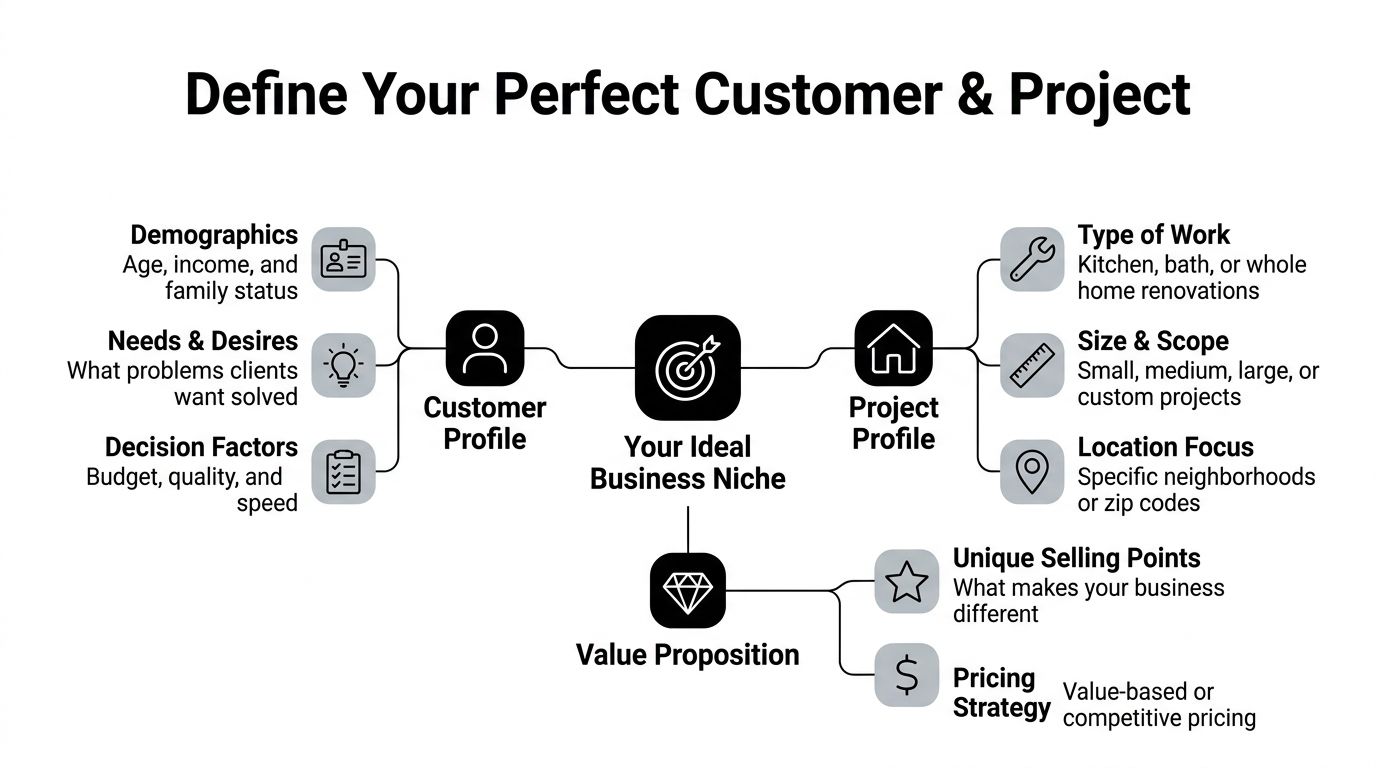
Use this simple filter:
| Question | Strong answer | Weak answer |
|---|---|---|
| Who do you serve? | Homeowners in established neighborhoods who want major remodels | Anybody with a house |
| What do you build? | Kitchens, baths, additions, whole-home remodels | Anything that pays |
| Why choose you? | Clean process, design help, craftsmanship, communication | We do quality work |
Weak answers create weak positioning.
Scout your market like a jobsite
Look at your market the same way you’d inspect a house before bidding it. You’re looking for fit, not just activity.
Single-family housing starts are projected to increase from 909,000 units in 2023 to 1.13 million by 2025, a 24% jump, according to the AGC of California 2025 industry outlook. For remodelers focused on single-family homes, that matters. It signals a healthy environment for residential work tied to homeowners and neighborhoods where people want to improve what they own.
Here’s the practical read. More single-family activity usually means more owners moving, upgrading, settling in, and investing in the house they chose. That’s favorable ground for remodelers.
So scout your service area with intent:
- Check neighborhoods where homes match your ideal project type.
- Review your own past jobs and find the ones with the least stress and best margin.
- Look at permit patterns qualitatively in your area if that data is available to you.
- Talk to referral partners like designers, real estate pros, and trade partners who know what homeowners are asking for.
Good market analysis isn’t complicated. It’s knowing where the best-fit jobs live and why your company should win them.
Build your niche around fit not ego
A lot of owners choose a niche based on what sounds impressive. That’s a mistake.
Choose a niche based on these three things:
You can price it well
If your team understands scope, sequence, and common surprises, your estimates get tighter.You can sell it confidently
Homeowners trust specialists more than generalists.You can deliver it repeatedly
Repetition creates smoother jobs, better referrals, and fewer headaches.
Try writing your market statement like this:
We help homeowners in [area] complete [type of remodel] with [main value promise].
That one sentence should make the right client say, “That’s us.”
If it’s too broad, tighten it. If it sounds like ten different services smashed together, start over.
A strong general contractor business plan doesn’t reward being available for everything. It rewards being known for the right thing.
How to Plan Your Profits and Cash Flow
Most owners avoid the financial section because they think they need accountant-level skills. You don’t.
You need three buckets. Money in. Money out. Money left over.
That’s it.

Use simple math not fancy spreadsheets
Start with your income goal. Then work backward.
Ask:
- How much revenue do I want?
- What project types will create that revenue?
- What does each job cost to produce?
- What’s left after labor, materials, overhead, and mistakes?
If you get lost when reading your numbers, slow down and learn the basics of how a P&L works. This guide from Elyx AI can help you master understanding profit and loss statements without turning it into a finance class.
You also need to know your margin targets by job type. If you don’t know what healthy margin looks like in your business, this article on construction profit margin gives you a practical place to start.
Protect labor before it eats the job
Here’s the blunt truth. Labor is where many remodelers lose their profit.
According to K-38 Consulting’s breakdown of why construction financial plans fail, labor often makes up 60% of the budget, 9 out of 10 projects go over budget, and a 10% to 15% labor contingency is best practice.
That should change how you estimate.
If your labor estimate is soft, the whole job is soft.
Build your labor planning around this checklist:
Use historical job data
Don’t guess crew hours from memory.Separate trade assumptions
Framing, tile, paint, trim, and punch each behave differently.Add labor contingency on purpose
Not as hidden fluff. As planned protection.Watch production during the job
Daily beats post-mortem.
Practical rule: If labor is your biggest cost, it deserves your tightest attention.
Cash flow is timing not theory
A profitable company can still feel broke if cash timing is bad.
Here’s where owners get burned:
| Cash flow problem | What it looks like |
|---|---|
| Deposit too small | You fund the early phase yourself |
| Billing too slow | Work is done, invoice isn’t out |
| Change orders delayed | Scope grows, cash doesn’t |
| Vendor payments hit first | Money leaves before client money lands |
Cash flow planning in your business plan should spell out:
- when deposits are collected
- when progress payments are due
- who sends invoices
- how fast change orders get approved
- what reserve you keep for surprises
This isn’t paperwork. It’s protection.
Your Plan to Become Local Famous
A lot of business plans still treat marketing like an afterthought. They mention referrals, yard signs, maybe a website, then move on. That’s old thinking.
If you want premium remodeling work, your visibility has to be built on purpose.

Google is the front door now
According to Wexford Insurance’s guide on general contractor business plans, 68% of homeowner leads for major remodels start on Google Search and Maps in 2026, and contractors who integrate Local SEO and a CRM into their plan see 40% higher conversion rates.
That means your marketing plan needs more than “post on social media sometimes.”
You need a real local search strategy built around:
- Google Business Profile with correct categories, photos, reviews, and service areas
- Local SEO pages for the services and locations you target
- Google Ads for high-intent searches where homeowners are ready to talk
- Conversion-focused website pages that show process, proof, and project fit
If you want a practical framework for that, this guide on marketing strategy for construction business lays out the moving parts well.
Your CRM is your digital office manager
Most contractors don’t lose leads because they’re bad at remodeling. They lose leads because follow-up is loose.
That’s where a CRM matters. Tools like GoHighLevel help track inquiries, organize the pipeline, and automate follow-up. If someone calls and nobody answers, a missed-call text-back can keep that lead warm instead of dead. If an estimate goes out, the CRM can remind your team to follow up instead of hoping somebody remembers.
That isn’t “marketing fluff.” It’s sales discipline.
Your business plan should document:
| Marketing system | Job |
|---|---|
| Website | Turn visits into inquiries |
| Google Business Profile | Capture local map visibility |
| Google Ads | Generate demand fast |
| CRM | Track and follow up on every lead |
Don’t market everything market one clear promise
Your message should match your niche.
If you want higher-value remodeling jobs, don’t lead with “we do it all.” Lead with the work you want more of. Show the kind of homes, the kind of clients, and the kind of process that fits that buyer.
A homeowner looking for a serious remodel doesn’t want a bargain-bin message. They want signs of order.
That means your plan should define:
- Primary service focus
- Primary service area
- Primary homeowner pain point
- Primary sales promise
Keep it simple. Be easy to understand in five seconds.
Build a Team and a Process You Can Trust
The sale is only half the business. Delivery is where your reputation gets built or damaged.
If your jobs depend on you personally solving every issue, you don’t have a system. You have a bottleneck with a truck.
Your delivery system needs to be boring
That’s a compliment.
A good remodeling company should run the same way every time. Not identical in design. Identical in process.
Write down your path from first call to final walkthrough:
Lead comes in
Who answers, how fast, and what gets logged.Discovery and qualification
Who checks fit, budget, and timeline.Estimate and scope
What has to be defined before pricing goes out.Preconstruction and scheduling
Selections, permits, ordering, and client expectations.Production
Site communication, supervision, and change order handling.Closeout
Punch list, final payment, warranty communication, review request.
When this lives only in your head, your team guesses. Guessing is expensive.
Write the rules before the problem shows up
Risk management sounds corporate. It’s not. It’s just deciding in advance how you’ll handle predictable trouble.
According to Deltek’s construction business plan guidance, supply chain issues caused 22% of construction delays in the U.S. recently. If your plan ignores material volatility and subcontractor issues, you’re leaving profit exposed.
Build response rules for common risks:
Material delays
Identify backup suppliers and decide when substitutions need client approval.Subcontractor failure
Keep a short list of alternates. Don’t wait until a crew disappears.Client changes
Require signed change orders before added work starts.Schedule slips
Define who updates the client, how often, and in what format.
When a problem repeats, it’s no longer a surprise. It’s a missing process.
People need clarity more than motivation
A lot of owners think team problems are attitude problems. Usually they’re clarity problems.
Your foreman needs to know what he owns. Your office person needs to know what must be documented. Your subcontractors need to know your standards before they step on site.
Write down:
| Role | Clear responsibility |
|---|---|
| Owner | Sales, key decisions, financial review |
| Project manager or lead | Schedule, communication, issue tracking |
| Field lead | Daily execution, site standards, crew coordination |
| Office admin | Lead intake, paperwork, billing support |
You don’t need a huge org chart. You need fewer gray areas.
Trust comes from repeatable behavior. That’s what your process creates.
Your Dashboard for Success and What to Do Next
A plan that never gets reviewed is dead paper.
You need a dashboard. Not a monster spreadsheet. Just a few numbers that tell you whether the business is healthy, like the gauges on your truck.
Track a few numbers that matter
Use a short scorecard you can review every week.
Here’s a simple version.
| Metric (KPI) | What It Tells You | Example Goal |
|---|---|---|
| Leads | Whether marketing is creating opportunities | Consistent qualified inquiries each week |
| Close rate | Whether you’re selling the right work well | Improve estimate-to-sold performance |
| Job gross profit | Whether projects are priced and managed correctly | Protect margin on every completed job |
| Production pace | Whether jobs are moving as expected | Keep projects on planned schedule |
If you need sharper financial help as you grow, talking with experienced Financial Analysts can help you build better reporting and decision habits without guessing.
Review weekly not yearly
Set one meeting with yourself every week. Same day. Same time. No excuses.
Bring these questions:
- Did we get enough qualified leads?
- Did we follow up fast enough?
- Did any active job drift off budget or schedule?
- What problem repeated this week?
Then do one more thing. Put two hours on your calendar this week to draft your business plan.
Start with one page on your perfect customer and project. Not your logo. Not your mission statement. Not the legal stuff. Start with the work you want, the client you want, and the jobs you should stop taking.
That one move will clean up more decisions than most owners expect.
A strong general contractor business plan isn’t about looking official. It’s about building a remodeling company that pays you well, runs with less chaos, and stops dragging you into every fire.
If you want help turning this plan into a lead system that brings in the right remodeling jobs, Constructo Marketing specializes in helping remodelers become Local Famous with Local SEO, Google Ads, websites, and CRM automation built for serious residential projects.