
Published May 29, 2026
You're probably in this exact spot right now. You spent real money on Google Ads, your website, SEO, maybe some social posts, maybe an agency, and a big project finally closed. Then you ask the obvious question: which part of my marketing helped win that job?
That's where most remodelers get stuck.
Not because they're bad at math. Not because marketing ROI is some genius-level finance trick. It's because most advice about how to calculate marketing ROI was written for short sales cycles, cheap purchases, and businesses where a customer clicks today and buys today. That is not your world when you're selling kitchen remodels, additions, whole-home renovations, and outdoor living projects that can take months from first click to signed contract.
You already know how to estimate a complex project. Marketing should be handled the same way. Count the full cost. Track the full timeline. Tie the work to the outcome. Then decide what's worth doing again.
Table of Contents
- Why Most Marketing Math Feels Like Guesswork for Remodelers
- Tallying Up Your Real Marketing Spend
- Connecting Dollars Spent to Projects Won
- The Remodeler's ROI Calculation Step-by-Step
- Avoiding Common ROI Calculation Mistakes
- From Messy Spreadsheets to a Clear Dashboard
Why Most Marketing Math Feels Like Guesswork for Remodelers
You can build a six-figure renovation plan with dozens of moving parts, but marketing math still feels muddy. That's normal. The problem isn't you. The problem is that most ROI advice assumes a straight line from ad to sale.
That's not how high-ticket remodeling works.
A homeowner might find you through Google, leave, come back through your website, read reviews, ask a neighbor, follow you on social media, and then call months later when they're finally ready. If you only look at the last action before the call, you miss most of the story.

Long sales cycles break lazy marketing math
Most generic marketing advice works better for simple purchases. A person sees an ad, buys a thing, and the sale gets counted fast. Remodeling is different because trust takes time.
That matters even more for SEO and content. Modern ROI measurement has shifted toward pipeline- and touchpoint-based attribution because buyers move through multiple interactions before they buy. Industry guidance also recommends measuring SEO ROI over 6–12 months because organic traffic and assisted conversions build gradually, not instantly, as explained in Demandbase's guide to calculating marketing campaign ROI.
Practical rule: If you expect a kitchen remodel lead source to prove itself in the same window as a pizza coupon, you'll cut good marketing too early.
Bad tracking creates fake confidence
A lot of remodelers get a report that looks clean, but the math underneath is weak. It credits one source, ignores others, and leaves out half the cost. That gives you a number, but not a useful one.
Here's where the confusion usually starts:
- Last-click obsession means the final call or form fill gets all the credit, even if other marketing did the heavy lifting first.
- Incomplete costs make a campaign look profitable because nobody counted software, creative work, admin time, or agency fees.
- Big project timing skews the picture because one signed contract can make a month look amazing even though the lead came in much earlier.
- Referral crossover muddies things because homeowners often hear about you in more than one way before reaching out.
The fix is simple. Stop asking, “Which ad closed this project?” Start asking, “Which marketing touches helped move this homeowner from stranger to signed client?”
That's a much better question. It matches how people buy remodeling services.
Tallying Up Your Real Marketing Spend
A remodeler can feel busy, see leads coming in, and still have no clear idea what marketing costs. That gets expensive fast, especially when you sell $75,000-plus projects with a sales cycle that stretches across seasons, not days.
You already know how bad estimates happen. Someone counts the visible line items and misses the actual work underneath. Marketing gets underestimated the same way. If you only pull your Google Ads bill and call that your investment, your ROI number is weak before you even start.
Count the full cost of getting and converting demand
The math itself is simple: (Revenue – Marketing cost) / Marketing cost x 100.
The hard part is getting the cost number right.
For a high-ticket remodeling firm, marketing spend includes every dollar tied to creating demand, capturing leads, following up, and supporting the sales process long enough to turn interest into a signed contract. The U.S. Small Business Administration's guidance on calculating the cost of doing business makes the same basic point. If you leave out real operating costs, your numbers stop helping you make decisions.
That is the trap.
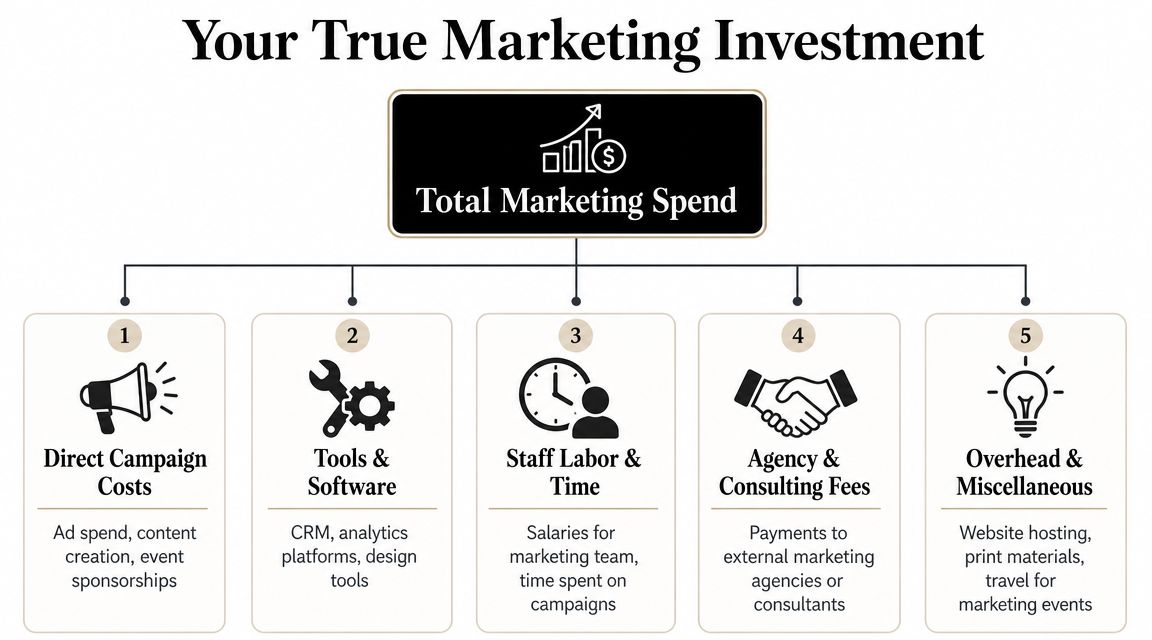
Use five cost buckets and stick to them
Keep your system plain. Fancy categories usually make tracking worse.
| Cost bucket | What belongs here |
|---|---|
| Direct campaign costs | Google Ads, Local Services Ads, paid social, print mailers, sponsorships, photography, video |
| Tools and software | Website hosting, CRM, call tracking, email platform, analytics tools, design tools |
| Staff labor and time | Office manager time, marketing coordinator time, owner time spent reviewing campaigns or vendors |
| Agency and consulting fees | Monthly retainers, strategy work, SEO, ad management, copywriting |
| Overhead and misc. | Landing page builds, branded materials, event travel, showroom promo items, small marketing-related extras |
If you want a clearer breakdown of where that money usually goes, this guide on what a remodeling company should spend on marketing and what it really costs lays it out well.
The bucket remodelers miss most often is labor. Your team's time costs money whether it shows up on an invoice or not. If someone on staff answers inbound leads, updates project photos, coordinates testimonials, chases follow-up tasks, or reviews agency work, that belongs in your marketing spend.
Owner time counts too.
If you spend three hours every week reviewing lead quality, sitting in agency calls, approving ad copy, or fixing website issues, that is part of the investment. Ignore it, and paid channels will look more profitable than they really are.
Ask what it took your business to create, run, track, and support the campaign from first click to signed contract.
Build one monthly marketing ledger
You do not need new software for this. A clean spreadsheet works if you keep it current and complete.
Use one row per expense. Tag each row to a channel or function so you can sort it later. A simple ledger might include:
- Google Ads management under paid search
- Website hosting under website infrastructure
- CRM subscription under lead handling
- Owner review time under management
- Project photography under portfolio marketing
This matters more for long-cycle remodel work than it does for lower-ticket businesses. A kitchen or whole-home project may require months of follow-up, design coordination, and sales effort before revenue lands. If you only count the click cost and ignore the support costs that carry that lead to the finish line, you will understate what it took to win the job.
Keep your dates clean too. If you review Q2 marketing costs, use Q2 costs. Do not grab revenue from a contract signed this month if the lead came from spending you are not including, unless you are intentionally measuring over a longer window. Sloppy timing is how good channels get cut and weak channels survive.
Connecting Dollars Spent to Projects Won
Most remodelers either gain clarity or stay confused forever at this point.
You already know that a homeowner doesn't wake up, click one ad, and sign a major remodeling contract that afternoon. The buying path is layered. So your tracking has to follow the whole path, not just the last step.
Attribution is just giving credit fairly
“Attribution” is a fancy word for a simple idea. It means deciding which marketing touches deserve credit for a project.
A remodel lead might follow a path like this:
- They click a Google ad.
- They visit your website.
- They leave.
- They come back later through an organic search.
- They fill out a form.
- They meet your estimator.
- They sign months later.
If you only credit the final form fill, you're ignoring the touches that started and nurtured the relationship.
That's why you need a CRM and a clear lead source process. Every inquiry should be tagged with first source, latest source, and notes from the sales conversation. If your team still asks “How did you hear about us?” and writes one vague answer in a spreadsheet, you're leaving money decisions to bad memory.
A stronger system tracks calls, forms, appointment stages, and contract outcomes in one place. If you want ideas for tightening your pipeline tracking, this resource on lead generation for contractors is a useful companion.
Generated revenue versus influenced revenue
These two ideas sound similar, but they are not the same.
Generated revenue is the money you can tie more directly to a source.
Influenced revenue is the money where marketing helped move the deal along, even if it didn't get the final click.
That matters a lot for high-ticket remodeling because multiple touches usually shape the decision.
A simple way to consider this:
- Generated means “this source brought the lead in.”
- Influenced means “this source helped the lead trust us enough to keep moving.”
If your website answered objections, your gallery built confidence, and your follow-up emails kept the conversation alive, those pieces mattered even if a referral closed the loop.
Set an attribution window that matches your sales cycle
This is the part most generic advice gets wrong. Remodelers need a longer view.
Your attribution window is the amount of time you allow between the first marketing touch and the contract before you count the result. For high-consideration projects, that window should reflect reality. If your average sales process stretches over months, a short window cuts off real influence.
Use your CRM to mark milestones such as:
- First inquiry
- Consultation booked
- Site visit completed
- Proposal delivered
- Contract signed
Once you can see those stages, marketing stops looking random. You can tell which channels start conversations and which ones help deals mature. That's the whole game in learning how to calculate marketing ROI for remodeling firms with long sales cycles.
The Remodeler's ROI Calculation Step-by-Step
You can be booked solid, your phone can be ringing, and your bank account can still leave you wondering whether your marketing is working. That happens all the time in high-ticket remodeling. A $150,000 kitchen project might start with a Google search, stall for two months, come back after a referral, then close six months later. If you use a short, generic ROI formula without context, you will misread what your marketing is doing.
Here's the straight way to calculate it.
The basic formula
Start with the core equation:
Marketing ROI = (Revenue – Marketing cost) / Marketing cost × 100
That gives you the percentage return on what you spent.
A simple example makes the math clear. If marketing brought in $5,000 in attributable revenue and you spent $1,000, your ROI is 400%. The formula is simple. The judgment is not. For remodelers selling projects above $75,000, the main challenge is deciding which jobs belong in that revenue number and which costs belong in the investment number.
The remodeler version
Use a quarterly view. Monthly reporting is too twitchy for long sales cycles and large contracts. Quarter by quarter, you can see whether your spend is producing real pipeline and signed work instead of reacting to noise.
Follow this process:
Pick the reporting period
Use a quarter, not a month. High-value remodeling jobs take time to move from first inquiry to signed contract.Total your full marketing investment
Count ad spend, agency or freelancer fees, website retainers, SEO work, photography, call tracking, CRM tools, email software, and the internal hours spent managing campaigns.Pull the projects won during that period that can be tied to marketing
Use your CRM, call tracking, lead source fields, and sales notes. If the source is muddy, clean it up before you trust the number.Assign only the revenue marketing influenced or generated
Don't throw every closed job into the pile. A homeowner who typed your URL directly the day before signing does not automatically make that project a marketing win.Run the formula and compare by channel, campaign, or project type
Total ROI matters. Channel-level ROI is what helps you make better budget decisions.
Here's a remodeler-friendly example. Say you spent $18,000 over a quarter on Google Ads, SEO, your website retainer, and call tracking. During that same quarter, you signed one basement remodel and one whole-home renovation that you can credibly tie back to those efforts, for $210,000 in attributable revenue. Using the basic formula:
($210,000 – $18,000) / $18,000 × 100 = 1,066.7% ROI
That looks great. Now apply some discipline. If one of those jobs had been driven by an architect referral and marketing only helped reinforce trust, you should not count the full contract value in the same way. This is why generic ROI advice falls apart for expensive remodeling work. The formula is easy. Attribution is where good operators separate themselves from hopeful guessers.
If you want a practical outside reference, Gilkes Media insights on ROI offer a useful framing.
Track CAC alongside ROI
ROI tells you the return. CAC tells you what it cost to win the job.
Use this formula:
CAC = Total marketing cost / Number of new customers acquired
For a remodeling company, CAC gets more useful when you split it by service line or project size. A $20,000 bath refresh and a $250,000 addition do not behave the same way. They should not share the same benchmark.
CAC matters for three reasons:
- It shows efficiency before every deal closes
- It helps you compare channels on equal footing
- It exposes expensive lead sources that look busy but fail to produce signed work
A channel can generate plenty of inquiries and still produce a terrible CAC. That usually means weak lead quality, poor targeting, or both.
A scorecard you will actually use
Keep the scorecard simple enough that your team updates it every quarter.
| Metric | What to record |
|---|---|
| Total marketing investment | Full cost for the period |
| New leads | All qualified inquiries |
| Appointments set | Consults booked |
| Proposals sent | Real selling activity |
| Projects won | Signed contracts |
| Attributed revenue | Revenue tied to marketing |
| CAC | Marketing cost divided by customers won |
| ROI | Return using your selected formula |
That scorecard gives you a cleaner read on performance than a lead count alone. Leads can flatter bad marketing. Signed projects, attributable revenue, and CAC show whether your spend is helping build the kind of remodeling business you want.
Avoiding Common ROI Calculation Mistakes
A remodeler can spend $12,000 on marketing, land a $180,000 project, and still read the result wrong.
That happens all the time with $75K-plus remodels because the sales cycle is long, the buying committee is rarely one person, and the final signed job usually reflects months of follow-up, trust-building, and scope refinement. If you use lazy math, you will either cut a channel that is effective or keep funding one that only looks good on paper.
Revenue can fool you
Contract value is the easiest number to grab. It is also one of the easiest ways to fool yourself.
Use gross profit in your ROI calculation whenever you can:
Marketing ROI = (Gross Profit – Marketing Investment) / Marketing Investment
That gives you a truer read on whether the work was worth winning. Two kitchen projects can both close at $150,000 and produce very different profit. One runs clean with solid change orders and healthy margin. The other gets chewed up by estimating misses, production headaches, and client hand-holding. Your marketing report should not treat those jobs as equal.
Sanity check: If a campaign keeps filling your pipeline with low-margin work, it is hurting your business even when revenue looks strong.
The mistakes that skew the number
High-ticket remodeling has a few predictable ROI traps. Avoid them.
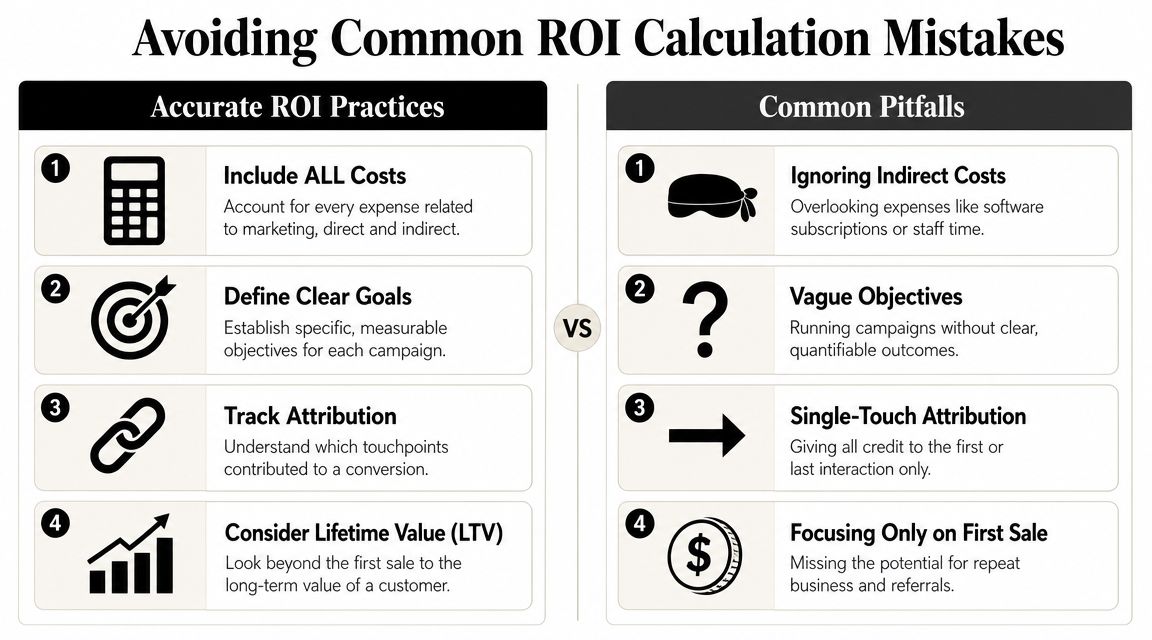
Judging channels on closed revenue alone
A long sales cycle hides real performance. Some campaigns create serious opportunities that will not close for six to nine months. Track pipeline influenced by marketing alongside closed jobs so you do not cut off future revenue.Using one-touch attribution for a multi-touch sale
Homeowners rarely click one ad and sign a $200,000 contract. They may find you through search, come back from direct traffic, read reviews, visit your gallery, then submit a form weeks later. Last-touch reporting gives too much credit to the final step.Counting every lead the same way
A tire-kicker asking for a small handyman job should not carry the same weight as a homeowner planning a full-home renovation. For remodelers, lead quality beats lead volume every time.Forgetting repeat and referral value
One great client can turn into a second project, a neighbor referral, or both. If your firm gets meaningful repeat or referral business, judge channels with that in mind, especially channels that attract better-fit clients.Reviewing results in disconnected systems
If your ad data lives in one place, your leads in another, and your sales notes in someone's inbox, your ROI number will be shaky. A system built for contractor follow-up and pipeline tracking, like this CRM software for builders, makes attribution a lot easier to trust.
A cleaner way to pressure-test your ROI
Use this quick filter before you trust any report:
| If the report says… | Check this before you believe it |
|---|---|
| ROI looks strong | Did you use gross profit instead of contract value? |
| Paid search looks weak | Are open proposals and active pipeline included? |
| One source gets all the credit | Did you review more than last-touch attribution? |
| Lead volume is up | Are those leads qualified for your target project size? |
| A channel looks expensive | Does it produce better-fit clients, referrals, or repeat work? |
The goal is not prettier reporting. The goal is better decisions.
A remodeler who works on $75,000-plus projects needs ROI math that respects margin, sales cycle length, and lead quality. Anything less turns your budget into guesswork.
From Messy Spreadsheets to a Clear Dashboard
Once you understand the logic, the next step is making it easy to repeat.
You do not want to rebuild this analysis from scratch every month. That's how numbers get missed, tags get changed, and trust in the data disappears. A clean dashboard beats a heroic spreadsheet every time.
What your dashboard should show
Keep the dashboard simple enough that you'll use it.
Your core view should include:
- Marketing spend by channel
- Leads by source
- Appointments and proposals
- Won jobs tied to source
- Attributed revenue or gross profit
- CAC and ROI by period
- Open pipeline influenced by marketing
That last one matters for remodelers. Some of your best marketing won't show up as closed revenue right away. But you should still see it building pipeline.
If you're evaluating systems built for contractor follow-up and pipeline visibility, take a look at this page on CRM software for builders.
Why this matters to your business
Knowing how to calculate marketing ROI isn't about becoming a marketing nerd. It's about control.
When your numbers are clear, you stop making budget decisions based on whoever talked the loudest last week. You can see whether Google Ads is producing real opportunities, whether SEO is maturing into pipeline, whether your website is helping close trust gaps, and whether your follow-up process is leaking leads.
That changes the feel of the business. You spend with more confidence. You cut waste faster. You stop guessing.
And for a remodeling company chasing larger projects, that clarity matters. Big jobs don't come from random acts of marketing. They come from a system that tracks cost, captures demand, follows up hard, and measures what converts to signed work.
If you want help turning all of this into a real tracking system instead of another spreadsheet project, Constructo Marketing helps remodelers build lead generation, CRM follow-up, and ROI visibility around the kinds of projects that grow the business.