


You're probably dealing with one right now.
A homeowner is upset. The job hit a delay. A change order turned into an argument. A crew member said the wrong thing. Now your phone is buzzing, your inbox is growing, and there's a review draft sitting online that could scare off the next serious client.
That's why responding to complaints can't be treated like an improv exercise. In remodeling, complaints aren't just emotional moments. They're business events. Handle them poorly and you damage trust twice. Once with the current homeowner, and again with every future homeowner who sees the mess. Handle them well and you look steady, organized, and worth hiring for a major project.
Table of Contents
- Why Every Complaint Needs a System Not Just a Reply
- Your 5-Stage Complaint Response Workflow
- Response Scripts for Every Channel
- Using Your CRM to Manage and Document Complaints
- How to Prevent Complaints Before They Start
- Frequently Asked Questions
Why Every Complaint Needs a System Not Just a Reply
Most remodelers hate complaints for a simple reason. A complaint feels personal. You worked hard, spent money, managed subs, dealt with delays, and then the homeowner focuses on what went wrong.
That frustration is real. But if you react from frustration, you usually make the problem worse.
A complaint is like a small leak in a wall. Ignore it and the damage spreads where you can't see it. Fix it the right way and you protect the whole house. Same with your business. One sloppy response can do more damage than the original issue.
The real problem isn't the complaint
The complaint itself usually isn't what hurts you most. The primary danger is what other homeowners think when they see how you handled it. In remodeling, trust drives everything. A serious prospect looking at a large kitchen, addition, or whole-home project doesn't just study your photos. They study your behavior.
If you sound defensive, scattered, or angry, they assume the project will feel the same way.
Practical rule: Your first response is not only for the unhappy homeowner. It's also for the next homeowner watching from the sidelines.
Large organizations don't rely on personality to handle complaints. They use a process. The CFPB's 2025 complaint report shows that about 6.635 million complaints were received, roughly 5.984 million were routed to companies, and 99.6% of the complaints sent to companies received timely responses. That happened because complaints moved through a defined system, not because someone hoped the right employee would remember to reply.
Remodelers need the same mindset. Smaller scale, same principle.
A system keeps you calm when emotions are hot
When a homeowner is upset, your team needs rails to run on. Otherwise people freelancing responses create bigger messes fast.
A basic complaint system should tell your team:
- Who owns the issue: One person must be responsible for the next step.
- Where it gets logged: Not in random texts, inboxes, or sticky notes.
- When the client hears back: Silence makes people assume you don't care.
- How updates are shared: Homeowners handle bad news better than no news.
- What gets documented: If the dispute grows, records protect you.
If you need a practical consumer-side view of how building complaints escalate, Awesim Building Consultants' advice is worth reading because it shows what frustrated owners tend to do when they feel ignored.
That should sharpen your thinking. You're not just answering a complaint. You're preventing the next stage of conflict.
For remodelers trying to build a strong local reputation, complaint handling belongs in the same business discipline as lead management, sales follow-up, and brand trust. That's part of why general contractor marketing systems work best when operations and reputation management support the promise your marketing makes.
Your 5-Stage Complaint Response Workflow
Forget the corporate jargon. A solid complaint workflow is just a job checklist for problems.
If you'd never let a cabinet install happen with no measurements, no material list, and no final check, then don't handle customer issues that way either.
Start with one home for every complaint
The biggest mistake is letting complaints live in too many places. A phone call lands with the office. A text goes to the project manager. An email goes to sales. A Facebook comment gets noticed late. Then everyone thinks someone else is handling it.
That's how good companies look careless.
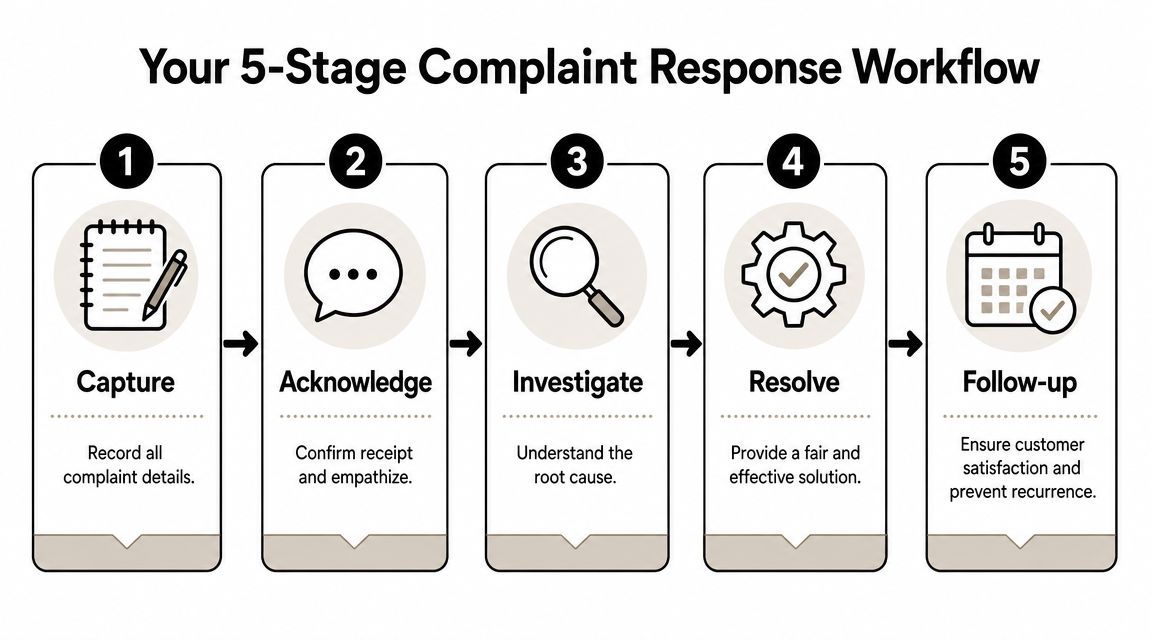
The best workflow starts by putting every complaint into one central system. The five-stage complaint management guidance from Mints emphasizes capture, categorize, investigate, resolve, and follow up, with special importance placed on centralizing intake from all channels into a single traceable record from the start.
One complaint. One record. One owner. That rule alone will clean up half the chaos in most remodeling companies.
The five stages in plain English
Here's the version I'd tell a child. Write it down. Decide what kind it is. Find out what happened. Fix it. Check back.
Capture
Write down the complaint right away. Don't trust memory. Record the homeowner's exact issue, the project address, the date, photos if needed, and who received it. If it came in by phone, type notes immediately after the call.Categorize
Not every complaint is equal. A dusty room is not the same as a water issue. A rude comment from a crew member is not the same as a billing dispute. Sort the complaint by type, urgency, and owner. That tells your team what happens next.Investigate
Now you gather facts. Look at the job file. Read the contract. Check change orders. Ask the superintendent. Review photos. If needed, visit the site. Don't promise a fix before you know what occurred.Resolve
Give the homeowner a clear next step. That might be a repair visit, a schedule update, a billing correction, a written explanation, or a meeting. Be specific. Vague promises sound like stalling.Follow up
This is the step many remodelers skip. After the fix, check back. Ask if the issue is resolved. Confirm it in writing. Then note whether the root cause needs a process fix inside your company.
Here's a simple field version:
| Stage | What your team does | Why it matters |
|---|---|---|
| Capture | Log the issue immediately | Stops details from being lost |
| Categorize | Mark urgency and assign owner | Gets the right person involved |
| Investigate | Gather facts and evidence | Prevents guessing |
| Resolve | Offer a clear action and timeline | Builds confidence |
| Follow up | Confirm the result and close record | Prevents repeat frustration |
One more thing. Acknowledge quickly, even if you can't solve quickly. Homeowners can wait for a solution better than they can wait in silence.
Response Scripts for Every Channel
When a complaint lands, most owners say too much, too little, or the wrong thing. That happens because they're trying to think and defend themselves at the same time.
Use scripts. Not because you want to sound robotic. Because you want to sound calm.

The rule for every script
Every good complaint response does three things:
- Acknowledge the issue
- Apologize for the frustration
- Act on the next step
That's it. Don't argue. Don't dump excuses. Don't write a courtroom brief.
For public reviews and social complaints, speed matters. The guidance from BrandBastion on managing complaints at scale on social media notes that some playbooks recommend responding within one hour, and the key move is shifting the conversation from public view to a private channel like phone or email where resolution can occur.
Phone or in-person script
Use this when a homeowner is upset and talking fast.
“I'm sorry you're dealing with this. I understand why you're frustrated. I'm writing down the details now so we can handle it properly. Here's what happens next: I'm going to review this with our team today, and I'll get back to you by [time/day] with the next step.”
If they keep venting, don't interrupt to defend yourself. Let them finish, then repeat the issue back in simple words.
Try this:
“I want to make sure I've got it right. You're concerned about [issue], and you want to know [desired outcome]. Is that correct?”
That one sentence lowers confusion fast.
Email script
Email needs to be short, clear, and documented.
Use a structure like this:
Subject: We received your concern about [project or issue]
Body:
Hi [Name],
Thank you for letting us know about this. I'm sorry for the frustration this has caused. We've documented your concern regarding [brief issue summary].
We're reviewing the details now with the appropriate team members. Your main point, as I understand it, is [brief restatement].
Here is the next step: [inspection call / site visit / internal review / scheduling update]. I will update you by [time/day], even if the full resolution takes longer.
Thank you,
[Name]
That last line matters. If the fix takes time, the update keeps trust alive.
Public Google review script
A public reply is not the place to win an argument. It's a stage. Future clients are watching how you behave under pressure.
Use this structure:
“Thank you for your feedback, [Name]. We're sorry to hear you're frustrated. We take concerns like this seriously and want to review the details directly with you so we can understand what happened and work toward a resolution. Please contact [name/office email/phone] so we can speak privately.”
Keep it boring. Boring is good here.
Don't do these things in a public reply:
- Don't post private project details: That makes you look reckless.
- Don't accuse the client of lying: Even if you believe it.
- Don't sound smug: Readers notice tone fast.
- Don't vanish: A blank review profile looks unmanaged.
If your online reputation is part of your lead flow, you should also understand how reviews affect visibility. This guide on whether Google reviews help SEO gives useful context on why smart responses matter beyond the individual complaint.
Quick test: Before you send any response, ask, “Would a calm homeowner trust this company more after reading it?” If the answer is no, rewrite it.
Using Your CRM to Manage and Document Complaints
Most remodelers buy a CRM for leads and estimates, then ignore its value once the job starts. That's a mistake.
Your CRM should work like a digital job notebook that never loses a page, never forgets a follow-up, and never leaves you guessing who said what.

Your CRM is the notebook that never gets lost
When a complaint comes in, create or update one contact record and treat that record as the single source of truth. Don't split the story across texts, email threads, and somebody's memory.
A simple setup works fine. You do not need some giant enterprise build.
Use basics like:
- A complaint tag: Something like “Customer Issue” or “Open Complaint”
- A pipeline stage: New, Under Review, Waiting on Site Visit, Resolved
- Task reminders: So nobody forgets callbacks or inspections
- Notes: Every call, promise, and update logged in date order
- Attachments: Photos, emails, signed documents, and screenshots
That creates a clean trail if the disagreement grows teeth.
What to track every single time
Keep the record plain and useful. Not fancy.
Track these items:
| Item | What to enter |
|---|---|
| Complaint summary | One-sentence description of the issue |
| Date received | When the complaint first came in |
| Channel | Phone, email, text, review, social, in person |
| Owner | Team member responsible for next action |
| Next step | Inspection, callback, crew review, billing review |
| Due date | When the next update must happen |
| Outcome | Open, resolved, pending client response |
A complaint that isn't documented will get retold three different ways by three different people.
If you're already using a builder-focused system, keep it simple and consistent. A platform like the one discussed in this guide to CRM software for builders can support reminders, notes, tags, and follow-up tasks so issues don't drift.
The point isn't software for software's sake. The point is control. When a homeowner says, “Nobody ever got back to me,” you should be able to see the exact timeline, the assigned owner, and the next promised action in one place.
That protects your team, your reputation, and your sanity.
How to Prevent Complaints Before They Start
The best complaint response is the one you never have to send.
Most remodeling complaints don't begin with evil clients or bad intentions. They begin with surprises. Surprise pricing. Surprise delays. Surprise dust. Surprise changes. Surprise silence.
If you remove the surprises, you cut down the anger.
Most complaints start as surprises
Homeowners can handle a lot when they feel informed. They struggle when they feel blindsided.
That means prevention starts long before the problem call. It starts in sales, estimating, contracts, scheduling, and production communication. If your salesperson promises a smooth dream project and your production team delivers a confusing real-life remodel, the complaint was planted on day one.
Here are the common roots:
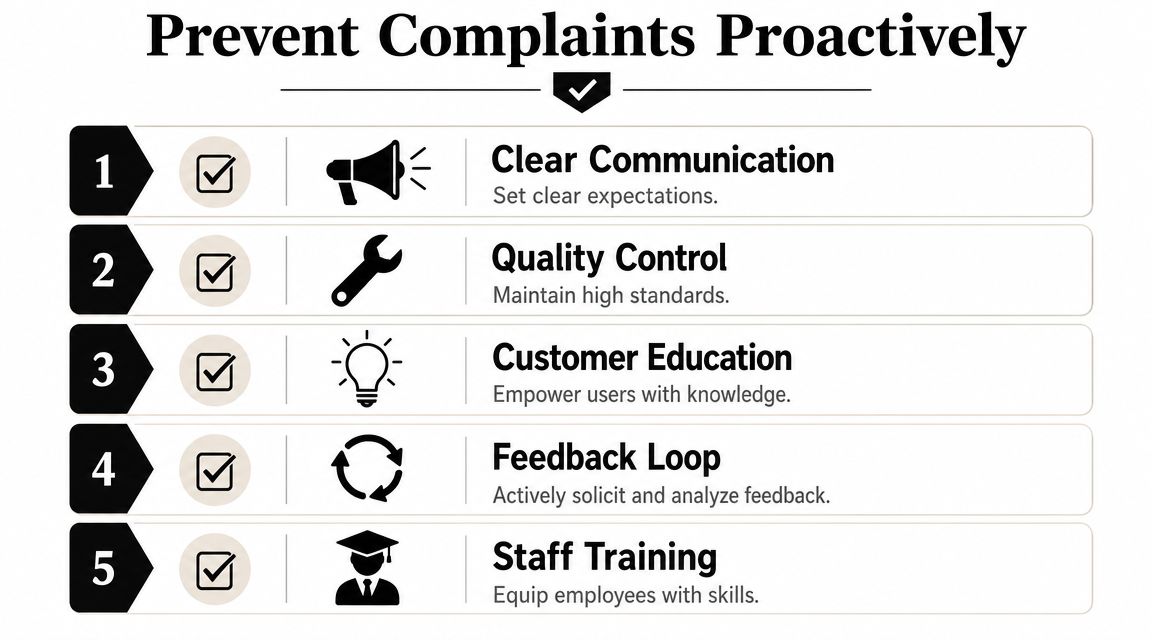
- Foggy expectations: The client thought something was included when it wasn't.
- Poor communication: Nobody gave an update, so the homeowner filled in the blanks.
- Messy handoff: Sales knew one thing, production knew another.
- Weak closeout: Small punch items sat too long and became trust issues.
Simple prevention habits that actually work
You don't need a massive policy manual. You need a few habits done every time.
Use painfully clear contracts
Spell out scope, exclusions, allowances, change-order rules, access needs, cleanup expectations, and likely disruption points. If something commonly causes confusion, put it in writing before the job starts.Send weekly updates even when nothing changed
Silence makes homeowners nervous. A short weekly message saying what happened, what's next, and what decisions are needed goes a long way.Explain the messy parts before they happen
Dust, noise, delays, lead times, and hidden conditions should never arrive as a surprise. If you say it early, it feels like planning. If you say it late, it feels like excuse-making.Do a preemptive walkthrough at key milestones
Don't wait for the final punch list to discover frustration. Walk the space during the job and ask, “Is anything worrying you right now?” You'll catch small irritation before it hardens.Finish with a real closeout process
Final walkthrough. Written checklist. Clear next actions. Warranty information. One last chance for questions.
Owner mindset: Prevention is not extra admin. It's cheaper than conflict, cleaner than damage control, and better for referrals.
A simple prevention checklist looks like this:
| Phase | Prevention action |
|---|---|
| Sales | Set realistic expectations |
| Contract | Clarify scope and exclusions |
| Pre-construction | Explain process and disruptions |
| Production | Give regular updates |
| Closeout | Use a formal walkthrough and checklist |
Teams that get good at responding to complaints usually discover something important. The same system that handles complaints also reveals why they keep happening. If three clients complain about the same handoff, update the handoff. If several complain about silence during delays, fix communication standards.
That's how you stop treating every complaint like a random storm and start treating it like useful business feedback.
Frequently Asked Questions
What if the homeowner is being untruthful
Treat it as a documentation problem, not an argument.
Your CRM becomes your primary tool here. Pull the project record, review the contract, photos, site notes, texts, emails, change orders, and timeline entries, then answer from that file only. Use direct language such as, “Our project record shows…” or “According to the signed change order dated…”
Do not accuse the homeowner of lying. Do not improvise from memory. A clean record protects your position, keeps your team consistent, and gives you something solid to use if the complaint spreads to email, review sites, or legal counsel.
Should you offer a discount just to make a bad review go away
No, not as a default response.
If your team made a real mistake, log the issue in the CRM, assign the corrective action, set a deadline, and complete the remedy. That may be a repair, a return visit, or a scope clarification in writing. Tie any goodwill gesture to a documented service failure, not to pressure.
If you hand out discounts every time someone gets loud, you train clients to negotiate through threats and you weaken your standards.
What if the complaint comes from someone who was never a real client
Create a record anyway.
Open a complaint entry in your CRM, note where the comment appeared, capture screenshots, log the name used, and check whether the person matches any lead, customer, or household in your database. Then post a short public reply that stays neutral: you take concerns seriously, you could not verify the project from the information provided, and your office is available to confirm details directly.
That response shows control. The CRM record gives you a paper trail if the platform asks for evidence or the situation escalates.
What if your employee caused the problem with rude behavior
Split the response into two tracks.
First, resolve the homeowner issue. Log the complaint in the project record, note who was involved, what was said, and what service recovery you offered. Second, open an internal follow-up record for the employee. Document the coaching conversation, the expectation you reset, and any next step such as retraining, a written warning, or removal from that jobsite.
Homeowners remember conduct as much as craftsmanship. If your team is inside someone's home, professionalism is part of the deliverable.
How long should you keep complaint records
Keep them long enough to defend the job and improve the business.
Set a written retention policy tied to your legal, insurance, and warranty requirements, then store every complaint under the project file in your CRM. Include the original issue, timestamps, messages, photos, internal notes, resolution steps, and closeout status.
The point is not just storage. It is pattern tracking. If the same complaint keeps showing up across projects, you have an operating issue to fix.
If your remodeling company wants better lead handling, tighter follow-up, and a CRM that supports the whole customer journey, not just the sale, Constructo Marketing helps remodelers build systems that protect reputation and capture more of the right projects.