


Most advice about general contractor markup is too soft and too shallow. It says, “Just add a percentage,” like pricing is a garnish you sprinkle on top of a bid. That’s how contractors stay busy, stressed, and broke.
Bad markup math doesn’t just trim profit. It starves your business. It leaves no room for supervision, warranty work, estimating time, office payroll, insurance, vehicles, and the mistakes every real project brings. Then owners wonder why they’re selling jobs and still feel like they’re losing.
If you run residential remodels, markup is not a dirty word. It’s the engine that keeps the company alive. It pays for quality. It pays for communication. It pays for the systems that keep a kitchen remodel from turning into chaos.
Table of Contents
- What Is General Contractor Markup Anyway
- The Dangerous Mix-Up Between Markup and Margin
- How to Calculate Your Markup for Any Job
- Setting Your Markup Rate Based on the Project
- Advanced Pricing to Guarantee Your Profit
- How to Explain Your Pricing to Homeowners
- Building a Business That Lasts
What Is General Contractor Markup Anyway
General contractor markup is the amount you add to direct job costs to cover overhead, protect the company from risk, and produce real profit.
That definition matters because plenty of contractors price work as if the only thing that counts is labor and materials. Then the office rent, insurance, estimating time, project management, callbacks, trucks, software, and owner salary hit the P&L later. That is how good builders stay busy and still go broke.

Markup is not a random fee you tack on because “that’s what contractors do.” It is the engine that pays for the parts of the job homeowners do not see but absolutely depend on. Clean scheduling. Fast communication. Supervision. Warranty follow-through. A company that still answers the phone six months after final payment.
What markup pays for
If your markup is too thin, the business eats the cost of running the business. That never ends well.
- Overhead pays for insurance, office staff, software, phones, vehicles, rent, permits, and all the fixed costs that keep the company operating.
- Project management pays for estimating, ordering, scheduling, site visits, coordination with trades, client updates, and the time spent solving problems before they become expensive.
- Risk gives you room for damaged materials, jobsite delays, scope friction, small mistakes, and warranty callbacks.
- Profit gives the company cash to survive slow periods, hire better people, improve systems, and stay healthy enough to stand behind the work.
If you want a clearer breakdown of how markup connects to profitability, review this guide on construction profit margin for contractors. It helps frame markup as a business system, not a gut-feel percentage.
You should also know how to measure service business profitability so you can see whether your pricing supports the company you are trying to build.
Why homeowners should want you to have markup
Homeowners do not win when you strip markup to make the number look prettier. They get a contractor with no cushion, no capacity, and no staying power.
Healthy markup funds the structure behind quality. It pays for planning before demo starts. It pays for supervision that catches mistakes early. It pays for the admin work that keeps allowances, change orders, and schedules from turning into chaos. It also gives you enough profit to remain selective, do the work right, and honor the warranty without resentment.
Here is the plain truth. If your price only covers visible job costs, your business is subsidizing every project. That is not generosity. It is bad math.
The Dangerous Mix-Up Between Markup and Margin
A lot of good contractors get hurt. They use the word “margin” when they mean “markup,” or the other way around, and the bid comes out too low.
That sounds like a small vocabulary problem. It isn’t. It’s a math problem that can wreck cash flow for years.
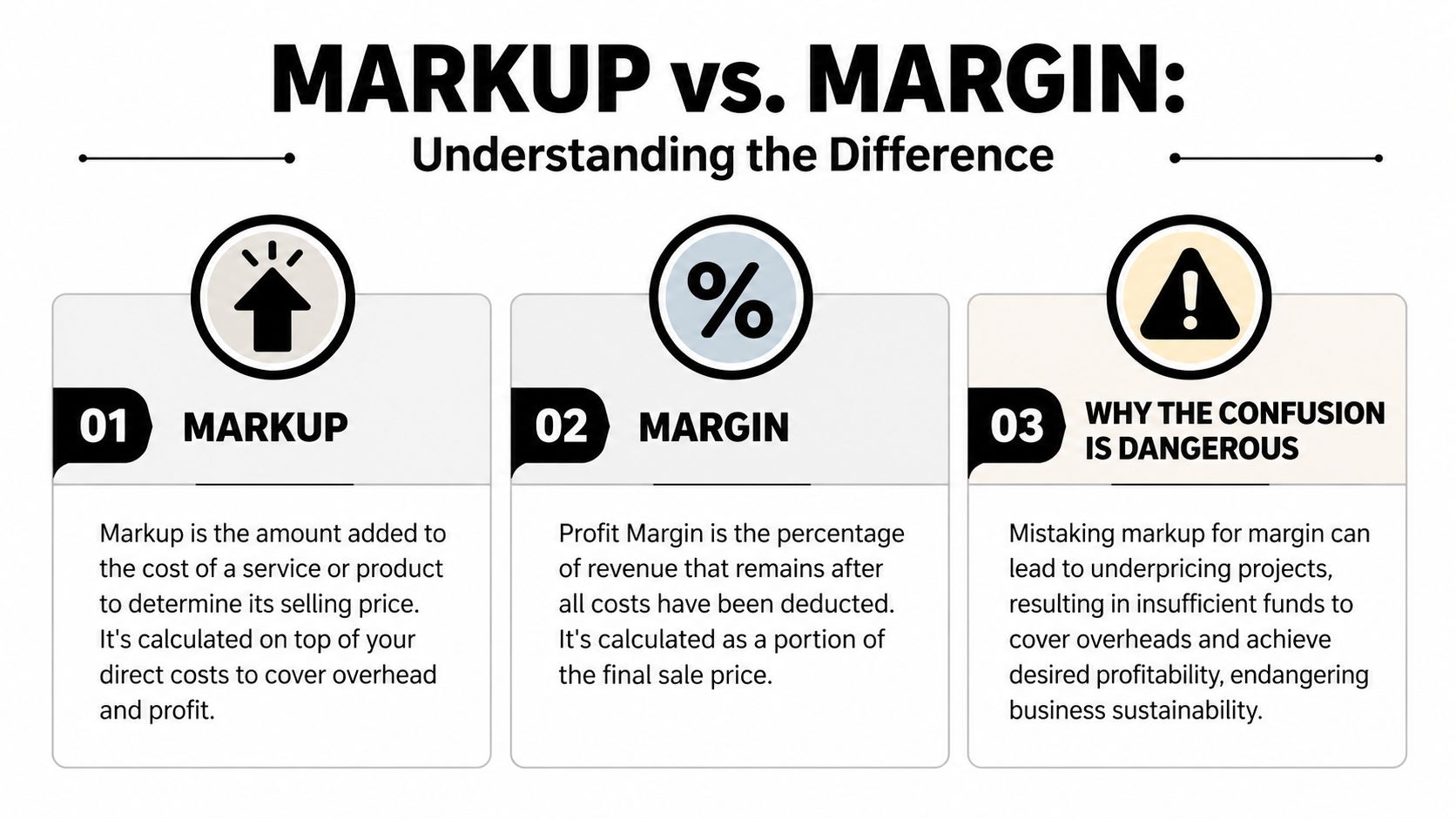
Markup goes up from cost
Markup starts with what the job costs you.
The formula is simple: ((Selling Price – Cost) / Cost) x 100. That tells you how much you added on top of cost. If something costs you one amount and you sell it for more, markup measures the increase from your cost base.
That’s why contractors often talk in markup language. It fits the estimating process. You total direct costs, then add what the business needs.
Margin looks back from the final price
Margin is different. Margin looks at the final selling price and asks, “What share of this sale is left after costs?”
Those are not twins. They are cousins. If you treat them like the same thing, you underprice.
The clearest example from Angi’s explanation of contractor markup is this: a 15% to 20% markup often yields only 1.4% to 2.4% in net profit, and a contractor who wants a 35% margin requires a 54% markup.
If your estimate says “I added profit,” but your bank account says “where did it go,” you probably mixed up markup and margin.
If you want a cleaner way to measure service business profitability, study gross profit and net profit separately. Too many remodelers mash everything together and then wonder why the numbers feel slippery.
Why this mistake wrecks contractors
Here’s what happens in real life.
You think a markup percentage equals your take-home profit. It doesn’t. Overhead eats first. Waste eats next. Rework takes a bite. Small misses across several line items finish the job. The proposal looked fine. The checking account tells the truth later.
Use this rule: estimate with markup, manage with margin, and review both every month. If you need a plain-English refresher on industry expectations, this construction profit margin guide is a useful companion.
| Term | What it measures | Where contractors go wrong |
|---|---|---|
| Markup | Amount added on top of cost | They think it equals final profit |
| Margin | Share of revenue left after costs | They don’t back into it before pricing |
The contractor who understands both doesn’t just bid better. He sleeps better.
How to Calculate Your Markup for Any Job
Bad markup math does not show up at the estimate meeting. It shows up halfway through the job, when cash is tight, selections changed twice, and you realize the “profit” was never there.

Start with the formula, then use it correctly
Use this formula for general contractor markup:
((Sale Price – Costs) / Costs) x 100
If a job costs you $80,000 and you sell it for $100,000, your markup is 25%.
Simple. But simple does not mean careless.
The mistake is treating markup like a single number you toss on the bottom of an estimate. Strong pricing starts with real costs, then applies markup where the business is carrying risk, coordination, and liability.
Build the estimate by cost category
Do not throw one blanket markup across the whole job. That shortcut hides risk and leaves weak spots in your price.
Break the estimate into categories:
Materials
Cabinets, flooring, fixtures, tile, trim, hardware, and finish items. Custom, fragile, delayed, or non-returnable materials need more protection than commodity products sitting on a shelf.Labor
Mark up your in-house labor. If you skip labor markup, you are telling yourself that supervision, payroll burden, callbacks, and schedule management cost nothing.Subcontractors
Electrical, plumbing, HVAC, roofing, glass, and specialty trades still consume your time. You scheduled them, coordinated them, handled questions, and carry the client relationship. Their bid is not a pass-through.Project-specific extras
Permits, dumpsters, site protection, temporary facilities, delivery handling, design coordination, and cleanup often get missed. Miss enough of these and the job funds itself out of your checking account.
A profitable estimate is a series of correct decisions, not one lucky percentage.
Use a simple calculation process on every job
Follow the same sequence every time.
First, total your direct costs by category.
Next, add any project-specific expenses that do not sit neatly inside labor or materials.
Then apply markup to each category based on the exposure you are carrying.
Finally, review the full selling price and ask one hard question: does this price pay for the actual work of delivering the project well?
That last step matters. Markup is not just a fee added to cost. It funds project management, communication, warranty protection, estimating time, and the stability homeowners expect when they hire a professional remodeling company.
Example of markup by category
Say you are pricing a kitchen remodel.
- Materials: $32,000
- Labor: $18,000
- Subcontractors: $14,000
- Project-specific extras: $6,000
Total cost: $70,000
If you decide the right selling price is $91,000, your markup is:
(($91,000 – $70,000) / $70,000) x 100 = 30%
That gives you the headline number. But the better move is to check whether each category got enough protection. If the cabinets are custom, the tile is special order, and the homeowner is still making layout changes, your material and coordination exposure is higher than average. Price that reality into the estimate before the job starts, not after the headaches arrive.
Clean systems protect your markup
Sloppy purchasing wrecks good estimating.
If field buys, supplier invoices, and change approvals are scattered across text messages, paper receipts, and memory, your job costing will be wrong. Wrong job costing leads to weak markup decisions on the next project too.
That is why many remodeling companies automate purchase orders and tighten approval workflows before materials get ordered. Clean purchasing gives you cleaner cost data. Cleaner cost data gives you pricing you can trust.
If you want a fast way to test different pricing scenarios before sending a proposal, use this remodeling pricing calculator. It is a practical way to pressure-test the math before a bad number turns into a bad job.
Setting Your Markup Rate Based on the Project
A bathroom refresh and a full home addition should not get priced with the same brain.
Some jobs are simple. Some are landmines with nice finishes. If you use one flat general contractor markup for everything, you’ll undercharge on the risky work and overcomplicate the easy work.
Some jobs deserve a higher markup
Raise markup when the job has more uncertainty, more handholding, or more chances for expensive mistakes.
A smart estimator looks at the whole picture:
- Complexity matters. Custom details, hidden conditions, phased work, and occupied homes create more management load.
- Coordination matters. The more trades, selections, inspections, and delivery points involved, the more opportunity for slippage.
- Risk matters. Non-returnable finishes, long-lead materials, and fussy clients all increase the chance that your team absorbs cost.
- Job size matters, but not in the way many owners think. Smaller jobs often still demand a lot of estimating, communication, and site management.
Experience proves its worth. You are not pricing hammers and tile alone. You are pricing the difficulty of getting the project to the finish line without drama.
Your market matters too
You also have to account for cost pressure outside your office. Turner’s building cost update says the Turner Building Cost Index rose 3.62% year over year in Q1 2025, while residential construction inflation is forecast at +5.0% for 2025, and single-family housing starts are projected to grow to 1.13 million units by 2025.
That matters for remodelers. If labor tightens, materials drift upward, and homeowner demand stays active, a weak markup becomes a slow leak in every signed contract.
Use a decision filter before final pricing:
| Project factor | What it usually means for markup thinking |
|---|---|
| Custom selections | Add protection for sourcing, damage risk, and replacement issues |
| Occupied home | Add room for site protection, communication, and slower production |
| Heavy trade coordination | Add room for management time and schedule pressure |
| Volatile costs | Don’t price like inputs will sit still |
The right markup rate is not the one you heard at a networking event. It’s the one that fits the actual risk sitting in front of you.
Advanced Pricing to Guarantee Your Profit
Most contractors price from habit. Better contractors price from intention.
If you want profit on purpose, stop starting with, “What markup should I add?” Start with, “What result does the business need?” Then work backward.
Work backward from the margin you want
In cost-plus work, this matters even more. According to Buildern’s guide to contractor markup, remodelers often use 20% to 50% on materials and 25%+ on labor, and the key conversion is this formula:
Markup % = Desired Margin / (1 – Desired Margin)
That same source gives the number most contractors need to tattoo on their estimating hand: to achieve a 35% margin, you need a 54% markup. Miss that conversion and profits can get compressed to 1.4% to 2.4%.
That’s the shift. You stop guessing. You stop copying competitors. You choose the margin your business needs, then calculate the markup required to support it.
Margin goal to markup formula
Use this table as a simple reminder of the relationship:
| Desired Profit Margin | Required Markup |
|---|---|
| 35% margin | 54% markup |
One line is enough to make the point. Margin goals and markup percentages are not interchangeable.
Coach’s note: If you want predictable profit, decide the outcome first and let the formula tell you the markup, not the other way around.
Use tiered markup on purpose
Cost-plus pricing gets stronger when you stop treating every cost item the same.
Use lower markups on straightforward commodity items if you need to stay competitive. Use higher markups where your risk is higher, such as custom orders, complex sourcing, or categories with frequent damage and reorder headaches. Do the same with labor and subcontracted scopes that demand serious supervision.
This is also where operations help pricing. If you’re exploring practical AI automation for SMBs, focus on tools that reduce estimating errors, track approvals, and tighten job costing. Better data won’t magically fix a bad pricing strategy, but it will stop your team from making the same pricing mistake over and over.
How to Explain Your Pricing to Homeowners
A lot of contractors know their number is fair, but they present it like an apology. That kills trust.
Homeowners don’t need a finance lecture. They need a clear reason your price is your price. If you sound nervous, they get nervous. If you sound like you pulled the number out of the air, they treat it like a yard sale.

Stop defending the number
Don’t say, “I know it seems high.”
Don’t say, “I can probably sharpen my pencil.”
Don’t say, “That’s just our markup.”
Say what the homeowner is buying. They’re buying planning, coordination, communication, craftsmanship, accountability, and a company that will still answer the phone after the last invoice clears.
Use plain language like this:
- “This price includes the management required to keep the project moving.”
- “We don’t treat supervision, scheduling, and communication like free extras.”
- “Our pricing supports licensed trades, insurance, and follow-through if something needs attention later.”
That’s honest. It’s also easier to respect than a vague percentage.
Simple language that homeowners understand
Homeowners understand value when you translate the number into outcomes.
Try these scripts in a sales conversation:
“You’re not just paying for materials and labor. You’re paying for a project that is organized, supervised, and finished professionally.”
“A lower bid can look attractive, but if it leaves out management time or risk protection, the job often gets more expensive later.”
You don’t need to reveal every internal calculation. You do need to explain what professional pricing makes possible.
A simple framework works well:
Scope
Explain what’s included, what isn’t, and where allowances or selections could change cost.Protection
Explain that real businesses carry insurance, manage permits, coordinate trades, and stand behind the work.Experience
Explain that the team prices for the actual complexity of the job, not for fantasy conditions.Reliability
Explain that your number supports communication, scheduling, documentation, and closeout.
When you say it clearly, markup stops sounding like a fee and starts sounding like what it is. The support structure behind a quality remodel.
Building a Business That Lasts
The contractors who survive don’t just build well. They price well.
General contractor markup is not a trick, and it’s not greed. It is the money that keeps the doors open, the trucks running, the team paid, the insurance active, and the promises funded. If you get this wrong, the rest of the business gets shaky fast.
Keep the core lessons simple.
- Know what markup is. It’s money added above cost so the business can operate and profit.
- Stop confusing markup and margin. That mix-up causes weak pricing and surprise disappointment.
- Price by category and by risk. Materials, labor, and subcontractors do not all deserve the same treatment.
- Sell the value with confidence. Homeowners don’t need a discount speech. They need clarity and trust.
If you want to grow, act like an owner, not just an estimator. Review your numbers. Audit your assumptions. Tighten your purchasing. Protect your labor. And stop copying the cheapest contractor in town.
A busy contractor can still be broke. A disciplined contractor has a chance to build something durable. If you want a stronger foundation for that growth, this general contractor business plan resource is a good next step.
If you want help turning sound pricing into stronger lead flow, better close rates, and a steadier remodeling business, talk to Constructo Marketing. They work with remodelers who want more than traffic. They want the right local projects, better systems, and a business that runs with more confidence.