


You're probably living this right now. You spend money on ads, SEO, lead platforms, maybe even social media, and the phone still rings with the wrong people. They want a bathroom for a bargain price, a kitchen “sometime next year,” or a whole-home remodel on a tiny budget. Meanwhile, the homeowners who can afford a $75K to $300K project either never see you or never remember your name.
That's the core problem. Most remodelers aren't losing because they do bad work. They're losing because their marketing is too broad. It's like throwing yard signs across an entire county when you only want to build in three neighborhoods with the right homes, right income levels, and right project potential.
Location based marketing fixes that. Not the gimmicky version. The practical version. The kind that helps you show up in the exact places where better-fit homeowners live, search, shop, and compare contractors.
If you want a plain-English breakdown of how targeting works beyond just location, this guide to demographic, geographic, psychographic, and behavioral segmentation is worth reading too. It helps you stop treating every homeowner like the same buyer.
Table of Contents
- Stop Marketing Everywhere and Start Marketing Somewhere
- What Is Location-Based Marketing Anyway
- Your Digital Toolbox Six Key Tactics Explained
- Putting It Into Practice Examples for Remodelers
- Measuring What Matters ROI for High-Ticket Projects
- Your Blueprint for Getting Started This Month
- Become Famous in the Neighborhoods That Matter
Stop Marketing Everywhere and Start Marketing Somewhere
Most remodeling owners market like they're bidding on every house in town. That's a mistake. If you want profitable work, you need to stop thinking like a general advertiser and start thinking like a builder doing site selection.
You wouldn't break ground on random land. You'd study the lot, the access, the budget, and whether the project fits your business. Marketing should work the same way.
Why broad marketing attracts bad-fit leads
When you advertise to everyone in a city, you invite noise. Low-budget shoppers click. Renters poke around. People outside your service area fill out forms. Then your team wastes time sorting junk from the few real opportunities.
For a high-ticket remodeler, that's backwards.
You don't need more eyeballs. You need the right homeowners in the right areas seeing the right message. A whole-home addition campaign should reach established neighborhoods with larger lots and older homes. A luxury kitchen campaign should show up where home values and expectations support that kind of investment.
Practical rule: If a neighborhood rarely produces your ideal jobs, stop paying to be visible there.
What “somewhere” really means
“Somewhere” doesn't just mean your city. It means the exact pockets where your best jobs come from.
That can include:
- Target zip codes: Areas where you've already closed profitable work
- Specific subdivisions: Neighborhoods with aging homes ready for updates
- Nearby design-related places: Showrooms, flooring stores, cabinet dealers, and similar local stops where homeowners start planning
- Tight service lanes: Places your crews can reach without turning scheduling into chaos
Location based marketing earns its keep. It helps you focus budget like a laser instead of spraying it like a broken hose.
What changes when you narrow the map
Once you shrink your target area, your message gets sharper. Your ads can mention the neighborhoods you serve. Your website can show nearby projects. Your Google presence can align with the places you want to dominate.
That's when marketing starts feeling less like gambling and more like estimating. You know what you're targeting, why you're targeting it, and what kind of job should come out the other end.
What Is Location-Based Marketing Anyway
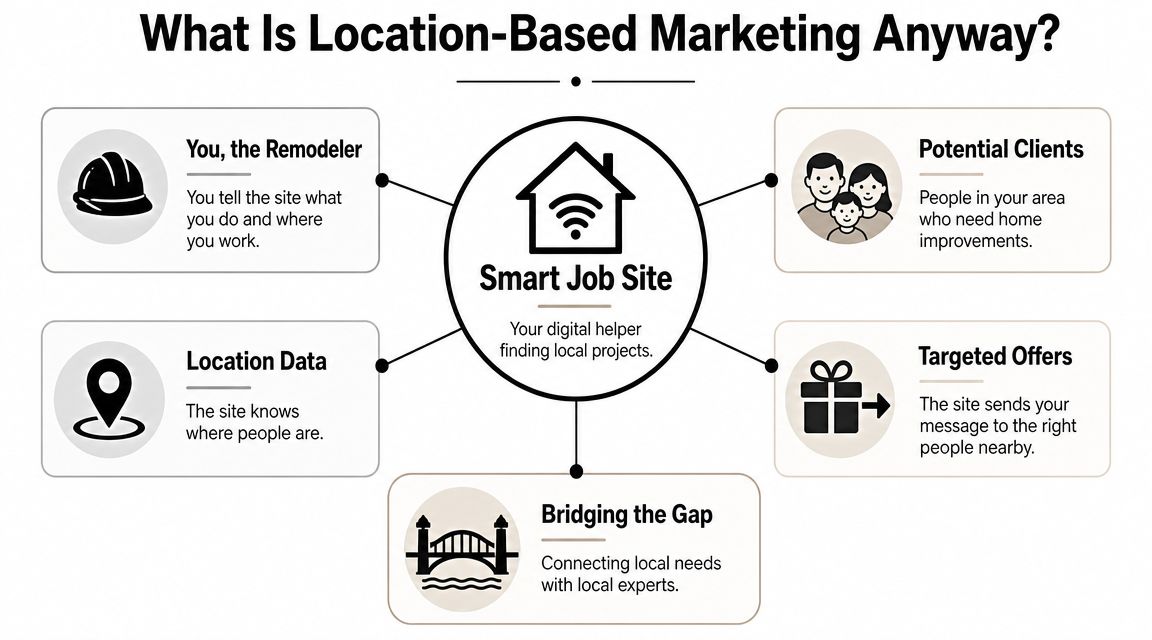
Location-based marketing puts your remodeling company in front of homeowners based on where they are, where they live, or where they're searching from.
For a remodeler chasing $75K to $300K projects, that matters. You do not need more random clicks from across the metro. You need to show up for the homeowners in the neighborhoods that can support a major kitchen, addition, whole-home remodel, or design-build project.
The simple version
You set the map.
Then your marketing tools help your business appear in the right places. That can mean local search results, map listings, paid ads, and neighborhood-specific pages on your website.
The goal is simple. Be visible where qualified homeowners are already looking, planning, and comparing options.
If you want a clear example, Google Local Service Ads for contractors put your business in front of nearby homeowners who are actively searching for help.
Why this matters for high-ticket remodelers
A bathroom handyman and a design-build remodeler should not market the same way.
Location-based marketing helps you filter for the kind of areas that produce profitable work. Older neighborhoods with strong home values. Established subdivisions where owners would rather renovate than move. Pockets near design showrooms, cabinet dealers, and premium home service businesses, where planning often starts.
Analysts at Business Research Insights report the location-based marketing market is projected to grow sharply through 2035, while also noting that 45% of location-based messages get ignored when people see them as irrelevant. That is the part remodelers need to pay attention to. Tight targeting alone does not save a bad offer or a generic message.
A badly aimed location campaign works like putting a high-end kitchen proposal in the wrong mailbox. You spent money, but it never had a real shot.
What it looks like in the field
Here is what location-based marketing looks like for a residential remodeler, not a retail chain trying to drive foot traffic:
| Situation | Smart location move |
|---|---|
| You want more luxury kitchens | Focus on older, higher-value neighborhoods with homes worth improving |
| You want additions | Prioritize family-heavy areas where people are staying put and need more space |
| You want design-build projects | Show up around local design centers, cabinet showrooms, and premium home service corridors |
| You want stronger local search visibility | Build pages and map signals around the specific towns and neighborhoods you actually want |
This same local intent shows up in other home-service searches too, whether someone is hunting for a remodeler or typing organic lawn service near me into Google. People look for nearby help. Your job is to make sure you appear in the right nearby places.
That is location-based marketing. It is disciplined visibility tied to the parts of town that fit your project size, margins, and crew capacity.
Your Digital Toolbox Six Key Tactics Explained
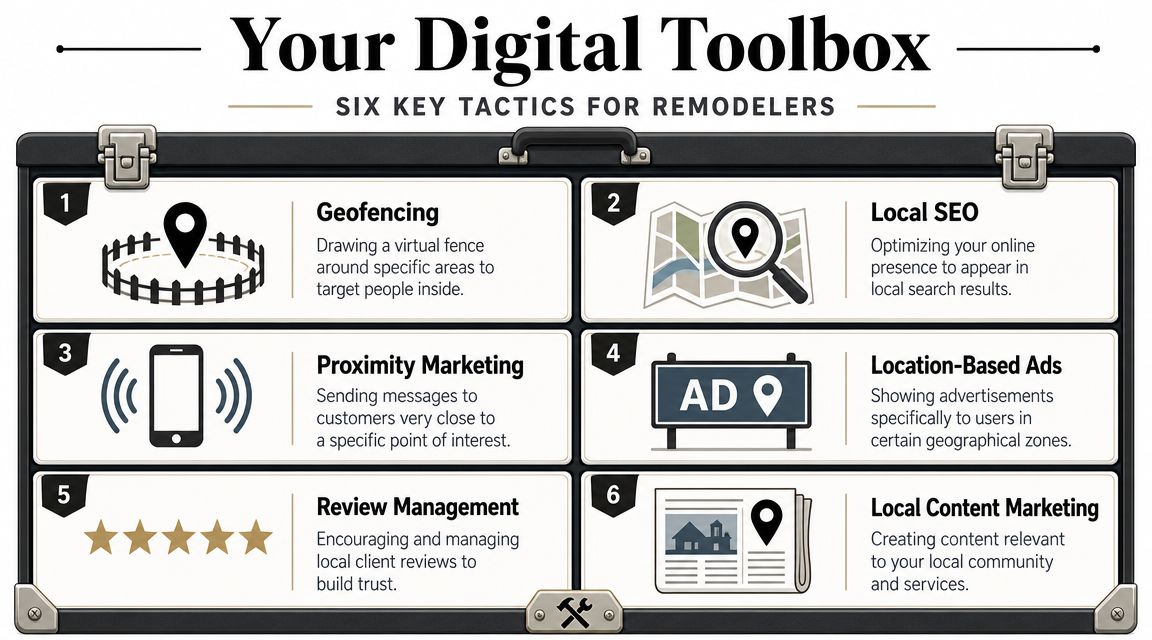
Location based marketing isn't one tool. It's a toolbox. Some tools are for broad coverage. Some are for precision cuts. If you use a framing nailer when you need a finish nailer, the job gets messy fast.
Geotargeting and geofencing are not the same thing
People mix these up all the time.
Geotargeting is broad. Think city, zip code, or service area. It helps you tell platforms, “Show my ads or content in these parts of town.”
Geofencing is tighter. Think one neighborhood, one showroom, one competitor location, or one event footprint. It's a digital fence around a very specific place.
For remodelers, you usually need both. Geotargeting helps you own the market zones you want. Geofencing helps you isolate high-value pockets inside them.
Precision matters more than most marketers admit
Not all location signals are equal. GPS is typically accurate to about 5 to 10 meters, Wi-Fi positioning about 10 to 25 meters, and cell-tower methods roughly 100 meters to 2 kilometers. That's a huge difference.
If you're trying to target a specific design showroom, GPS and Wi-Fi are useful. If you're trying to understand a broader neighborhood pattern, cell-tower data may be enough. But if someone sells you “precise” targeting without explaining the underlying signal, be careful.
A remodeler should ask one basic question: How close can this tool get me to the place I care about?
The six tools that matter most
Here's the toolbox I'd focus on.
- Geofencing: Use it like a velvet rope. Draw a boundary around a high-value subdivision, a home show, or a premium kitchen and bath showroom.
- Local SEO: This is how you show up when someone searches for your service nearby. If homeowners type “home addition contractor near me,” your business needs local relevance, not just a pretty website.
- Google Business Profile: This is your digital storefront on Google Maps. It needs complete service details, strong photos, review activity, and real location signals. This Google Business Profile checklist for remodelers is a solid reference if yours is half-finished.
- Location-based ads: These are paid ads shown in selected geographic zones. They work well when you already know where your ideal clients live.
- Review management: Reviews act like referrals that scale. Local homeowners want proof from nearby projects, not vague praise from across the state.
- Local content marketing: Write and publish content tied to the neighborhoods, project types, and homeowner concerns you serve.
A quick construction-style analogy
Think of these tools like this:
| Tool | Construction analogy | Best use |
|---|---|---|
| Geotargeting | Marking the whole lot | Broad service-area visibility |
| Geofencing | Taping off one room | Tight targeting around a specific place |
| Local SEO | Street signage to the site | Capturing “near me” demand |
| GBP | Your model-home front desk | Building trust on Maps |
| Reviews | Client references | Reducing hesitation |
| Local content | Your project portfolio binder | Showing relevance before the call |
One trap to avoid
Don't confuse local intent with random proximity.
Someone standing near a flooring store might be a serious remodeling prospect. Someone driving past it might be on the way to lunch. The same logic applies in adjacent home services. A homeowner searching for organic lawn service near me has clear local intent because the search is tied to a nearby property need. Remodeling searches and location signals work the same way when they're set up properly.
The best campaigns don't just find people near a place. They find people near a place who are likely to need your type of project.
If you want outside help setting up the system side of this, one option in the remodeling space is Constructo Marketing, which combines local SEO, Google Ads, websites, and CRM tracking for remodelers. That kind of integrated setup matters because location tactics fall apart when the lead capture and follow-up process is weak.
Putting It Into Practice Examples for Remodelers
Theory is nice. Jobs are better. Here's what location based marketing can look like when a remodeler uses it with common sense.
Example one targeting move-up neighborhoods
A design-build firm wants larger additions and whole-home renovations. Instead of advertising across the entire metro, they focus on older, established neighborhoods where families love the school district but have outgrown the house.
Their ad copy doesn't talk like a generic contractor. It speaks directly to staying in the home you already love and redesigning it to fit the next stage of family life. Their project gallery highlights nearby homes with similar architecture.
That's the key. The location sets the context, and the message matches it.
Example two owning a few zip codes
A kitchen remodeler decides to stop chasing every lead in the county. They pick three zip codes with strong home values, plenty of aging kitchens, and manageable drive time.
Then they align everything. Their Google Business Profile reflects kitchen-specific services. Their local landing pages mention those communities. Their reviews showcase homeowners from the same small cluster of areas.
This is why location-targeted advertising keeps growing. Advertisers spent at least USD 57 billion on location-targeted campaigns in 2025, and the same source says nearly 90% of consumers prefer personalized ads over non-personalized ones. Personalized doesn't just mean using a first name. It means showing the right offer in the right local context.
Example three borrowing intent from related home upgrades
An outdoor living contractor notices that homeowners planning exterior upgrades often think in bundles. If they're doing a pool, patio, or major backyard overhaul, they may also be thinking about hardscape, shade structures, or a future home addition.
That contractor creates content around adjacent homeowner decisions and uses it to attract local planning-stage traffic. For example, a homeowner researching new home landscaping options in Peoria is often in the early phase of shaping how they want the property to live and feel. That kind of intent can overlap with premium outdoor living and renovation work.
What these examples have in common
None of these remodelers market like a billboard company. They act like specialists.
They choose a small area, a specific project type, and a message that fits the homeowners there. That's why location based marketing works for higher-ticket remodeling. It doesn't just pull in traffic. It helps pre-frame the kind of job you want.
Measuring What Matters ROI for High-Ticket Projects
A kitchen remodel lead is not a win. A signed $180,000 project in the right neighborhood is.
That distinction matters because location-based marketing can make weak performance look strong. A report packed with clicks, impressions, and map views may look polished, but those numbers do not tell you whether your campaign is bringing in homeowners who can fund a whole-home remodel, a major addition, or a premium kitchen project.

Why vanity metrics get remodelers in trouble
High-ticket remodeling has a long sales cycle and a small number of valuable wins. That changes how you judge marketing. Ten cheap leads from the wrong zip codes can waste more time than one serious inquiry from the right subdivision.
Location targeting makes that problem sharper, not easier. If your map, radius, or audience filters are sloppy, you will pay to reach homeowners outside your service sweet spot or below your project minimum. The result looks like activity, but it behaves like rework on a jobsite. More motion. Less profit.
If your agency or vendor cannot connect local targeting to qualified consultations, proposals, and signed jobs, the reporting is not useful.
Ask one question first. How many right-fit homeowners from this area turned into real opportunities?
What remodelers should track instead
Track the numbers that tell you whether a campaign is feeding the kind of backlog you want:
- Qualified leads by area: Which neighborhoods produce homeowners that match your budget floor, project type, and service model
- Consultation rate: Which campaigns turn inquiries into scheduled appointments
- Proposal volume by location: Which areas generate serious buyers, not casual shoppers
- Closed project value by source area: Which zip codes, towns, or subdivisions lead to signed work
- Sales quality: Which campaigns bring in homeowners who understand timelines, design fees, and premium project costs
Those metrics fit the way a remodeling business works. You are not trying to fill a restaurant at lunch. You are trying to win a handful of large projects with healthy margins.
A simple scorecard
Keep the scorecard plain and strict.
| Metric | Weak version | Useful version |
|---|---|---|
| Leads | Total form fills | Qualified homeowner leads from target areas |
| Traffic | Website sessions | Calls and consultations tied to local campaigns |
| Ad performance | Click-through rate | Signed projects sourced from location efforts |
| Market coverage | Citywide visibility | Share of leads and revenue from profitable neighborhoods |
You do not need complicated reporting software to do this well. You need a CRM your team uses. Tag every lead by source, neighborhood, and project type. Then follow that lead through consultation, proposal, and close.
That process shows you where location-based marketing is producing revenue, and where it is just burning through budget.
Your Blueprint for Getting Started This Month
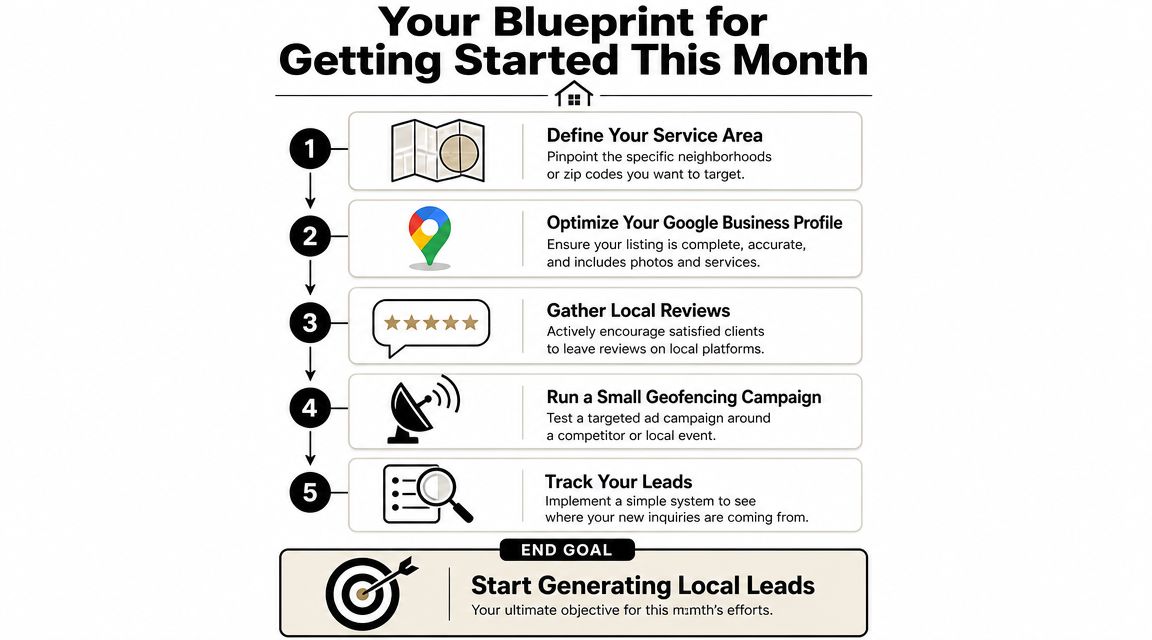
Don't overbuild this. Most remodelers make location based marketing sound harder than it is. Start like you'd start a renovation. Scope the job, check the foundation, and build one clean phase at a time.
Step one define the map
Pick the neighborhoods, zip codes, or towns that match your ideal jobs. Use your own history first. Where did your best projects come from? Which places had the least friction, strongest budgets, and best referral potential?
Don't choose areas just because they're close. Choose them because they fit your business.
Step two clean up your local foundation
Before you spend a dollar on ads, make sure your basics are solid.
Check these first:
- Google Business Profile: Services, categories, service area, photos, and business details
- Website pages: Clear service pages for the project types you want most
- Project portfolio: Photos and descriptions that match homes in your target neighborhoods
- Reviews: Recent feedback that reinforces trust and local relevance
If your online presence looks generic, location targeting won't save it.
Step three launch one tight campaign
Start small. One geofenced area or one focused local ad set is enough to learn.
Use precise boundaries. Expert guidance recommends polygon-shaped geofences and POI matching instead of simple circular radii, and adding dwell-time thresholds to reduce false visits and pass-by traffic. That matters because circles often catch people who were merely nearby, not actively engaged with the location.
A simple radius can act like painting with a broom. A polygon is closer to cutting trim with the right saw.
Step four match the message to the place
Your ad and landing page should fit the local context. If you're targeting an older upscale neighborhood, talk about preserving character while updating layout and function. If you're targeting a newer move-up area, focus on expanding without moving.
Bad local marketing says, “We do kitchens.”
Good local marketing says, “We help homeowners in this kind of neighborhood solve this kind of problem.”
Step five track every lead like a project file
Use a CRM or even a disciplined spreadsheet if that's what you have right now. Every lead needs a source, location tag, project type, and status.
Keep it simple:
- Mark the source: Google Maps, local ad, geofenced campaign, organic search
- Record the area: Zip code, subdivision, or town
- Note the project: Kitchen, bath, addition, whole-home, outdoor living
- Advance the status: Inquiry, consultation, proposal, sold, lost
- Review monthly: Look for patterns, not guesses
Small, well-tracked tests beat big messy campaigns every time.
What to do first if you're overwhelmed
If this all feels like a lot, do these three things this week:
- Choose three target neighborhoods
- Audit your Google Business Profile
- Build one page or campaign for one project type in one location cluster
That's enough to get momentum. You don't need a giant system on day one. You need a clear map and one honest test.
Become Famous in the Neighborhoods That Matter
The remodelers who win better projects usually aren't the loudest. They're the most visible in the right places.
That's the whole point of location based marketing. You stop burning budget on homeowners who were never a fit. You focus on the streets, subdivisions, and search zones where strong projects are hiding. Over time, you become the company people keep seeing when they're finally ready to move.
Use this quick checklist:
- Pick your top three target zip codes or neighborhoods
- Review your Google Business Profile photos and services
- Decide which project type you want more of first
- Launch one small local campaign instead of five scattered ones
- Track leads by area and project value, not just by click count
Do that well, and your marketing starts acting like a pipeline, not a gamble.
If you want help building a local-first system for higher-value remodeling jobs, Constructo Marketing works specifically with remodelers who want to become local famous in the neighborhoods that matter most.