


Generative Engine Optimization, or GEO, means shaping your website so AI answer engines can understand, trust, and cite your business, and research summarized in industry sources says adding things like statistics, sources, and quotations can improve visibility in generative answers by 30% to 40%. For a remodeler, that means GEO is the next version of showing up at the top of Google. It's about becoming the contractor the AI recommends when a homeowner asks who to hire.
Most advice on this topic is fluff. You'll hear people say, “Just use AI to write more blogs,” or “SEO is dead.” Both are lazy takes. Homeowners aren't just clicking blue links anymore. They're reading AI summaries, asking ChatGPT-style tools for recommendations, and letting those systems narrow their shortlist before they ever visit your site.
If you're a remodeling company chasing serious kitchen, bath, addition, or outdoor living projects, this matters now. The winner won't be the contractor with the fanciest jargon. It'll be the one who gives AI clear proof of expertise, local relevance, and trustworthy answers.
Table of Contents
- Why Your Old Google Strategy Is Breaking
- What GEO Really Is Explained for a First Grader
- How GEO Differs from Your Current SEO
- The Big Wins and Real Risks for Remodelers
- Your Practical GEO Strategy to Get Started
- Example Prompts and Simple Tools for Remodelers
- How to Know If GEO Is Working for You
Why Your Old Google Strategy Is Breaking
A lot of remodelers still think Google works the old way. Rank your homepage. Get a few backlinks. Stuff “kitchen remodeler near me” in the copy. Wait for the phone to ring.
That playbook is fading.
Google now puts AI-generated answers in front of the old list of links. Other platforms do the same thing. So the fight isn't only about being one of ten options anymore. It's about being part of the answer the homeowner sees first.
Google is turning into an answer engine
When a homeowner asks, “Who's the best contractor for a luxury bathroom remodel in my area?” AI tools try to summarize the field. They pull from websites that are easy to understand, easy to trust, and easy to cite.
That shift is big enough that Generative Engine Optimization is being treated as its own market. One market research report projects the GEO market will reach USD 1,089.3 million in 2026 and grow at 40.6% annually, which tells you this isn't a cute little side tactic anymore. It's a real category tied to AI search visibility, according to Dimension Market Research's GEO market projection.
If you still treat your website like an online brochure, you're behind.
Old SEO asked, “Can I rank?”
GEO asks, “Will the machine trust me enough to recommend me?”
Remodelers have to think beyond rankings
Traditional SEO still matters. You still need a solid site, local relevance, and service pages that make sense. If you need a refresher on those basics, this guide to SEO for online success covers the foundation.
But foundation isn't the same as edge.
The edge now comes from being the clearest local expert in your market. Not the noisiest. Not the cheapest. The clearest. If your site explains your process, your project types, your service area, your materials, your timelines, and your answers better than the contractor across town, AI has something useful to work with.
That's the point. GEO isn't magic. It's organized expertise.
What GEO Really Is Explained for a First Grader
Generative Engine Optimization is the practice of structuring and refining content so AI answer engines can accurately analyze, summarize, and cite it. The goal is machine interpretability, not just old-school search ranking, as explained in HubSpot's overview of how generative engine optimization works.
Said like a first grader would understand it, GEO means this: you're teaching a smart robot what your company is really good at.
Think of AI like a smart apprentice
Say you hire a new apprentice. He's bright. He works fast. But he only knows what you clearly teach him.
If you mumble, he gets confused.
If your instructions are messy, he guesses.
If you give him clean notes, he does a great job.
AI search works the same way.
Your website is the notebook. GEO is how you organize that notebook so the apprentice can open it, find the answer fast, and repeat it back correctly when a homeowner asks a question.
What the apprentice needs from your website
AI doesn't “feel” impressed by your brand slogan. It doesn't care that your homepage says “quality craftsmanship with integrity.” Every contractor says that. That copy is wallpaper.
What helps is simple, concrete structure like this:
- Clear service pages: One page for kitchen remodeling, one for bathroom remodeling, one for additions, one for design-build.
- Straight answers: A paragraph that directly answers a real homeowner question.
- Scannable headings: Headings that say what the section is about.
- FAQs and schema markup: Extra structure that helps machines sort the content.
- Entity-rich wording: Real terms like quartz countertops, aging-in-place design, design-build remodel, whole-home renovation, permit process, and your city names.
Here's the easy test. If a 10-year-old can tell what the page is about in five seconds, AI probably has a better shot too.
Practical rule: Write so a homeowner can skim it, and so a machine can extract it.
That means fewer fluffy intros and more useful language. Don't write “We transform spaces into timeless reflections of your lifestyle.” Write “We design and build kitchen remodels in Raleigh that include layout changes, custom cabinetry, island design, lighting plans, and permit coordination.”
That second version gives a homeowner confidence and gives AI something to work with.
How GEO Differs from Your Current SEO
Most remodelers hear “GEO” and assume it's just SEO with a new haircut. It's not. They overlap, but they're not the same job.
SEO helps your page show up in search results. GEO helps your business show up inside the answer itself.
SEO gets you found and GEO gets you chosen
Traditional SEO has trained contractors to obsess over rankings. That made sense when the goal was getting into the list.
Now the game is tighter. AI tools often pull a handful of sources, summarize them, and present one clean response. So your content has to be built for extraction, not just indexing.
That changes the mindset:
- SEO thinks in pages and positions
- GEO thinks in answers and citations
- SEO can tolerate some fluff
- GEO punishes fluff because fluff is hard to reuse
A page can rank in Google and still be lousy for GEO if it rambles, hides the answer, or says nothing specific.
GEO vs Traditional SEO at a Glance
| Aspect | Traditional SEO (Search Engine Optimization) | GEO (Generative Engine Optimization) |
|---|---|---|
| Goal | Rank higher in search results | Get cited or used in AI-generated answers |
| Main win | More visibility in the list of links | More visibility in the answer itself |
| Content style | Keyword-targeted, broad topic coverage | Direct answers, clear facts, clean structure |
| Ideal format | Strong pages, metadata, internal linking, backlinks | Extractable paragraphs, FAQs, headings, citations, quotes |
| What hurts you | Thin content, weak authority, poor local signals | Vague copy, missing evidence, hard-to-parse formatting |
| Best mindset | “How do I rank?” | “How do I become the trusted source?” |
GEO doesn't replace SEO
You still need local SEO. You still need a Google Business Profile, city pages that don't sound spammy, service pages with substance, and a site that loads cleanly.
But if your current SEO strategy is built on thin location pages, recycled blog posts, and keyword repetition, that won't carry you very far in AI search. AI systems need meaning. They need context. They need confidence.
That's why what is Generative Engine Optimization is really the wrong question for many remodelers. The better question is this: “How do I make my company easy to recommend?”
Answer that, and both SEO and GEO get stronger.
The Big Wins and Real Risks for Remodelers
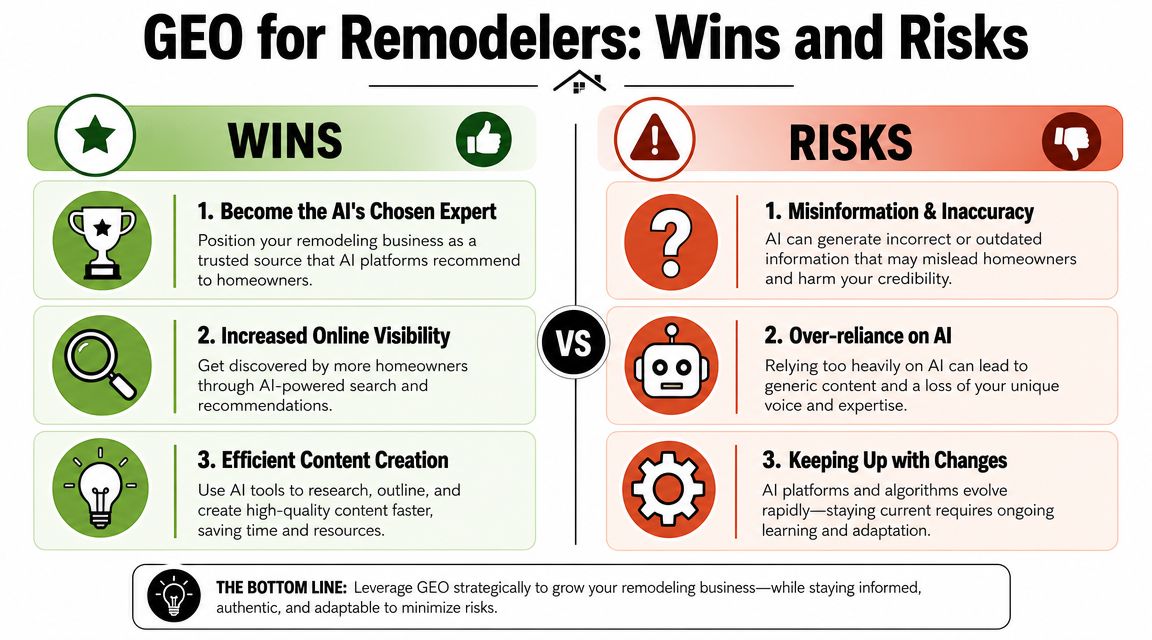
For a local remodeling company, GEO can be a weapon or a blind spot. There isn't much middle ground.
If you do this right, AI starts seeing your company as the local authority on the kinds of projects you want. If you ignore it, somebody else gets that position.
When you do it right
A homeowner asks an AI tool: “Who should I talk to for a high-end kitchen remodel in my area?”
The AI scans the web. It finds one remodeler with project pages that explain scope, materials, design choices, neighborhoods served, and common homeowner questions. It finds clear service pages, helpful FAQs, and proof that this company knows luxury kitchens, not just generic handyman work.
That remodeler gets mentioned. Maybe cited. Maybe summarized as the company with the clearest expertise.
That's a better lead than random traffic. It's a homeowner already framed around the exact service you want to sell.
When your competitor does it first
Now flip it.
Your competitor has built cleaner pages. Their project descriptions are specific. Their content answers the key questions people ask before spending serious money. Their company becomes the easiest local source for AI to understand.
Your site still says things like “trusted professionals” and “custom solutions.” That language sounds fine to you because you already know your business. To AI, it's fog.
You don't disappear from the internet. You just stop becoming the obvious choice.
If two remodelers do good work, the one with clearer proof online usually gets the first call.
The real business upside
The upside isn't vanity. It's fit.
Good GEO can help you attract better-matched homeowners because your content speaks directly to project type, budget mindset, process, and expectations. That means fewer junk inquiries and more conversations with people looking for the kind of remodeling work you actually want on the board.
The risk is simple too. If you wait, you're training the internet to trust the other company.
Your Practical GEO Strategy to Get Started
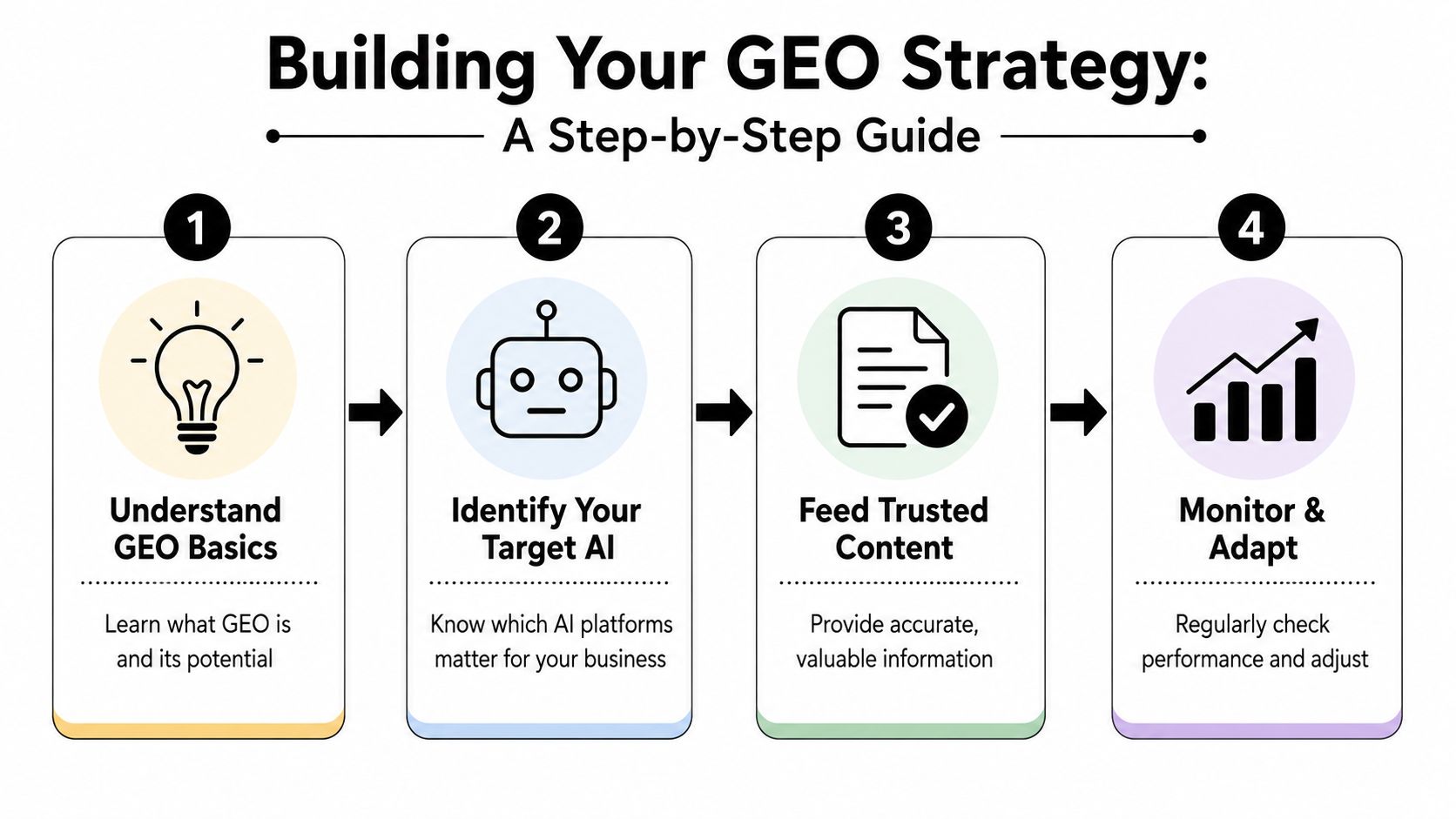
You don't need a total rebuild. You need cleaner pages, better answers, and stronger proof.
Research summarized in industry sources says optimization methods like adding statistics, citing sources, and including quotations can improve visibility in generative engine responses by 30% to 40% compared with unoptimized content, according to this GEO guide on visibility improvements. That matters because AI likes evidence. It doesn't want vague marketing talk.
Start with the questions rich homeowners already ask
Don't begin with software. Begin with questions.
Write down the things people ask before they hire you:
- Process questions: How does design-build work? Who handles permits? How long does planning take?
- Money questions: What affects the cost of a kitchen remodel? What drives change orders?
- Fit questions: Do you handle older homes? Can you match the style of the existing house?
- Trust questions: How do you communicate during the project? Who manages trades? What happens if we live in the home during construction?
Those questions are your content map. Every strong answer becomes a page section, FAQ, blog, or project note.
Build pages that answer like a pro
Most service pages are weak because they try to sound polished instead of useful.
Do this instead:
- Lead with the answer: Start a page with a plain-English paragraph that says exactly what you do, where you do it, and who it's for.
- Break down the work: Explain scope, common layouts, materials, process, and homeowner concerns.
- Use project examples: Describe what you changed. Cabinet layout, wall removal, tile choice, aging-in-place features, drainage, covered porch framing.
- Add proof: Use quotes, source-backed facts where relevant, and clear references rather than empty claims.
A bathroom page that says “we create spa-like retreats” is filler. A bathroom page that explains curbless showers, waterproofing, ventilation, storage planning, and lighting zones is useful.
The best GEO content reads like a contractor who knows the job, not a marketer who knows adjectives.
Make your site easy for machines to read
Many remodelers lose the plot. They publish good ideas in messy formats.
Clean it up:
- Use simple headings: “Kitchen Remodeling in Charlotte” beats “A Higher Standard of Culinary Living.”
- Add FAQ sections: Real questions. Real answers.
- Keep paragraphs tight: One idea at a time.
- Use lists and tables when helpful: Machines and humans both scan better that way.
- Avoid hiding important content in fancy design elements: If the core message is buried, it's harder to extract.
Also make sure your local signals line up. Your service areas, company name, project types, and contact details should be consistent across your site and profiles. AI is more confident when your business looks like a real, coherent local entity.
Example Prompts and Simple Tools for Remodelers
If you're busy running jobs, managing subs, and dealing with clients, you're not sitting around dreaming up content systems. Fair enough. Use prompts.
Semrush reports that in one study of 10,000 real-world queries, pages with quotes and statistics had 30% to 40% higher visibility in AI responses than pages without them. It also notes that AI crawlers may struggle with JavaScript-heavy client-side rendering, which is why clean, machine-readable content matters, as covered in Semrush's guide to generative engine optimization and AI visibility.
Copy and paste prompts that actually help
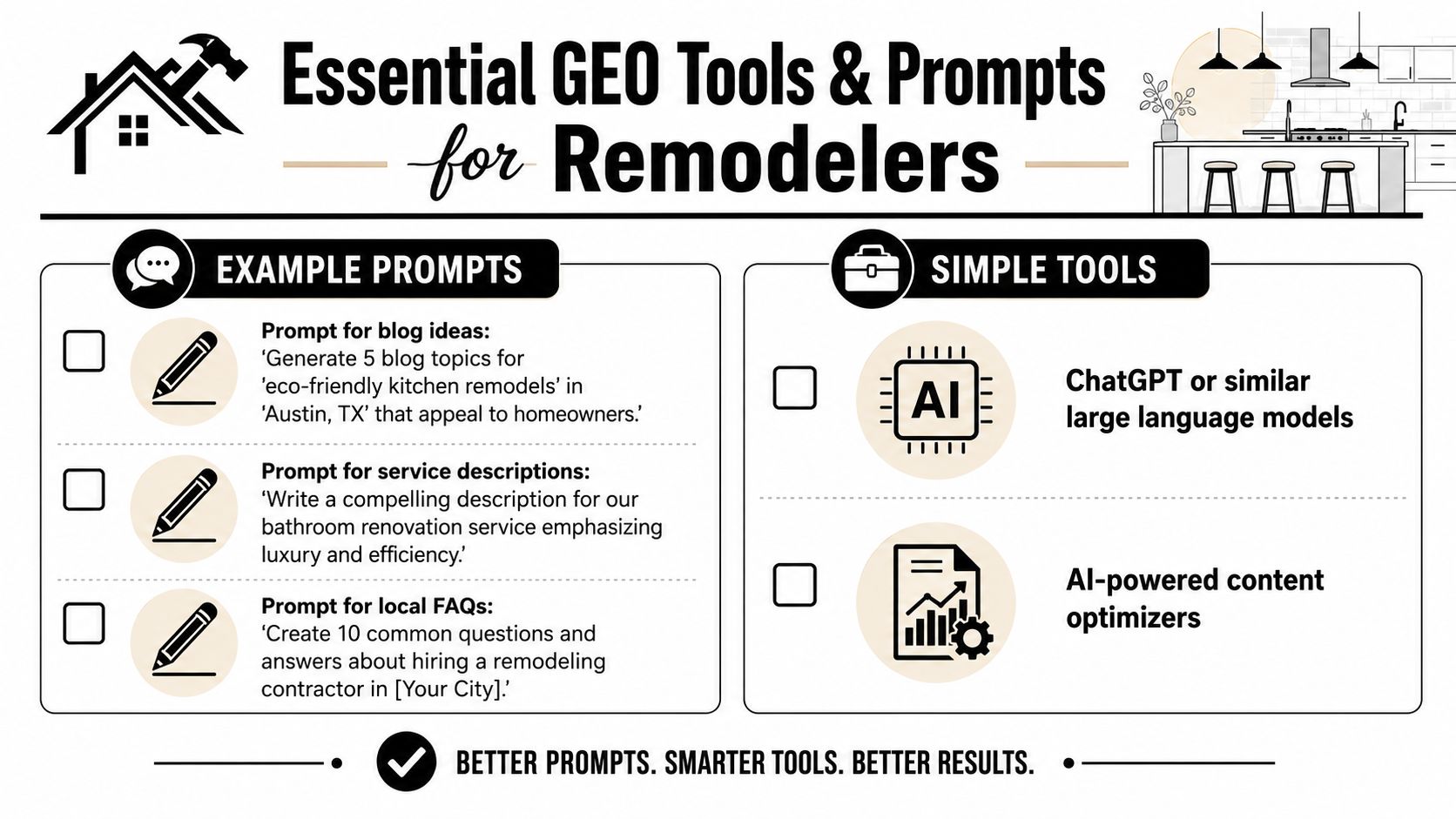
Use ChatGPT, Claude, or a similar writing assistant as a draft partner, not a truth machine. Give it specifics. Make it write for your market.
Try prompts like these:
For a portfolio page
“Write a project description for a mid-century modern kitchen remodel in Austin, TX. Include the homeowner's main problems, the design-build solution, layout changes, cabinet style, countertop choice, lighting updates, and a short FAQ section. Keep it clear, specific, and easy for AI search engines to quote.”For an FAQ page
“Create 12 FAQ questions and answers for homeowners considering a whole-home remodel in Raleigh, NC. Answer in plain English. Focus on permits, design timeline, budget planning, living in the home during construction, and communication.”For a comparison blog post
“Write a blog outline comparing quartz, granite, and porcelain countertops for a luxury kitchen remodel. Use simple headings, a short comparison table, and direct answers to what homeowners care about most.”For a service page upgrade
“Rewrite this bathroom remodeling page so it starts with a direct answer, uses scannable headings, includes common homeowner concerns, and sounds like an experienced remodeling company instead of a generic agency.”
Why these prompts work
They force structure. They force specificity. They force the tool to produce content that can be lifted into an AI answer.
Bad prompt: “Write a great remodeling blog.”
Better prompt: “Write a page that answers whether a homeowner should move walls during a kitchen remodel, include tradeoffs, planning considerations, and a five-question FAQ.”
That second prompt creates extractable content.
If you want help building that kind of system into your search strategy, this overview of an AI SEO service for contractors shows what a more structured approach can look like.
Simple tools that keep this manageable
You do not need a giant tech stack.
A simple working setup looks like this:
- ChatGPT or Claude: Draft FAQs, outlines, project summaries, and comparison content.
- Google Search itself: Type your service plus your city and look at the questions and AI summaries that appear.
- Your own sales notes: Your estimator and designer already hear the best content ideas every week.
- A clean CMS page editor: The simpler it is to publish readable content, the better.
The point isn't to automate your voice away. It's to get your expertise out of your head and into a format machines can understand.
How to Know If GEO Is Working for You
You won't judge GEO the old way. “Did I move from position five to position three?” is too narrow now.
The better question is whether your business is showing up in the places where homeowners get answers.
The signals that matter now
Watch for signs like these:
- Brand mentions in AI answers: Search for the kinds of questions your best prospects ask and see whether your company appears.
- Citations from your pages: Check whether AI summaries seem to pull from your service pages, FAQs, or project content.
- Better lead quality: Listen to how people describe finding you. If they say they already see you as the expert, your content is doing its job.
- More relevance in inquiries: Fewer tire-kickers. More homeowners asking about the exact project types you want.
Don't obsess over vanity. Tie the work back to actual business outcomes. If you need a practical way to connect traffic and leads to outcomes, use a simple framework for calculating marketing ROI.
Your 15 minute first move
Open your kitchen remodeling page.
Read the first 200 words and ask one blunt question: “Would an AI tool know exactly what we do, where we do it, and why a homeowner should trust us?” If the answer is no, rewrite that opening today.
Make it plain. Make it local. Make it useful.
That's how you start.
If you want a marketing partner that understands how remodelers win premium local jobs, Constructo Marketing is built for that. They help remodeling companies become local-famous with integrated Local SEO, AI-driven SEO, Google Ads, conversion-focused websites, and CRM systems that keep leads from slipping through the cracks.