


You're probably in one of these two spots right now.
You're either spending on marketing with no real plan, or you're barely spending at all because the last few things you tried felt like lighting cash on fire. A Facebook boost. A postcard drop. Maybe somebody sold you SEO, and all you got was a monthly report full of words that didn't turn into jobs.
That frustration makes sense. Most marketing advice is built for software companies, online stores, or giant brands. It's not built for a remodeler selling trust, craftsmanship, and big-ticket projects to local homeowners who take their time before they call. That's why random tactics fail. They aren't connected.
A real small business marketing budget should work like a clean job schedule. Every dollar has a job. One part brings traffic. One part turns visitors into leads. One part follows up so leads don't leak out of the bucket. When those pieces work together, marketing stops feeling like gambling and starts acting like a system.
Table of Contents
- Marketing That Feels Like a Messy Job Site
- How to Figure Out Your Marketing Money Pot
- Where to Spend Your Dollars to Build a Growth Machine
- Sample Remodeler Marketing Budgets in Action
- How to Know If Your Marketing Is Actually Working
- Stop Wasting Money and Start Building Your Lead Pipeline
Marketing That Feels Like a Messy Job Site
A lot of remodelers run marketing the same way a bad crew runs a site. Tools are everywhere. Nobody knows what happens next. Money gets spent, but nothing useful gets built.
One owner boosts a few social posts when things get slow. Another prints door hangers because a rep promised they'd “crush it” in his neighborhood. Another pays for a nice-looking website that acts like a brochure and never asks the visitor to do anything. Then everybody says the same thing: marketing doesn't work.
That's the wrong conclusion.
Isolated tactics don't hold much weight in a remodeling business. Homeowners don't usually see one ad and sign a contract for a kitchen, addition, or whole-home project. They search your name, look at your reviews, compare your photos, check your website, wait a bit, then maybe call. If your system is weak at any step, the lead disappears.
Random spending creates random results
When a remodeler says, “I spent money and got nothing,” I usually hear one of these stories underneath it:
- No foundation: The website looked fine but loaded slowly, had weak photos, or gave people no clear next step.
- No search visibility: The company wasn't showing up where local buyers look, especially on Google Search and Maps.
- No follow-up: Calls got missed, form leads sat in an inbox, and hot prospects cooled off.
- No proof: There weren't enough project photos, reviews, or clear explanations of the process.
That isn't a marketing problem. It's a system problem.
A budget doesn't trap you. It gives you control over what gets built first.
Good remodelers already understand this. You don't start a project by buying random materials and hoping they fit together later. You start with a plan, sequence the work, and fund the pieces that matter. Your small business marketing budget should work the same way.
What a real budget should build
For a remodeling company, marketing isn't just “ads.” It's a stack of business assets that support each other:
- Visibility assets: Local SEO, Google Business Profile work, and paid search.
- Conversion assets: A website that turns interest into calls and form fills.
- Management assets: A CRM, lead tracking, and follow-up automation.
- Trust assets: Reviews, project galleries, service pages, and useful content.
When you budget for the whole machine, you stop guessing. You start building a pipeline.
How to Figure Out Your Marketing Money Pot
Most owners get stuck on the first question. “How much should I spend?” They either pick a number that feels safe or copy what some other contractor said in a Facebook group. Both are lazy.
Use one of these three methods instead. Pick the one that matches where your business is right now.
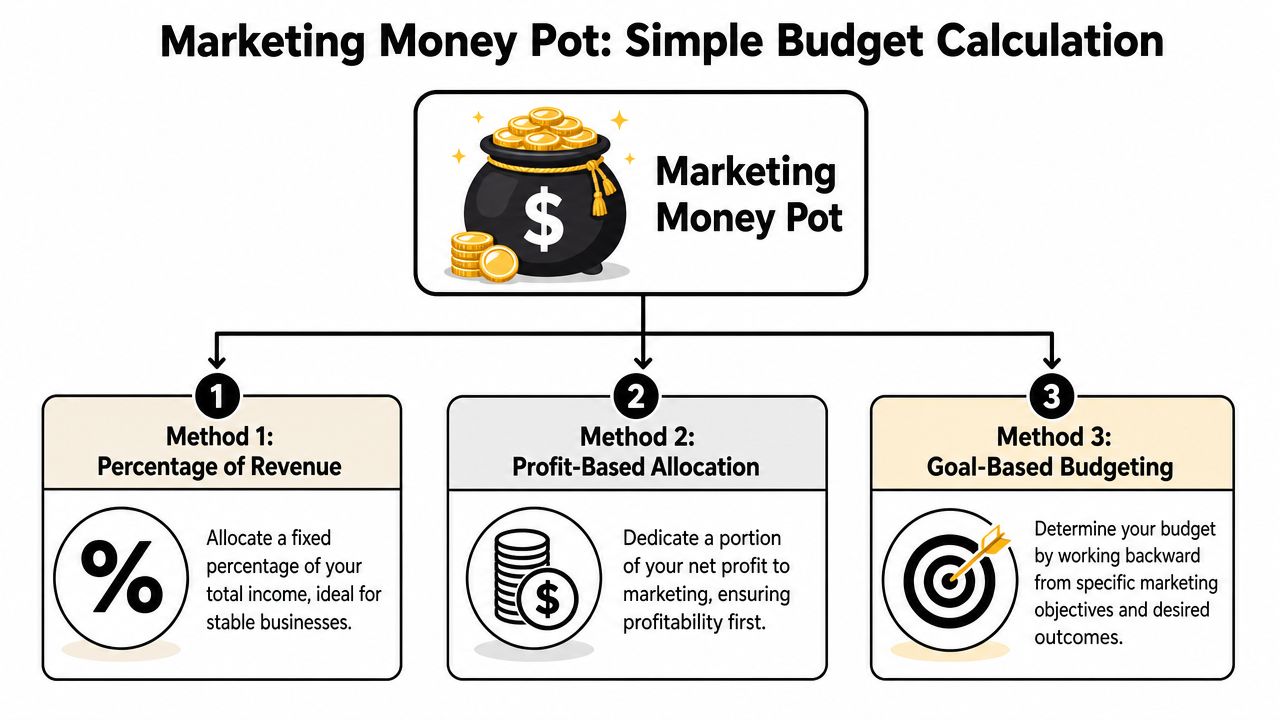
Method One works backward from jobs
This is the best method for a newer company, a firm entering a growth push, or any remodeler who's tired of guessing. Shopify's budgeting advice gets this part right. Build your budget as an objective-and-task system. Set a goal, choose the tasks required to hit it, then size the budget backward from those outcomes using customer acquisition cost as the key constraint, not a flat guess from sales percentage (Shopify on objective-and-task budgeting).
Simple version:
- Decide how many jobs you want.
- Decide what kind of jobs you want.
- List the marketing tasks needed to create those opportunities.
- Add the actual cost of those tasks.
If you need more qualified consultations, your money pot probably needs to cover search visibility, paid traffic, website fixes, and lead follow-up. If one of those pieces is missing, your target falls apart.
For companies pushing growth, the usual rule of thumb often isn't enough. Mercury notes that early-stage businesses or companies in a growth push may need to invest 10% to 20% of projected revenue to build awareness and learn which channels work (Mercury on growth-stage marketing spend).
Practical rule: If you want a bigger year, don't use last year's timid budget.
Also, don't ignore cash flow. A budget can be smart on paper and still choke the business if timing is bad. If you need a cleaner handle on how spending hits the business month to month, these EndureGo Tax cash flow insights are worth reading before you lock in the number.
Method Two uses revenue as a guardrail
This is the easiest method for stable remodeling companies that already have decent referral flow and want a sensible planning range.
The U.S. Small Business Administration suggests companies under $5 million in revenue allocate 7–8% of gross revenue to marketing (Pronto Marketing summary of SBA guidance). Broader planning guidance often lands in the 5–15% of revenue range depending on growth goals, as noted in that same source.
For remodelers, that range is useful because you're in a B2C business, and B2C firms often allocate 5–10% of revenue to marketing, while B2B firms often allocate 2–5% (BDC small business marketing budget benchmarks).
Here's the simple way to use it:
- Use the lower end if referrals are strong and you mainly need consistency.
- Use the middle if you want steady growth and better lead quality.
- Use the higher end if you're entering new service lines, new neighborhoods, or trying to reduce dependence on word-of-mouth.
This isn't perfect. It's a guardrail. But guardrails are better than driving blind.
Method Three uses your existing pipeline
Established remodelers can budget from what's already happening in the pipeline.
Look at your booked work, your active estimates, and your referral strength. Then ask a plain question: where is future revenue most likely to break? Usually it's one of three places.
- Lead volume is thin: You need more demand generation.
- Lead quality is weak: You need better targeting and better messaging.
- Lead handling is sloppy: You need CRM discipline and faster follow-up.
This method works because mature businesses already have some momentum. They don't need a budget based only on theory. They need a budget that shores up the weak spots in the sales pipeline they already have.
A good small business marketing budget isn't just a spending plan. It's a decision about what problem you're paying to solve.
Where to Spend Your Dollars to Build a Growth Machine
Most remodelers blow the budget in one of two dumb ways. They put too much into ads before the house is ready, or they spread money across too many channels and give none of them enough fuel to work.
You need a toolbox, not a junk drawer.
The broader market has already moved this direction. 72% of marketing budgets now go to digital channels, and website/blog/SEO is ranked the #1 ROI-generating channel for marketers (Revenue Memo digital budget and ROI benchmarks). That matters because local remodeling buyers live online long before they call you.
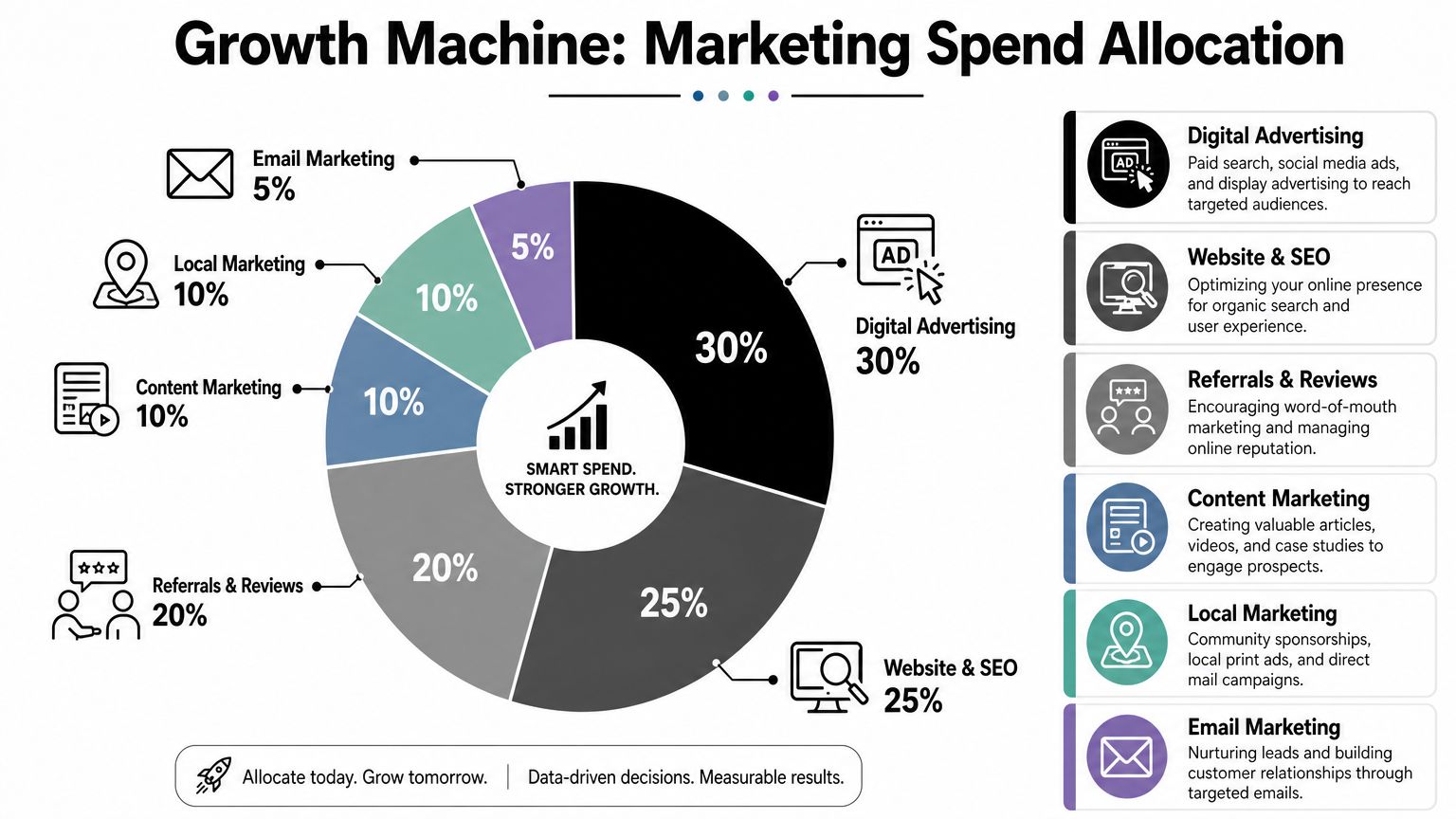
Foundation tools come first
If your foundation stinks, every ad dollar gets weaker.
Your first dollars should usually go into the parts of the system that make all later spending perform better.
Website
Your site has one job. Turn a curious homeowner into a lead. That means clear service pages, project photos that prove quality, strong calls to action, and simple contact paths. A pretty site that doesn't convert is showroom fluff.
CRM
A CRM is your jobsite superintendent for leads. It tracks who called, who filled out a form, who got a reply, and who slipped through the cracks. If you don't have one place to manage leads, you will lose opportunities and never know why.
Tracking
Call tracking, form tracking, and source tracking aren't fancy add-ons. They're the measuring tape. Without them, you can't tell if Google Ads worked, if SEO brought the lead, or if your website is leaking.
If you can't track the lead, you can't trust the budget.
Demand tools fill the top of the funnel
Once the foundation is in place, you put money into demand generation.
Local SEO matters because homeowners search by service and city. They want somebody nearby, credible, and established. Your Google Business Profile, location pages, review strategy, and service content all support that. SEO is slower than ads, but it builds an asset that keeps working.
Google Ads are your speed tool. They help you capture demand right now, especially when you need lead flow sooner. But paid traffic only works when the traffic lands on the right page and gets handled correctly after the click. If you want to sharpen this side of the machine, this guide on pay-per-click advertising for contractors is a solid next read.
Retargeting and branded search support can help reinforce trust after a homeowner has already checked you out. These aren't always the first spend for every company, but they often make sense once the core engine is running.
Proof and follow-up close the gaps
A lot of remodelers lose good leads at this stage.
A homeowner looking at a major project wants proof. Not marketing fluff. Real evidence that you know what you're doing.
Use your budget to build these assets:
- Project galleries: Before-and-after photos, room-by-room images, and clear descriptions.
- Reviews: A repeatable process for asking happy clients at the right time.
- Helpful content: Simple articles that answer real homeowner questions.
- Sales support: Estimate follow-up, missed-call text-back, and lead nurture emails.
Some firms also benefit from outside coaching, especially when the owner is still making every sales and marketing decision personally. Coaching helps the business tighten offer clarity, lead handling, and accountability. That's not glamorous spending, but it often protects the rest of the budget from getting wasted.
Here's the real story. You are not buying ads. You are buying a growth machine made of connected parts. When those parts work together, the business gets more predictable. When they don't, even a decent budget can disappear with nothing to show for it.
Sample Remodeler Marketing Budgets in Action
A budget gets real when it turns into line items. So let's stop talking in circles and put numbers on paper.
For companies under $5 million in revenue, the SBA guidance says 7–8% of gross revenue is a reasonable marketing allocation to maintain position and grow, as summarized here by Pronto Marketing. For a remodeler, that gives you a practical planning anchor.
The examples below are simple starting points, not handcuffs. Shift dollars based on your market, close rate, backlog, and whether you need fast demand or long-term visibility.
Sample Monthly Marketing Budgets for Remodelers
| Expense Category | Small Crew (<$500K Rev) | Growing Firm (~$1M Rev) | Established Firm ($2M+ Rev) |
|---|---|---|---|
| Google Ads | $800 | $2,000 | $4,000 |
| Local SEO | $700 | $1,500 | $3,000 |
| Website updates and landing pages | $300 | $800 | $1,500 |
| CRM and lead follow-up tools | $200 | $500 | $1,000 |
| Reviews, photo organization, and content support | $300 | $700 | $1,500 |
| Reporting and strategy oversight | $200 | $500 | $1,000 |
| Estimated Monthly Total | $2,500 | $6,000 | $12,000 |
| Estimated Annual Total | $30,000 | $72,000 | $144,000 |
A few notes matter here.
Small crew budgets should stay focused. Don't split a modest budget across five different channels. Pick the essentials and make them work together.
Growing firms need balance. This is usually the stage where owners overspend on lead generation and underfund the website, CRM, and content that make lead generation pay off.
Established firms should think like operators, not gamblers. At that size, the budget should support market dominance, better lead quality, and tighter lead handling. You're not just buying leads. You're protecting close rate and production quality by attracting better-fit projects.
The best budget is the one you can actually stick to for long enough to judge it honestly.
If you're building your own version of this, put it in a spreadsheet and assign every line item a job. One column should show spend. The next should show what outcome that spend is supposed to produce. That alone will clean up a lot of waste.
How to Know If Your Marketing Is Actually Working
You wouldn't trust a tape measure that changes length every week. Don't trust marketing that isn't tracked.
A smart budget is built with an objective-and-task system. You set a target, identify the tasks needed to reach it, and build the budget backward from revenue goals, not from vibes. Shopify explains it plainly in this overview of building a marketing budget from goals.

Track the numbers that matter
Most remodelers don't need a monster dashboard. They need a short list of numbers that help them make decisions.
For SEO, ask:
- Are you showing up locally: Are people finding you on Google Search and Maps for your desired services?
- Are good pages getting traffic: Are your kitchen, bath, additions, or outdoor living pages getting attention?
- Are visitors turning into leads: Are calls and forms coming from organic traffic?
For Google Ads, ask:
- What did it cost to get the lead: Not clicks. Leads.
- What kind of lead came in: Was it a serious homeowner or a tire-kicker?
- Did the page match the ad: If not, you paid for confusion.
For your website, ask:
- How many form fills came through
- How many calls came from the site
- Which pages helped create those conversions
For your CRM, ask:
- How fast did you respond
- How many leads got follow-up
- How many consultations turned into sold work
That's enough to run the business side of marketing without drowning in jargon.
Use a simple scorecard
A plain weekly or monthly scorecard works better than a giant pile of reports nobody reads.
Try a short checklist like this:
- Lead count: Total inbound leads by source
- Lead quality: Good fit or bad fit
- Response speed: Fast enough or too slow
- Booked consultations: Yes or no
- Sold projects: Which source started them
If you want a clearer framework for tying spend back to return, this article on how to calculate marketing ROI will help you tighten the math.
Good tracking doesn't make marketing complicated. It makes decisions easier.
The biggest mistake is chasing vanity numbers. More traffic sounds nice. More impressions sound nice. But a remodeler can stay busy with a small number of high-quality leads if the system is built right. Track what helps you sell profitable work. Ignore the rest.
Stop Wasting Money and Start Building Your Lead Pipeline
Most wasted marketing money comes from the same handful of mistakes.
- Chasing shiny objects: Owners jump from one tactic to the next before anything has time to work.
- Underfunding the basics: They spend on ads but skip the website, CRM, reviews, and follow-up.
- Quitting too early: They expect long-term channels like SEO to act like an on-off switch.
- Letting leads rot: Calls get missed, forms sit untouched, and nobody follows up.
- Confusing activity with progress: They celebrate clicks and traffic instead of consultations and sold jobs.
That last one hurts the most. You can buy attention. You still need a system to turn attention into booked work.
A strong small business marketing budget isn't about spending the least. It's about spending with purpose. Build the foundation. Fund the channels that match how homeowners buy. Track what happens. Fix the leaks. Then stay consistent long enough for the machine to do its job.
If you want steadier demand, stop treating marketing like a side task you squeeze in when production slows down. Treat it like the lead pipeline your business depends on. If you need a bigger view of how that pipeline gets built, this guide to lead generation for contractors is a smart next step.
If you're tired of random marketing and want a system that helps remodelers win better local projects, take a look at Constructo Marketing. They focus on integrated SEO, Google Ads, websites, CRM automation, and coaching built for contractors who want a reliable pipeline, not more marketing noise.