


You know this feeling. The job is finished. The photos look great. The client is happy. Your crew did solid work. Then you look at the final numbers and think, “How did we work that hard and keep so little?”
That usually isn’t a building problem. It’s a pricing problem.
Most remodelers are far better at construction than they are at setting a general contractor fee. That’s normal. You learned how to solve jobsite problems, manage subs, and hit deadlines. Nobody sat you down and showed you how to build a fee that pays for office time, risk, supervision, callbacks, and actual profit.
So let’s make this simple. Think like a first grader simple.
Your fee is not a made-up number. It is the money that keeps your business alive. If you underprice it, the project can still look successful from the outside while your bank account says otherwise. If you price it clearly and protect it, you can take on the kind of remodeling work you want.
If your company is chasing larger residential projects, your pricing system has to be as real as your production system. That’s why a written general contractor business plan matters. It forces you to decide how your company makes money before the next estimate goes out the door.
Table of Contents
- Your Guide to Pricing Remodels for Profit
- What a General Contractor Fee Actually Is
- The Three Main Fee Models Explained
- How to Calculate Your Fee for a Remodel
- Communicating Your Fee and Best Practices
- Red Flags That Erode Your Profit
- Frequently Asked Questions About GC Fees
Your Guide to Pricing Remodels for Profit
A remodeler usually undercharges for one reason. He thinks the visible work is the work. It isn’t.
The cabinets, tile, framing, paint, and trim are only the part the client can touch. The hard part is everything else. The planning. The sequencing. The permit headaches. The callback prevention. The sub coordination. The calls nobody sees. The hours your office burns up before demo even starts.
That hidden work is exactly why your general contractor fee matters so much.
Stop treating the fee like leftovers
Too many contractors price the job this way:
- Add materials
- Add labor
- Add subs
- Throw a number on top and hope it works
That isn’t pricing. That’s guessing.
A better rule is simple. Build the fee on purpose. Decide what your company must collect for management, overhead, and profit before you send the proposal.
Practical rule: If your fee feels random, your profit will be random too.
Use a business lens, not a jobsite lens
On a larger remodel, your fee has to do more than “cover a little extra.” It has to support the business that made the project possible in the first place.
That means your general contractor fee should help pay for things like:
- Office support: Admin time, bookkeeping, scheduling, and client communication
- Field leadership: Supervision, site checks, quality control, and punch management
- Risk: Problems you carry even when the homeowner never sees them
- Profit: Money left over after the bills are paid
If you don’t build those in, you’re donating management for free. That’s a bad habit, not a sales strategy.
What a General Contractor Fee Actually Is
The easiest way to explain a general contractor fee is this. It pays for the brain work of the project.

Think of yourself as the director
A movie director usually doesn’t hold the camera, sew the costumes, build the set, and edit the film. The director makes sure all those parts come together in the right order.
That’s your role on a remodel.
You are not just selling labor and materials. You are selling coordination, judgment, timing, accountability, and problem-solving. When the electrician and cabinet installer clash, you solve it. When inspections shift the schedule, you solve it. When a homeowner wants clarity, you provide it.
That is what the fee is for.
What the fee pays for
Your general contractor fee is not the same thing as direct costs. Direct costs are the obvious job expenses. Materials. Labor. Subcontractors. Permits.
Your fee sits on top of that because it covers the work of running the project and the company behind it.
According to this breakdown of general contractor costs, the standard general contractor fee ranges from 10% to 20% of total project cost, with larger projects sometimes reaching up to 25%. That same source says GCs maintain average net profit margins of 10% to 12%, compared with the broader U.S. construction industry average of about 5%.
That should tell you something important. The market already understands that professional oversight has value. You do not need to apologize for charging for it.
Your fee is not a bonus for showing up. It is payment for making the project work.
Here’s the part many remodelers miss. The fee is not pure profit.
Before profit shows up, the fee has to carry overhead. That includes insurance, office expenses, software, estimating time, management salaries, trucks, phones, and all the small monthly costs that keep your company functioning. If you treat the whole fee like profit, you’ll think you’re making more than you are.
Use simple language with clients too. Don’t bury this in jargon. Say, “This fee covers the management and responsibility required to run your project from start to finish.”
That’s honest. And it’s true.
The Three Main Fee Models Explained
Every remodeler needs a pricing model he can explain without stumbling. If you can’t explain your model clearly, you probably don’t fully trust it.
Below are the three models most contractors use.
Fixed price
A fixed-price job is like selling a finished sandwich for one price. The client knows what they’ll pay up front. You figure out the ingredients, labor, and management before the sale.
This model works well when scope is clear and selections are mostly known. Homeowners like it because it feels safe. Contractors like it when estimating is tight.
The downside is obvious. If you miss something, you own the mistake unless the contract gives you a clean path for changes.
Cost-plus
Cost-plus is like taking a client shopping and charging for what gets bought, plus your fee for managing the trip.
The homeowner pays actual project costs, then pays an agreed fee or markup on top. This can be a good fit when scope is still moving or selections are open. It gives flexibility. It also demands great paperwork.
If your records are sloppy, cost-plus becomes a fight. If your records are clean, cost-plus can be fair and easy to defend.
Percentage of cost
This model ties your general contractor fee to the project cost as a percentage. It is straightforward and common in residential remodeling.
It’s easy to understand, and it scales naturally with project size. The risk is perception. Some homeowners think a percentage fee means you make more by spending more. That’s why you need to explain the management value clearly and show that your process is disciplined.
Comparing General Contractor Fee Models
| Fee Model | Contractor Risk | Homeowner Risk | Best For |
|---|---|---|---|
| Fixed Price | Higher if scope is missed | Lower on budget certainty | Well-defined remodels with tight plans |
| Cost-Plus | Lower on unknown conditions, higher admin burden | Higher if scope expands | Complex remodels with evolving details |
| Percentage of Cost | Moderate, depends on scope control | Moderate, depends on transparency | Larger residential projects where oversight is a major value |
A blunt recommendation. If you run $75K to $300K remodels, don’t choose your fee model based on what feels easiest to sell. Choose the one your team can estimate, track, and document consistently.
A pricing model doesn’t fail because of the math. It fails because the contractor can’t manage it.
How to Calculate Your Fee for a Remodel
Most pricing mistakes happen because contractors skip steps. They jump from rough costs to final price too fast.
Slow down. Use an order.
Start with direct costs
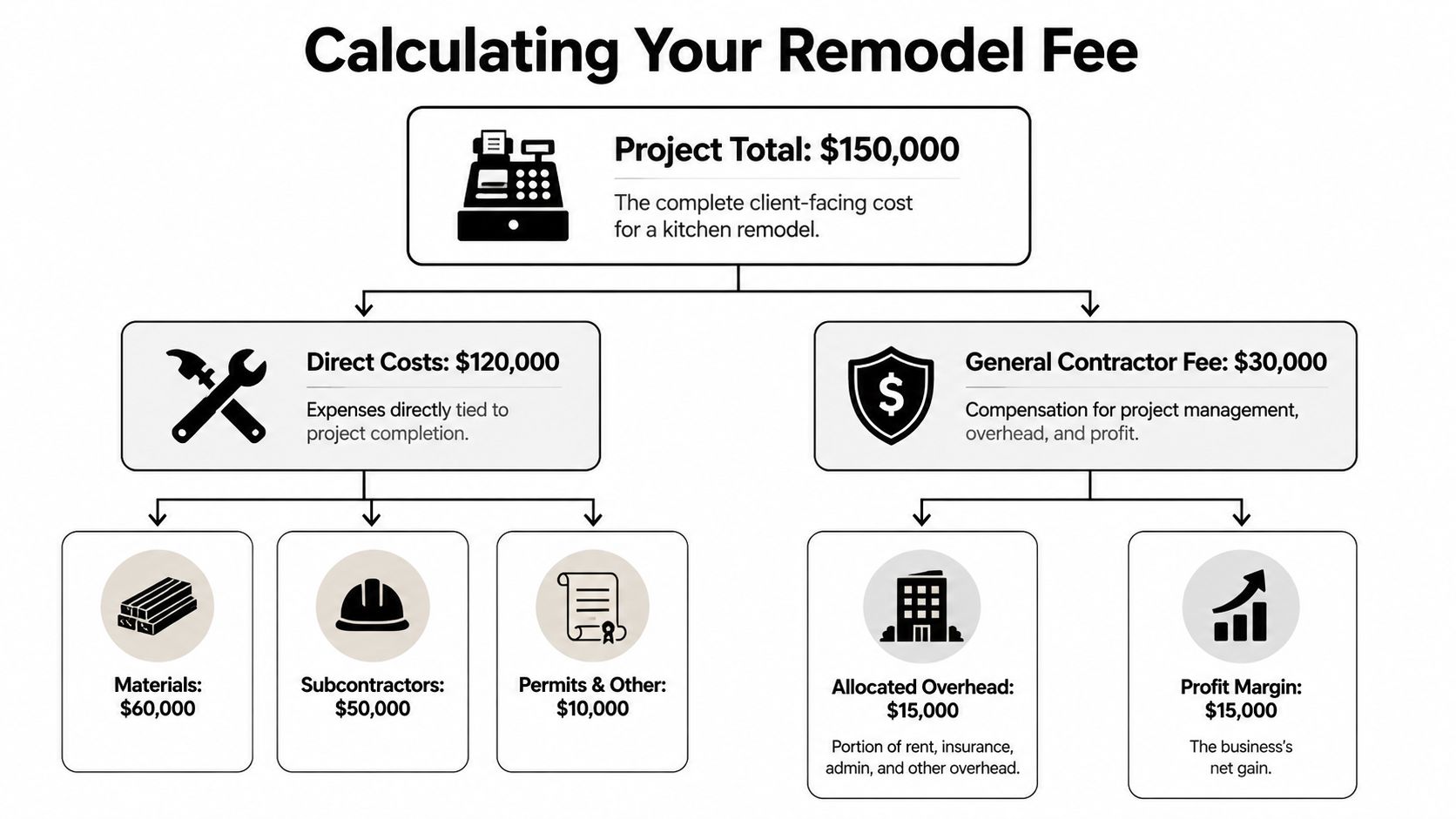
Let’s use a simple project total of $150,000 because it sits right in the middle of the kind of remodel many firms want.
A clean estimate starts by listing direct costs first. In the infographic example, that total includes materials, subcontractors, permits, and other project-specific expenses. Then the general contractor fee is shown separately so the client-facing total makes sense.
This is the sequence I recommend:
- List all direct costs first. Materials, subcontractors, permits, dumpsters, and other job costs.
- Check scope line by line. Make sure each trade quote covers the full job.
- Assign internal overhead and profit targets. Don’t guess after the fact.
- Build the final selling price from that structure.
If you want a deeper explanation of pricing layers, this guide to general contractor markup is worth reviewing alongside your estimating process.
Add markups before the management fee
Many remodelers get confused. They think the general contractor fee is the only place profit lives. It isn’t.
According to Buildern’s explanation of contractor markup, labor markups average 25% or higher, and material markups can reach 30% to 50%. That same source explains these markups are applied to direct costs before the primary GC fee is calculated.
That means your estimate may have layers:
- Direct labor and material costs
- Markups on labor and materials
- General contractor fee for management, overhead, and profit
That layered structure is normal. Stop feeling guilty about it.
Show it cleanly on the bid
Your proposal should be simple enough for a homeowner to follow and disciplined enough for your office to track.
A sample bid layout might look like this in plain language:
| Bid Section | What goes here |
|---|---|
| Project scope | Clear description of what is included |
| Direct costs | Materials, trade partners, permits, disposal, specialty items |
| Contractor management | Project planning, supervision, coordination, scheduling, quality control |
| Allowances and exclusions | Items still to be selected and anything not included |
| Change order process | Written approval required before extra work starts |
If your numbers look good at signing but fall apart during production, the problem usually isn’t the estimate alone. It’s tracking. Tight job costing and WIP management helps you catch when labor, materials, or supervision start drifting before the fee gets eaten alive.
Build the estimate so your office can track it later. If accounting can’t follow it, estimating didn’t finish the job.
For smaller remodels and larger ones alike, the rule stays the same. Calculate with order. Present with clarity. Track with discipline.
Communicating Your Fee and Best Practices
A lot of contractors know their number and still lose the sale because they explain it badly.
If you get awkward when the fee comes up, the homeowner gets nervous too. Confidence matters here. Not fake confidence. Clear confidence.

Say what the homeowner is buying
Don’t say, “That’s just our fee.”
Say this instead:
“Our general contractor fee covers the management of the entire project. That includes planning, scheduling, subcontractor coordination, quality control, communication, and the responsibility of delivering the work correctly.”
That sentence does two things. It explains value. It also tells the client you run a real company, not a side hustle.
You should also walk them through the contract terms in plain English. If you want a useful checklist for what belongs in that paperwork, SheetMergy's contract elements guide is a solid reference for tightening the basics.
How to answer can you do it for less
You will hear this question. Don’t panic and don’t slash your fee first.
Use this response:
- Acknowledge the concern: “I understand you want to stay within budget.”
- Protect the price structure: “I don’t reduce management just to make the number feel better.”
- Move to scope: “If we need to bring the investment down, let’s look at finishes, selections, or project scope.”
That is the right move because it keeps the business healthy. Cutting the fee usually means you’re cutting the very thing that keeps the job organized.
Here are stronger habits to keep:
- Be line-item clear: Show enough detail that the client understands what they’re paying for.
- Use consistent language: Don’t call it fee on one page, markup on another, and overhead somewhere else.
- Put change order rules in writing: Verbal approvals turn into unpaid work.
- Discuss allowances early: Unknown selections create confusion later.
A homeowner doesn’t need a lecture. They need confidence that you know where the money goes and why.
Red Flags That Erode Your Profit
A decent fee can still turn into a bad result.
That’s the trap. You win the job with what looks like a healthy number, then the project starts chewing through it. By the end, you did all the responsibility of a professional GC and kept far less than you expected.
Where your fee disappears
One of the biggest dangers is fee erosion.
According to this article on fee erosion in construction, in cost-plus contracts, initial GC fees of 10% to 20% are often eroded down to 1% to 6% profitability when general conditions are underestimated, subcontractor bids have scope gaps, and change orders are insufficient.
That should wake you up.
Low fees don’t make you competitive if they force you to work for scraps later. They just delay the pain.
A simple protection checklist
Watch for these red flags early:
- Vague subcontractor quotes: If the scope is fuzzy, the cost will move.
- Thin general conditions: Site management, supervision, cleanup, and logistics have to be accounted for.
- Loose allowances: If selections are unclear, your estimate is softer than you think.
- Informal change orders: If work starts before approval, payment gets harder.
- Admin overload: Too many calls, texts, and interruptions can consume office time. Some contractors use tools from this guide to AI solutions for contractors to tighten communication and reduce avoidable drag.
If you want your margins to survive, study your construction profit margin the same way you study production schedules. The job isn’t profitable because the contract amount looks big. It’s profitable when the fee survives the whole ride.
Bid low if you want busy crews. Price correctly if you want a healthy company.
Frequently Asked Questions About GC Fees
Should I show my fee as a line item
Usually, yes. Clear presentation builds trust.
You don’t have to expose every internal calculation, but the homeowner should understand that project management is a real service with a real cost. If you bury it completely, clients may assume it’s arbitrary when they do notice it.
Can I charge a management fee on self-performed work
Yes, if you are still managing that work as part of the full project.
Your company still carries scheduling, supervision, responsibility, warranty exposure, and coordination. Self-performed labor doesn’t magically manage itself. Charge in a way that reflects both production and oversight.
What is the difference between overhead and profit
Overhead is the cost of running your company. Profit is what remains after the company’s costs are paid.
A lot of remodelers mix these together and think they’re making money when they’re only paying business bills. Separate them in your own mind, even if the client sees them combined inside the general contractor fee.
What should I do with supplier discounts
Decide your policy before the job starts and stick to it.
If you pass discounts through, say so in writing. If your pricing is based on your buying power and vendor relationships, say that too. The mistake is being vague. Hidden rules create resentment. Clear rules create trust.
If you want more of the right remodeling leads, better visibility for high-ticket projects, and a marketing system built for contractors instead of generic businesses, Constructo Marketing is worth a look. They focus on helping remodelers become the obvious local choice, with SEO, Google Ads, websites, CRM automation, and coaching built around real growth, not vanity metrics.