


You're probably in one of two spots right now.
Either you tried Google Ads already and got a pile of junk leads, missed calls, and homeowners who wanted a full remodel for a handyman budget. Or you've held off because every agency pitch sounds the same. More clicks. More traffic. More visibility. None of that pays for a kitchen remodel crew, a designer, or your overhead.
For high-ticket remodelers, Google Ads only works when it behaves like a sales system, not a slot machine. You don't need more random leads. You need the right homeowners, in the right neighborhoods, searching for the right work, and landing in a process that gets answered and tracked.
Table of Contents
- Why Most Contractor Google Ads Fail
- The Blueprint Before You Build Your Campaigns
- Structuring Your Campaigns to Attract Big Projects
- Keywords and Ad Copy That Speak to High-Value Homeowners
- Turning Clicks into Profitable Jobs with Tracking and CRM
- Optimizing Your Ads to Find Better Leads Not Just More Leads
Why Most Contractor Google Ads Fail
A remodeler spends thousands on Google Ads, gets a stack of calls, and still closes almost nothing. Half the callers want small repairs. A few are price shopping. Two went to voicemail and never called back. On paper, the campaign produced leads. In practice, it produced noise.
That is why most contractor Google Ads fail. The account is built to collect inquiries instead of sold projects.
Most campaigns chase volume instead of good-fit jobs
If you build kitchens, baths, additions, or whole-home remodels, your ads should not behave like a general lead vacuum. A company chasing $100,000 projects needs a sharper filter.
Google will spend your money on almost any search you allow. If your targeting is loose, your budget gets split between serious homeowners and people looking for ideas, cheap bids, or small handyman work. Those clicks look the same inside the platform. They do not look the same in your sales pipeline.
High-ticket remodelers need ads that screen people before they call.
Generic messaging does the opposite. Phrases like “quality service” and “free estimate” pull in everybody because they say nothing. Better ads show signs of a real remodeling process: design-build experience, project minimums, service area, timeline expectations, and the kind of homes you want to work on.
Here is where contractor accounts usually break:
- Everything gets lumped together: one campaign covers every service, every town, and every search type
- The ad copy is bland: it attracts clicks from shoppers who were never a fit
- No filter is built in: there is no mention of project size, scope, process, or premium positioning
- The owner blames Google: the actual problem is a sloppy setup
A bad account structure works like a junk drawer. Everything gets thrown in, and you cannot find what matters.
The real leak usually starts after the click
The second failure point is operations.
A homeowner calls during the day and nobody picks up because your team is on jobsites. A form comes in and sits in an inbox until evening. By the time someone responds, that prospect has already booked appointments with two competitors who answered first.
This is why advice about “more traffic” frustrates good contractors. Traffic does not pay for crews, trucks, or overhead. Qualified conversations that turn into estimates and signed jobs do.
If your team cannot answer, track, and follow up fast, more ad spend just buys more missed chances.
For remodelers going after larger projects, this is where CRM discipline matters. You need every call, form, text, missed call, and follow-up tracked in one place. You also need to know which leads turned into appointments, which appointments turned into estimates, and which estimates turned into signed jobs. A system like GoHighLevel helps close that gap. Without that feedback loop, Google Ads becomes a guessing game, and expensive guesses are still expensive.
The contractors who win with Google Ads treat it like part of a sales system. The click matters. The speed to lead matters more. The sold job matters most.
The Blueprint Before You Build Your Campaigns
A remodeler spends money on Google Ads for three months, gets a pile of calls, and still signs the wrong jobs. Small repairs. Price shoppers. People outside the service area. The problem usually is not Google. The problem is building campaigns before deciding what the business is trying to sell.
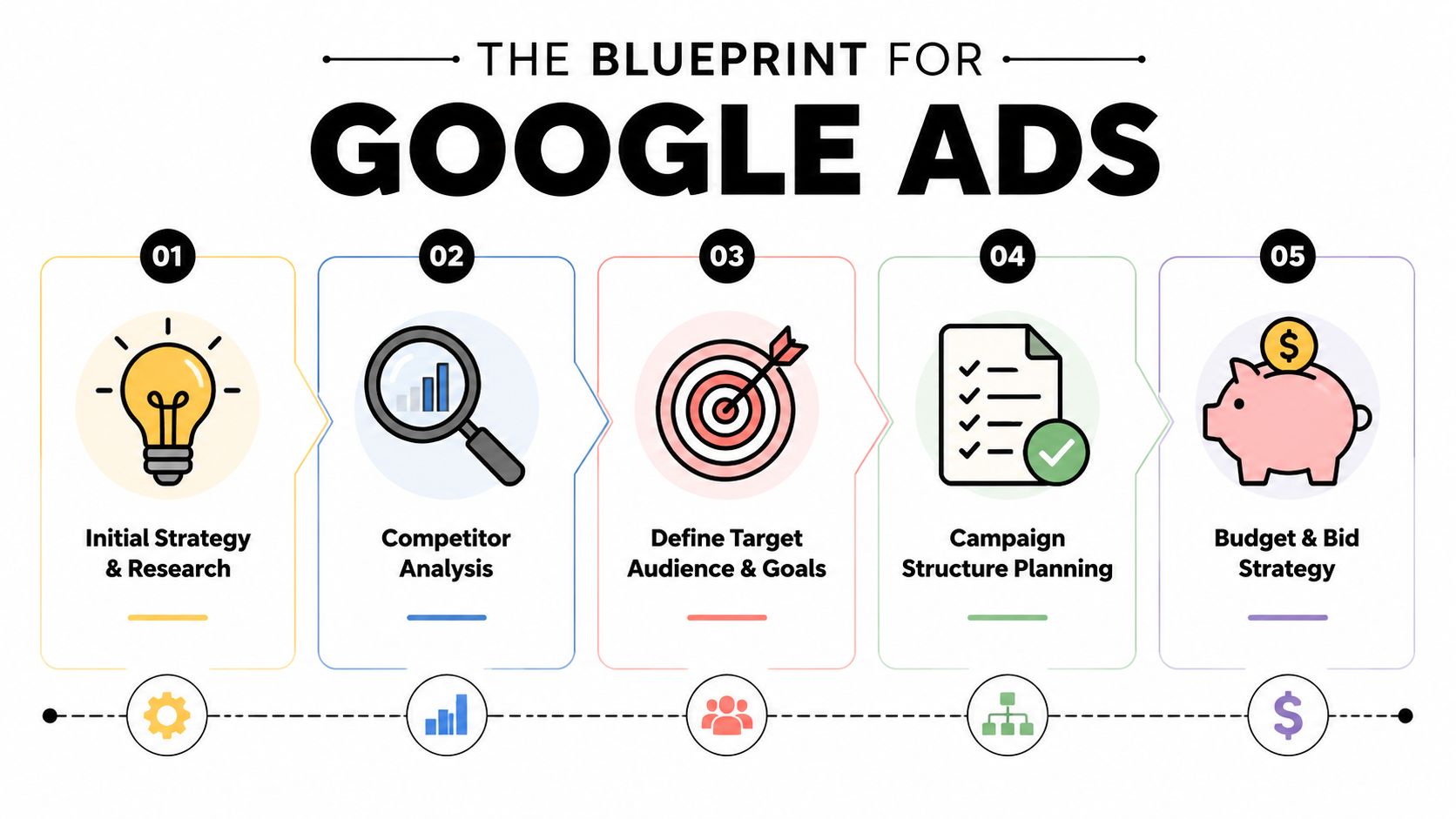
Start with the job you want, the area you want, and the homeowner you want. Then build ads around that target.
Pick one ideal job first
“More remodeling leads” is not a plan. It is a complaint.
Choose the project type that improves your business. Kitchen remodels. Whole-home remodels. Additions. High-end baths. If you want $100k-plus projects, say that clearly in your strategy before you spend a dollar.
Then answer four questions:
- What project type are you pushing
- Which towns or ZIPs matter most
- What kind of homeowner fits your process
- What early signs tell you they're serious
This sounds simple because it is. Contractors get in trouble when they skip it.
A broad campaign attracts broad demand. If your ads talk to everyone, Google will send you everyone. That includes the homeowner looking for a handyman quote and the lead who wants a full design-build remodel. Those are not the same buyer, and they should not hit the same campaign.
Your target area needs the same discipline. A location-based marketing strategy for contractors helps you focus spend on neighborhoods and towns where higher-value projects come from, instead of funding clicks from every corner of your metro.
Set a budget that can learn
A tiny budget does not create efficiency. It creates static.
Google Ads needs enough spend to test searches, ads, and audiences, then shift money toward what produces qualified consults. If you spread a small budget across too many services and too many towns, you do not get insight. You get noise.
Use budget the same way you would staff a jobsite. Put resources where the payoff is highest. If additions and whole-home remodels drive the best margins, fund those first. If one service area regularly produces homeowners with real budgets, protect that market before expanding into fringe areas.
Here is the practical version:
| Business decision | Weak approach | Better approach |
|---|---|---|
| Budgeting | Pick a number that feels safe | Fund the service lines you want to sell more of |
| Geography | Cover every town within driving distance | Focus on the service areas with stronger project values |
| Goal | Buy more leads | Buy qualified consultations tied to a specific project type |
Decide what a win looks like
Clicks are not the win. Even leads are not the win.
For a high-ticket remodeler, a win is a qualified homeowner who books a consult, shows up, receives an estimate, and turns into a real sales opportunity. The best accounts track that full path inside a CRM such as GoHighLevel so you can see which campaigns produce sold jobs, not just form fills.
That changes how you judge performance:
- Qualified consults: Homeowners match your service, area, and budget range
- Tracked opportunities: Calls, forms, texts, and booked appointments are logged in one place
- Sales visibility: You can connect ad spend to estimates and signed projects
- Fit over volume: Fewer weak inquiries, more serious conversations
Build the campaign backward from revenue. That is the blueprint.
If you define success as traffic, Google will find traffic. If you define success as cheap leads, Google will find cheap leads. If you define success as high-value opportunities and feed that outcome back through your CRM, the account gets sharper over time and wastes less money on calls that go nowhere.
Structuring Your Campaigns to Attract Big Projects
A messy Google Ads account is like a messy shop. The tools are there, but nobody can find anything, and every job takes longer than it should.
You need structure. Clean structure gives you control over budget, messaging, landing pages, and reporting.
Treat your account like a filing cabinet
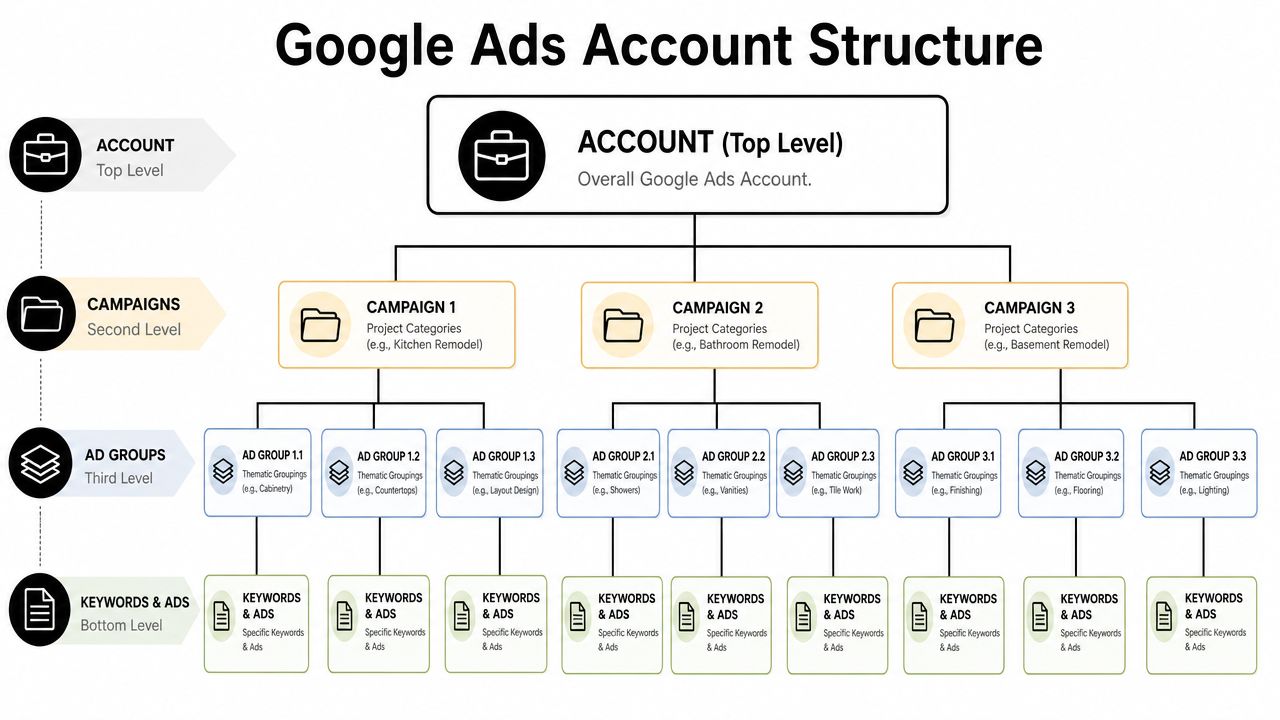
Don't put kitchen remodeling, bathroom remodeling, additions, and roofing into one campaign. That's one junk drawer. Google can't sort your priorities if you haven't sorted them first.
Build separate campaigns by service line and local market. That lets you control budget where it matters and write ads that match the search.
A practical setup for contractors starts with high-intent search terms, then segments by service line and local market, aligns each ad group to a tightly matched landing page, and uses multiple conversion types so bidding can optimize toward better outcomes instead of raw clicks, according to Sona's setup guide for design contractors.
A clean structure looks like this:
- Campaign level: Kitchen remodel, bath remodel, addition, whole-home remodel
- Ad group level: Narrow themes inside each service
- Keyword level: Tight keyword sets around specific homeowner intent
- Landing page level: One page that matches the exact service and location
If local targeting is part of your growth plan, this guide to location-based marketing for contractors is worth reviewing alongside your ad structure.
Use the right campaign type for the job
Not every campaign type deserves equal attention.
Search campaigns are the workhorse for high-intent demand. These are your best friend when somebody is actively searching for the service you offer.
Performance Max can help expand reach, but it needs supervision. It can be useful when you already know your offer works and you've got strong tracking in place. If you launch it too early, it can turn into a black box.
A simple rule:
| Campaign type | Best use |
|---|---|
| Search | Homeowners actively looking for your service now |
| Performance Max | Expansion after core search campaigns are proven |
Most remodelers should master Search first. Search gives you tighter control over intent, copy, and landing page match. That matters when every lead has the potential to turn into a large project.
Match the ad to the page
If the ad says “Kitchen Remodeling in Austin,” the page cannot be your homepage. That's lazy and expensive.
The ad, keyword, and page should feel like one sentence. Search for kitchen remodeling. Click a kitchen remodeling ad. Land on a kitchen remodeling page for your service area. That match is what keeps the experience clear for both the homeowner and Google.
A tight match tells Google, “This is exactly what we meant.” A loose match tells Google, “Good luck figuring it out.”
Broad targeting without service and location separation is one of the fastest ways contractors waste spend. Keep the filing cabinet clean.
Keywords and Ad Copy That Speak to High-Value Homeowners
Keywords are the bait. Ad copy is the handshake. If either one is wrong, you'll fill your pipeline with the wrong people.
Here, a lot of remodelers accidentally buy curiosity instead of intent.

Cheap clicks are usually expensive mistakes
For high-value services, some Google Ads clicks can cost up to $80 per click, which is why match types and keyword control matter so much. Contractor-focused guidance recommends starting with exact match for proven keywords so broad match doesn't drain budget on low-intent searches, as explained in this contractor Google Ads training video.
That means you should stop thinking like this:
- “Let's bid on anything with remodel in it.”
- “More traffic means more chances.”
- “Google will figure it out.”
No. Google will spend money wherever you allow it to.
A better keyword approach for high-ticket remodelers looks more like this:
| Weak keyword | Better keyword |
|---|---|
| kitchen remodel cost | design build kitchen remodeler |
| bathroom remodel ideas | luxury bathroom remodeling contractor |
| contractor near me | home addition contractor |
| remodel | whole home renovation company |
The stronger keyword usually carries stronger intent. Not always. But usually.
Write ads that filter not just attract
Your ad copy should tell the homeowner who you are and who you're for. That means your headlines and descriptions need to signal process, specialization, and trust.
Weak ad copy:
- Kitchen Remodeling Near You
- Free Estimates
- Affordable Remodel Services
Better ad copy:
- Design-Build Kitchen Remodeling
- Custom Remodels With Clear Process
- Local Team for High-End Renovations
The second set won't attract everybody. Good. That's the point.
Better ad copy acts like a bouncer at the door. It lets the right people in and keeps the wrong people out.
Use language that reflects how serious homeowners think. They care about design, planning, communication, scheduling, and craftsmanship. They don't just care about “cheap” or “fast.”
For outdoor living contractors, showing visual concepts early can help move homeowners from browsing to serious inquiry. A tool like this AI landscape design generator can be useful in the planning phase because it helps prospects visualize the kind of project they're asking about.
Negative keywords are your fence
If keywords are bait, negative keywords are the fence around your yard. They stop the wrong people from wandering in.
Start blocking junk intent early. Think about searches tied to:
- DIY behavior: homeowners looking to do it themselves
- Employment searches: people hunting for jobs or salaries
- Cheap intent: price-only searches if they don't fit your positioning
- Wrong audience: renters, students, or people outside your services
You don't need a giant fancy list on day one. You need discipline. Review what people searched, then keep tightening.
Turning Clicks into Profitable Jobs with Tracking and CRM
Most Google Ads advice falls apart right here.
It tells you how to get the click, then leaves you alone with the hard part. The hard part is turning that click into a real conversation, a real estimate, and a real job.
Your landing page is the jobsite foreman
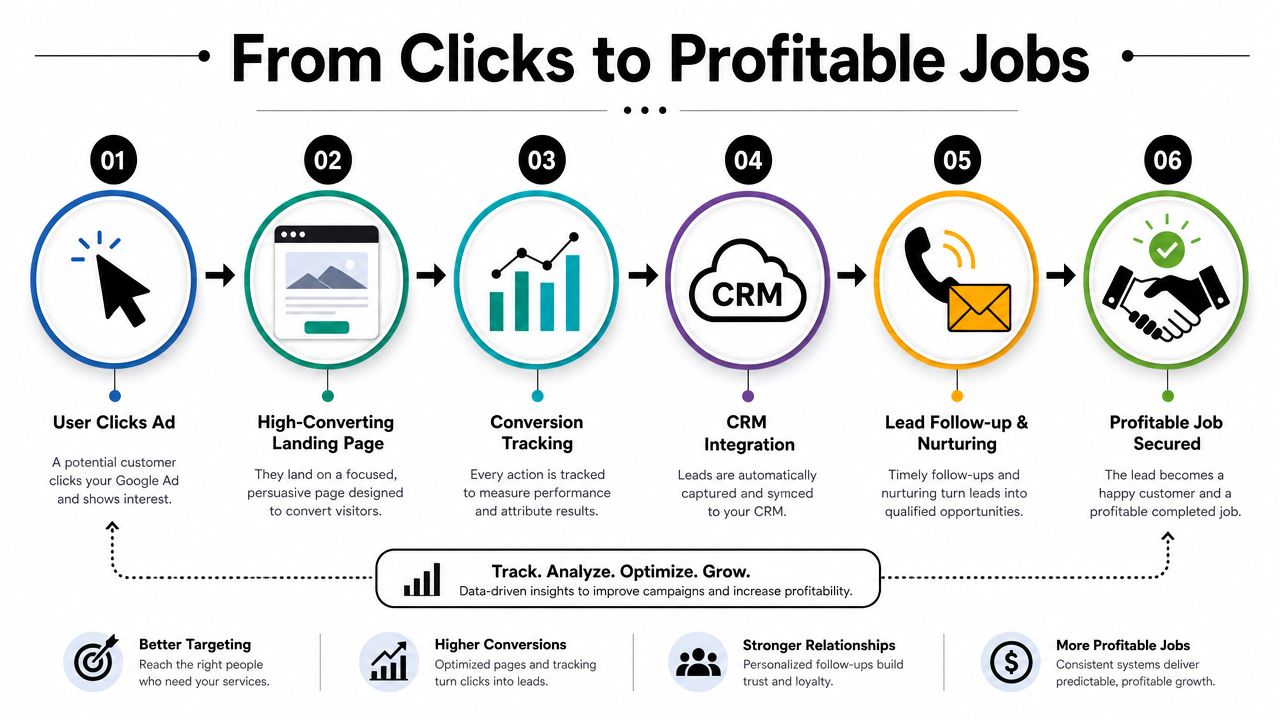
Your homepage is not the place to send paid traffic. A landing page should have one job and do it well.
Imagine a foreman on a jobsite. A good foreman gives clear instructions, keeps people moving, and doesn't create confusion. A bad foreman lets everyone wander around.
A strong contractor landing page usually includes:
- One service focus: kitchen remodel, bath remodel, addition, or another single offer
- One location focus: the actual market you serve
- One primary action: call, form fill, or booked consultation
- Proof: photos, process language, testimonials, and trust signals
- No clutter: fewer exits, fewer distractions
If somebody clicked an ad for a high-end bathroom remodel, don't make them hunt through your navigation menu to figure out whether you even do that work.
Tracking is your cash register
Conversion tracking is how you know whether money went into the register.
Track the actions that matter. Not just page views. Not just time on site. Track phone calls, form submissions, and booked consultations. A practical contractor setup should track multiple conversion types so Smart Bidding can learn from the right signals instead of chasing raw clicks, as covered earlier in this article.
The reason this matters is simple. Google Ads economics in home services can swing a lot. In a large home services dataset, total tracked spend reached $214.27 million with $2.25 billion in tracked revenue opportunity. Cost per paying customer moved from $642.67 in 2023 to $658.85 in 2024, then improved to $308.14 in 2025. Cost per conversion moved from $90.17 in 2023 to $93.88 in 2024 and then down to $85.83 in 2025, according to The Data-Driven Trades analysis of Google Ads economics.
That's the whole lesson in one sentence. If you don't track cleanly, you can't tell whether your costs are normal, inflated, or fixable.
Clicks are guesses. Tracked conversions are receipts.
A CRM closes the gap between lead and sold job
Now the big one. You need a CRM connected to the ad system.
When a lead comes in, it should land in one place. It should trigger follow-up. It should show whether the person answered, booked, no-showed, received an estimate, or became a sold job. If you use a platform like GoHighLevel, you can automate a lot of the handoff that usually breaks.
That matters because the biggest leak in many remodeling businesses isn't ad traffic. It's response speed and follow-up discipline. More advanced contractor guidance also points out that paid search performs better when it connects to retargeting, email nurture, and a strong landing-page-to-CRM handoff, as discussed by Halstead Media's contractor PPC mistakes article.
Here's the practical setup I recommend:
- Every call gets tracked
- Every form drops into the CRM immediately
- Every missed call triggers a text-back
- Every lead gets tagged by service and source
- Every opportunity gets followed through to estimate and sale
If you're comparing systems, this overview of CRM software for builders is a useful starting point.
The missed-call text-back matters more than most contractors realize. You're on a jobsite. Your phone rings. You can't answer. If your system texts back right away, you still have a chance. If it doesn't, that lead often goes to the next contractor.
Optimizing Your Ads to Find Better Leads Not Just More Leads
Launching the campaign is not the victory. It's the first rep.
A strong Google Ads account gets smarter over time, but only if you feed it the right feedback and stop rewarding bad leads.
Stop judging success by clicks
Clicks are easy to count and easy to misuse.
A remodeler chasing large projects should care more about lead quality by intent stage. Most contractor ad guides miss this. They talk about keywords, geography, ad copy, and landing pages, but skip the harder question: who is ready to buy now versus who is still researching. For firms pursuing $75K to $300K projects, the primary issue is identifying which leads are in-market now, as explained in Sona's guide for remodeling contractors.
That means your scorecard should focus on things like:
- Qualified lead quality: Did the homeowner fit your service, area, and budget profile?
- Sales progression: Did the lead become an appointment, estimate, or opportunity?
- Booked revenue potential: Are you attracting projects worth your time?
- Actual closed jobs: Which campaigns produced signed work?
Run a simple review rhythm
Don't overcomplicate optimization. You don't need to live inside the ad account. You do need a steady routine.
Use a weekly check for search terms and lead quality. Use a monthly check for budget shifts and sales outcomes.
A simple rhythm:
| When | What to review |
|---|---|
| Weekly | Search terms, junk queries, lead notes, missed calls |
| Monthly | Service-level performance, landing page fit, sales outcomes |
One useful benchmark from contractor PPC guidance is to give Smart Bidding enough room to learn, around 30 conversions in 30 days, and once performance stabilizes, make changes gradually in 10 to 15% increments instead of yanking bids around aggressively, as outlined in the earlier linked YouTube source.
Teach Google who your best prospect is
Google learns from your conversion signals. If you feed it every form fill equally, it can't tell the difference between a serious homeowner and a tire-kicker.
That's why better optimization usually comes from better feedback, not louder bidding. Mark which leads were qualified. Note which ones booked. Push sold-job data back into your reporting if you can. That's how you move from “more leads” to “better leads.”
If you want a cleaner way to prioritize serious prospects, this look at predictive lead scoring for contractors can help frame what to track.
The best Google Ads account is not the one that generates the most noise. It's the one that helps you spot the homeowners already raising their hand.
If you're tired of fuzzy reporting, missed opportunities, and campaigns that look busy but don't turn into real projects, Constructo Marketing is built for remodelers who want a tighter system. They focus on qualified local demand, conversion-focused websites, and CRM-driven follow-up that helps capture serious residential projects instead of wasting money on leads that go nowhere.