


You're probably doing marketing already. The phone rings, a form comes in, somebody says they found you on Google, and you keep moving because there's a job to run. Then a month later you look at your ad spend, your website, your schedule, and you still can't answer one simple question.
Which marketing brought in the good jobs?
That's where data driven marketing helps. Not the big corporate version with a room full of analysts. The practical version. The one that helps a remodeler figure out which channels produce tire-kickers, which ones produce serious homeowners, and where to put the next dollar so it has a better chance of turning into a six-figure project.
Building without a blueprint means you can still swing a hammer, but you'll waste time, waste material, and fix mistakes later. Marketing works the same way.
Table of Contents
- What Is Data Driven Marketing And Why Should a Remodeler Care
- Your Data Toolbelt The Four Sources You Already Have
- Key Numbers That Actually Matter for Booking Jobs
- A Simple Workflow for Turning Numbers into Dollars
- How Two Remodelers Used Data to Grow
- Your Implementation Checklist
- Stop Guessing Start Building Your Business
What Is Data Driven Marketing And Why Should a Remodeler Care
A homeowner fills out your form on Monday, calls on Wednesday, then disappears. Another lead comes in from the same zip code, asks better questions, books a consultation, and signs a kitchen project worth six figures. If you cannot see what was different between those two leads, your marketing budget starts acting like scrap lumber. Money goes out, but you cannot tell what was built.
Data driven marketing means using the numbers already sitting in your business to make better decisions. For a remodeler, that usually comes from Google, your website, your ads, and your CRM. The goal is simple. Find what brings in qualified homeowners and cut what attracts time-wasters.

A clearer way to run marketing
A blueprint tells the crew what belongs where before anyone starts cutting. Data does the same job for marketing. It shows which service pages bring calls, which campaigns produce tire-kickers, and which parts of town keep sending serious inquiries.
That kind of visibility helps owners stop treating marketing like a black box.
If you already use visual planning tools to help homeowners see the finished project before demo starts, you already understand the value of getting clear early. Tools like Room Sketch 3D for contractors make the project easier to see before the work begins. Marketing data gives you that same visibility before you spend another dollar chasing leads.
Why remodelers should care
For a remodeler, marketing is not about piling up traffic reports or admiring click counts. It is about booking better jobs, attracting better-fit clients, and keeping the pipeline full of work you want to build.
Practical rule: If a marketing report cannot help you decide where the next budget dollar goes, it is probably noise.
The good news is you do not need a giant tech stack or a full-time analyst to do this well. In practice, a remodeler can get a lot of value from a few connected systems and clean lead tracking. A decent website, call tracking, and a solid CRM software setup for builders usually go farther than another flashy dashboard.
I have seen the same trade-off over and over. Owners who run on gut instinct move fast, but they also waste money faster. Owners who check a few core numbers each week usually spot problems sooner, shift budget sooner, and protect their sales team's time. That is a key reason to care. Data driven marketing is not a fancy side project. It is a practical way to run marketing with more control from first click to signed contract.
Your Data Toolbelt The Four Sources You Already Have
Most owners think they need some huge software stack before they can use data well. Usually, they don't. They already own the main tools. They just haven't clipped them onto the same belt.
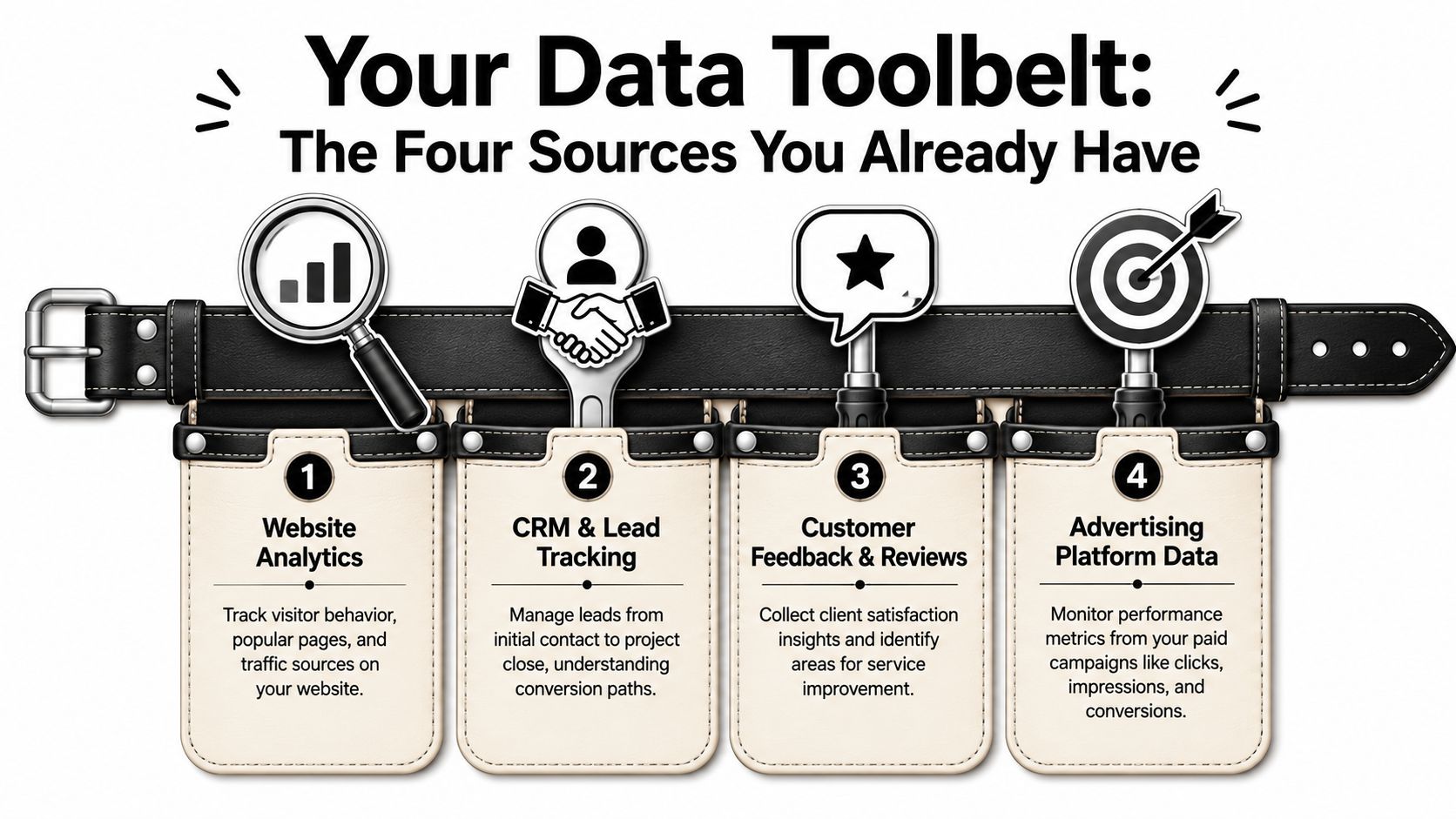
A useful way to think about it is this. Each source answers one simple question.
Google Business Profile
Your Google Business Profile is your digital jobsite sign out on the road. It helps you understand who found you through local search and maps activity.
It answers a simple question. Are nearby homeowners noticing us when they search?
This matters more than owners realize. Someone who finds you through maps, reviews, or local branded search is often farther along than someone casually browsing design ideas.
Google Ads
Google Ads is like a paid foreman. You give it a budget and a job. Then you watch whether it brings in qualified traffic or wastes labor on the wrong tasks.
It answers this question. Which searches are bringing people who want to talk about a project?
Not every click is helpful. A broad keyword might bring plenty of interest but very little buying intent. A tighter campaign built around service type, location, and homeowner need usually gives you cleaner signals.
Website analytics
Your website analytics is your traffic report. Not street traffic. Jobsite traffic. It shows where people land, what they read, what they ignore, and where they leave.
It answers this question. What are homeowners doing after they get to our site?
If lots of visitors hit your kitchen page and stay there, that means something. If they land on your homepage and disappear, that means something too. The numbers don't need to be complicated. You're just checking whether the site is helping the sale or getting in the way.
CRM
Your CRM is the project pipeline binder. It should hold every lead, every follow-up, every appointment, and every final outcome in one place.
It answers the most important question. Which leads turned into real revenue?
That's the whole game. Without the CRM, you can see top-of-funnel activity but miss the part that matters most. If you want to automate workflows with CRM, that kind of setup helps connect calls, follow-ups, and sales activity so leads don't get lost in the shuffle. If you're still sorting options, this guide to CRM software for builders is a practical place to start.
Most marketing problems aren't traffic problems. They're tracking problems.
What works and what doesn't
Here's what works in the field:
- One place for lead status: Every inquiry should have a source, a service type, and a next step.
- Clean naming: If one person labels a lead “Google” and another labels it “website,” your reports turn into junk.
- Closed-loop tracking: A lead should be tied to its final outcome, not just the first call.
What doesn't work:
- Scattered notes: Sticky notes, inboxes, and memory aren't a system.
- Last-touch only thinking: The final click isn't always the whole story.
- Counting leads without checking quality: Busy phones can still hide weak sales.
A widely cited business summary says companies adopting data-driven marketing are six times more likely to be profitable year-over-year, and that data-driven personalization can deliver five to eight times ROI on marketing spend, increase sales by 10% or more, reduce marketing costs by up to 30%, increase customer acquisition by 20%, and improve retention by 10% (HG Insights on data-driven marketing).
The big takeaway is simple. Your data toolbelt already exists. The job is to use the tools together.
Key Numbers That Actually Matter for Booking Jobs
Many remodelers drown in reports because they're looking at too many numbers. You don't need a hundred metrics. You need a small scoreboard that tells you whether marketing is helping you book profitable work.
The numbers that deserve your attention
The easiest way to judge a metric is to ask, “Can this help me make a decision?” If the answer is no, it belongs in the background.
| Metric | What It Means In Plain English | Why It Matters |
|---|---|---|
| Lead volume | How many people raised their hand | Shows whether your market is hearing from you at all |
| Cost per lead | How much you paid to get one inquiry | Helps you compare channels without guessing |
| Lead-to-appointment rate | Out of all the people who contacted you, how many agreed to the next step | Tells you whether the lead quality and your intake process are solid |
| Appointment-to-estimate rate | How many appointments turned into real quoting opportunities | Shows whether you're getting into the right homes |
| Estimate-to-close rate | How many bids became signed jobs | Reveals sales strength and lead quality together |
| Average job value | The typical project size you're actually selling | Keeps you focused on revenue, not just activity |
| Customer acquisition cost | What it costs to win one new client | Helps you judge if growth is healthy or expensive |
| Return on marketing investment | Whether the revenue from marketing justifies the spend | Keeps marketing tied to profit, not vanity |
| Sales cycle length | How long it takes to go from first lead to signed deal | Important for cash flow and forecasting |
| Source-to-revenue | Which channel actually produced closed-won jobs | Prevents you from overvaluing channels that only look busy |
Vanity metrics vs useful metrics
A lot of reports brag about clicks, impressions, and traffic spikes. Those numbers can be useful, but only if they connect to booked jobs. If they don't, they're like admiring a pile of lumber without checking whether the house is framed correctly.
A channel that sends fewer leads can still be your best channel if those leads close at a higher value.
Pay attention to the full path
One of the biggest mistakes in data driven marketing is acting like the last click deserves all the credit. In remodeling, buying journeys are rarely that neat. People may see your Google Business Profile, visit your site, come back through an ad, read reviews, and call later.
Technical guidance on data-driven marketing stacks recommends multi-touch attribution and a warehouse-first setup so CRM, ad-platform, and revenue data are unified before reporting. That approach reduces siloed measurement and helps teams optimize for pipeline velocity, CAC payback, and incremental revenue instead of relying on misleading last-click metrics (Improvado on data-driven marketing decisions).
You don't need to build an enterprise data warehouse tomorrow. But you do need to stop thinking that one click explains the whole sale. If you want a practical way to tie spending back to business results, this guide on how to calculate marketing ROI gives you a cleaner framework than just counting leads.
A Simple Workflow for Turning Numbers into Dollars
The easiest version of data driven marketing is a loop. Capture. Analyze. Act. Then repeat. Like any good build process, the power comes from doing the same fundamentals well every time.
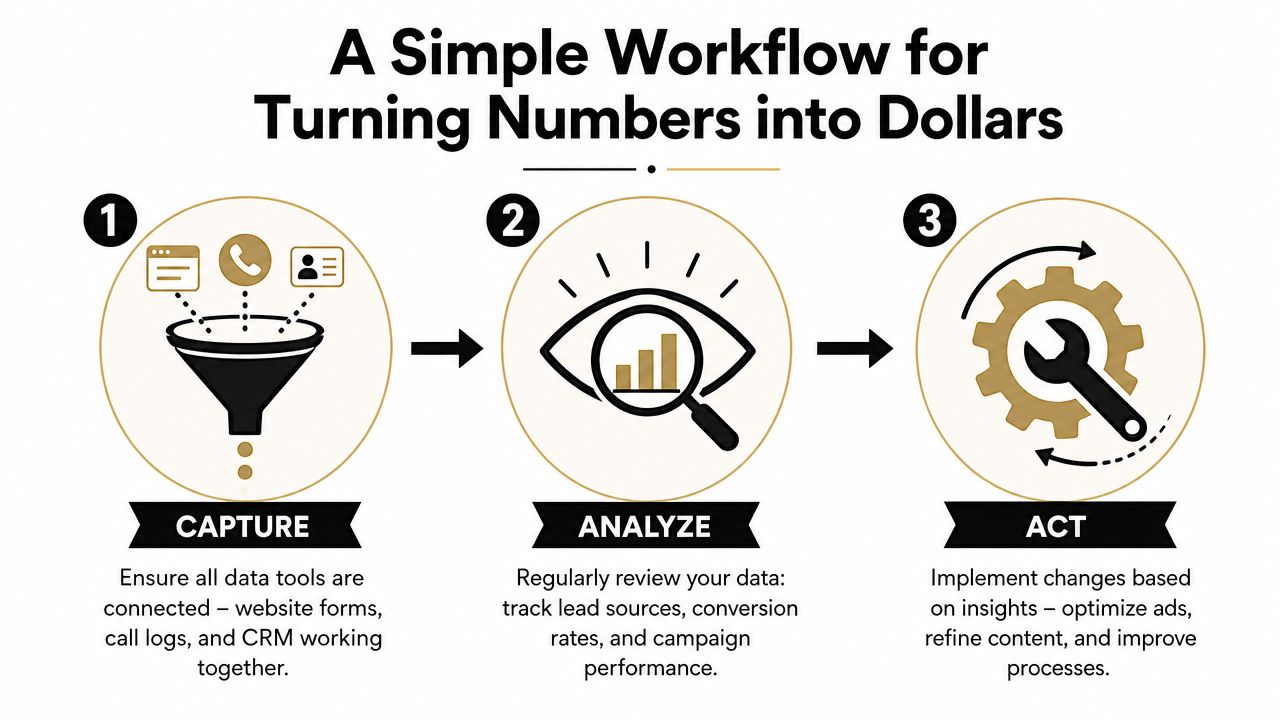
Capture
Start by making sure your tools can talk to each other. If a website form comes in, it should land in your CRM. If a call comes from an ad, that source should be visible. If a lead turns into a sold project, that outcome should be tied back to the original channel.
Many small businesses often encounter difficulties. Guidance on privacy-safe measurement points out that small teams frequently struggle with data minimization, CRM cleanup, and offline conversion tracking, especially things like phone calls from ads. The practical fix is to connect calls, forms, and closed-won revenue into one usable system (Siteimprove on obstacles to data-driven marketing).
A simple capture checklist looks like this:
- Forms feed the CRM: No copy-paste from email inboxes.
- Calls have source tracking: At minimum, know whether the call came from Google Ads, organic search, maps, or referral.
- Lead records include service type: Kitchen, bath, addition, outdoor living, roofing, or other.
- Sales outcomes are updated: Open, qualified, estimate sent, won, lost.
Analyze
Once a week, look at the numbers like a superintendent walking the site. Not to admire the work. To find what needs attention.
Ask plain questions:
- Which source brought the best leads?
- Which service generated inquiries but no appointments?
- Which pages or ads attracted the wrong homeowner?
- Did booked jobs come from the same places as raw leads?
Field note: Weekly reviews beat giant quarterly report sessions because you can still fix things while the campaign is running.
The operational advantage of data-driven marketing comes from closing the loop between customer signals and campaign actions in near real time, which lets teams shift spend toward channels with higher expected ROAS (ThoughtSpot on data-driven marketing).
That means you don't wait three months to discover an ad group has been attracting weak leads. You catch it while the concrete is still wet.
Act
This is the part owners skip. They collect numbers, glance at a dashboard, then change nothing. Data without action is just office clutter.
If one campaign is producing serious kitchen remodel leads, put more money there. If a landing page gets visits but no forms, rewrite it. If one service line creates lots of noise and little revenue, narrow your targeting or pause it.
A simple weekly decision sheet might look like this:
- Keep the channels bringing qualified appointments.
- Fix the campaigns with interest but poor conversion.
- Pause the ads that attract bad-fit projects.
- Expand the messaging that lines up with profitable job types.
A plain-English example
Say a remodeler checks the CRM on Friday. The Google Ads dashboard says one ad group drove several form submissions. That sounds good. But the CRM shows most of those leads wanted small handyman-style work, not full remodeling.
Another campaign brought fewer leads, but those homeowners asked about full kitchen projects and followed through to consultations.
The right move is obvious once the numbers are connected. Lower spend on the noisy campaign. Increase budget on the campaign tied to the better-fit jobs. If you want to make that sorting easier, predictive lead scoring can help prioritize leads based on likely quality instead of just first contact volume.
That's what turning numbers into dollars looks like in real life. Not fancy. Just disciplined.
How Two Remodelers Used Data to Grow
A lot of remodelers already have useful numbers. They just have them scattered across Google, website forms, call logs, and the CRM, like tools tossed in the back of the truck instead of organized in the toolbelt.
The kitchen remodeler who stopped treating every lead the same
One kitchen remodeling company looked busy on paper. The phone rang, forms came in, and the pipeline seemed full. But the owner kept running into the same problem. Too much time went to small update requests, while the larger kitchen projects they wanted were harder to spot early.
The fix started with better lead labels inside the CRM. Instead of dumping every inquiry into one bucket, the team tagged contacts by project type and scope. Full layout changes, custom cabinetry, and design-build kitchens kept showing up on stronger opportunities. Smaller cosmetic requests usually stalled out or turned into lower-value work.
That gave them something they could use. They rewrote website copy and ad messaging to attract full-scope kitchen remodels instead of broad “kitchen updates” searches. They also made the service page sound more like the jobs they wanted to sell, with clearer language around cabinetry, functionality, and complete remodel planning.
The lead count did not explode. The fit improved, which was paramount.
The outdoor living contractor who found the right pocket of town
An outdoor living contractor had a different problem. Calls were coming in, but the owner could not tell which neighborhoods were producing serious backyard projects and which ones were mostly shopping for basic repairs.
After lining up local search data, call records, and closed jobs in the CRM, a clear pattern showed up. One area kept producing larger projects, including covered patios, kitchens, and higher-end outdoor builds. Other areas generated activity, but not the kind that filled the schedule with profitable work.
So the contractor changed the plan. They tightened their geo-targeting, adjusted local page copy, and used project photos that matched the expectations of homeowners in that area. In construction terms, they stopped pouring concrete all over the lot and started building where the footings were strongest.
Clean data does not make the call for you. It shows where to aim.
Both companies used numbers they already had. No fancy system. No analyst sitting in a back office.
They needed cleaner records, source tracking, and the discipline to connect first contact with final sale.
Your Implementation Checklist
A lot of remodelers already have enough numbers to make better marketing decisions. The problem is that the numbers are scattered like tools left across a jobsite. This checklist helps you see whether your system is set up to win better jobs, or whether good leads are slipping through the cracks.
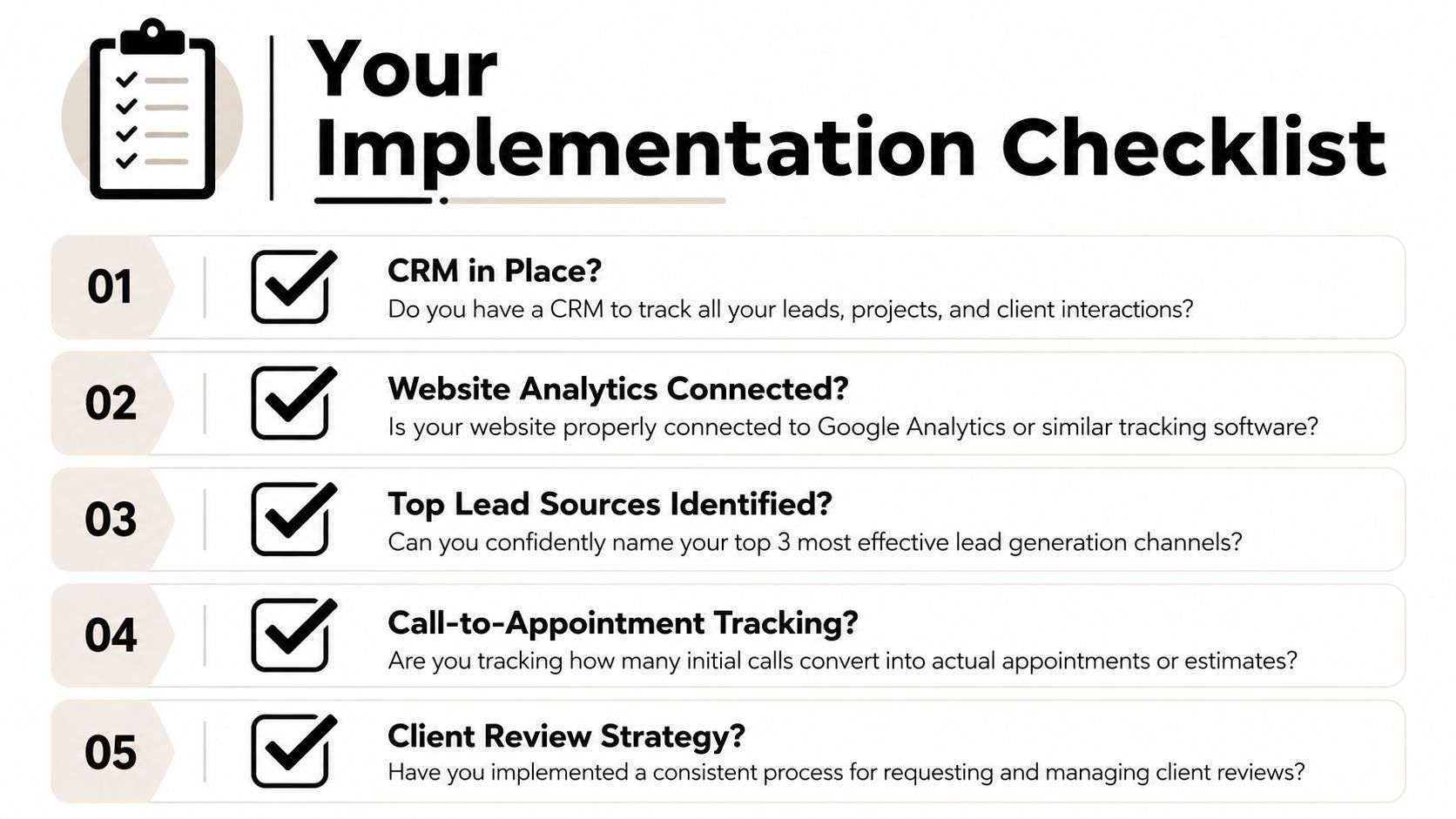
The short checklist
Run through these questions like a final punch list.
- Do you have one place for all leads? If inquiries live in email, text threads, notebooks, and your memory, you cannot trust the numbers.
- Is your website tracking connected? You should be able to see which pages people visit and which forms they submit.
- Can you name your top lead sources? Use tracked sources, not hunches.
- Do you track calls and form fills separately? They come from different behavior and usually convert at different rates.
- Do you know which leads became appointments? That step shows whether you are getting real sales opportunities or just inquiries.
- Do you know which appointments became sold jobs? That is where marketing starts tying back to revenue.
- Are service types labeled clearly? Kitchen remodels, baths, additions, and outdoor living need their own labels if you want to see where better projects come from.
- Are lost leads marked with a reason? Price, timing, bad fit, no response, and lost to a competitor each point to a different fix.
The standard you're aiming for
The goal is not a fancy dashboard.
The goal is a clean line from first click to signed contract. If you can see where a lead came from, what type of project they wanted, whether they booked an appointment, and whether they bought, you have the blueprint you need to improve.
As noted earlier, data-driven marketing is common across the field. For a remodeler, that does not mean copying enterprise marketing teams or chasing AI tools. It means using the numbers you already have from Google, your website, and your CRM to answer practical questions. Which channels bring in design-build additions instead of small repair shoppers? Which pages produce consultations? Which neighborhoods and service lines lead to six-figure jobs?
If you cannot answer those questions yet, start with clean records and consistent labels. That work is boring. It also pays.
A sloppy CRM is like building from a crooked layout line. Everything that follows gets harder to trust.
Stop Guessing Start Building Your Business
Data driven marketing isn't about becoming a spreadsheet person. It's about becoming a better builder of your business.
The best remodelers don't make major construction decisions by gut alone. They use plans, measurements, and sequences. Marketing should work the same way. Start with a few numbers you can trust. Track where leads come from. Watch which ones become appointments. Follow those all the way to sold work.
One question matters more than most owners realize. Are your marketing efforts creating new demand, or are they only catching people who were already searching for you? That gap in measuring incrementality is still one of the most important unanswered questions in marketing, especially for local service businesses that need to prove their campaigns are generating real new opportunity, not just taking credit for branded searches or repeat visitors (University of Minnesota guide to data-driven marketing).
If your marketing feels chaotic, the answer usually isn't more activity. It's better measurement, cleaner systems, and smarter decisions.
Start small. Build the blueprint. Then improve it every month.
If you want help building a marketing system that brings in the right local projects instead of more random leads, Constructo Marketing helps remodelers become Local Famous, track what drives revenue, and turn marketing into a repeatable growth system.