


Conversion rate optimization is the work of getting a bigger share of your website visitors to take the next step, and the basic math is simple: (conversions ÷ total visitors) × 100. Most websites sit around 2% to 5%, with one benchmark at 2.35%, another at 3.68%, and top performers reaching 11% or higher.
Think of your website like the path from your front door to your kitchen table. If the hallway is dark, cluttered, or confusing, guests stop, turn around, or leave. Your site works the same way. Homeowners land on your homepage, project pages, or service pages, and if they can't quickly figure out who you help, what you do, and how to contact you, they vanish.
For a remodeler, that matters more than most businesses. You don't need a pile of cheap clicks. You need the right homeowner to call, fill out a form, or book an estimate for a serious project. That's what conversion rate optimization is really about.
Table of Contents
- What Conversion Rate Optimization Really Means
- Why CRO Is Your Secret Weapon for Winning Big Projects
- The Key Conversions Every Remodeler Must Track
- Simple CRO Tactics That Get More Remodeling Leads
- Connecting CRO with SEO Ads and Your CRM
- Your First Steps to Improving Website Conversions
What Conversion Rate Optimization Really Means
A homeowner lands on your site after searching for a kitchen remodeler. They like the photos. They skim your process. Then they hit a wall. The phone number is buried, the form asks for too much, and nothing tells them whether you handle projects at their budget level. They leave and call the next contractor.
That leak is what conversion rate optimization fixes.
The simple definition
What is conversion rate optimization? It is the practice of increasing the percentage of visitors who take a desired action on your website by improving the pages, offers, forms, calls to action, and overall user experience, according to Fullstory's CRO guide.
For a remodeler, the desired action is usually a qualified lead. A phone call. A form fill. A request for an estimate. A serious homeowner raising their hand.
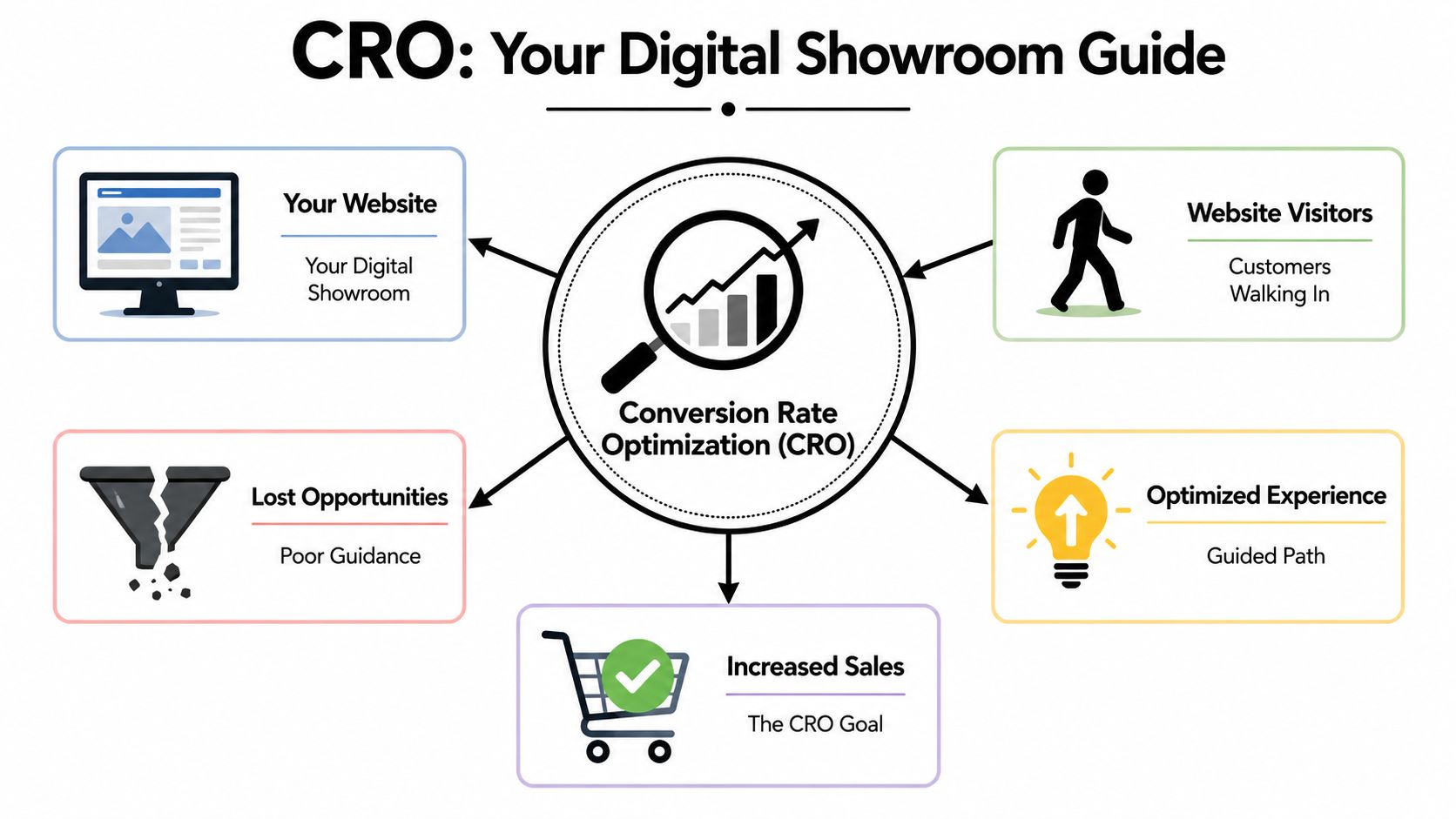
Your website works like a showroom and a sales coordinator rolled into one. It should show the quality of your work, answer the big trust questions, and make the next step obvious. If it does that well, more of the right prospects contact you. If it does it poorly, your traffic goes to waste.
The math on the whiteboard
CRO is simple math.
- Conversions: People who call, submit a form, or request a consultation
- Visitors: People who came to your site
- Conversion rate: Conversions divided by visitors, multiplied by 100
Here is the plain version:
| Visitors | Conversions | Conversion rate |
|---|---|---|
| 100 | 2 | 2% |
| 100 | 5 | 5% |
If 100 people visit your site and 2 contact you, your conversion rate is 2%. If 5 contact you, it is 5%.
Same traffic. More chances to sell a large project.
That is why CRO matters so much for remodelers. You do not always need more visitors. You often need a better path from visit to inquiry.
Practical rule: CRO means removing friction so the right homeowner can take the next step without hunting for it.
What good looks like
Good CRO does two jobs at once. It gets more inquiries, and it improves the quality of those inquiries.
A strong remodeling site does not just ask people to "contact us." It shows the kind of projects you take on, the areas you serve, the price level you work in, and what happens after someone reaches out. That is good filtering. It saves your team from wasted estimate requests and helps serious prospects feel confident enough to start the conversation.
Benchmarks can give you context, but your number only matters if it turns into real opportunities. A smaller jump in conversion rate can mean several more high-value conversations each month, especially if your traffic is already solid.
And once those inquiries come in, your team still has to convert leads to booked jobs with a clear follow-up process, solid qualification, and tight handoff from marketing to sales.
Why CRO Is Your Secret Weapon for Winning Big Projects
Remodeling is not e-commerce
A lot of CRO advice online is built for stores that sell lots of low-cost products. That's not your world.
You are not fishing with a wide net. You're spearfishing. One serious kitchen, whole-home, or addition lead can matter more than a flood of weak inquiries. So the goal isn't "get more random conversions." The goal is "get more of the right homeowners to take the right action."
For high-consideration services like remodeling, CRO shifts away from instant online purchases and toward the touchpoints that influence a longer buying decision, especially qualified calls and booked estimates, as discussed in this research on conversion optimization and sales-influencing touchpoints.
That changes how you should think.
Your website should qualify, not just collect
A weak site says, "Contact us." That's lazy.
A strong site says, in plain language, what kind of project you do, what areas you serve, what style of work you're known for, and what the next step looks like. That helps the right homeowner move forward and helps the wrong one self-select out. Both outcomes are good.
Here's the difference:
- Bad CRO mindset: Make everybody fill out a form.
- Good CRO mindset: Help the best-fit prospect feel confident enough to start the conversation.
If your site gets traffic but your sales team keeps saying, "These leads aren't qualified," you don't just have a traffic problem. You have a handoff problem.
A remodeler chasing larger projects should care about three things on the website:
Clarity
Homeowners should know within seconds whether you do the kind of work they want.Trust
They need proof. Real project photos, a clear process, service area details, and straightforward messaging.Momentum
Every page should make the next step obvious. Call. Fill out the form. Request a consultation.
This is why CRO is a secret weapon. It makes your existing marketing work harder. Your SEO traffic becomes more valuable. Your Google Ads clicks stop leaking. Your website stops acting like a brochure and starts acting like a pre-sale conversation.
For high-ticket services, that's the whole game.
The Key Conversions Every Remodeler Must Track
The word "conversion" confuses people because it sounds technical. It isn't. A conversion is just a homeowner raising their hand.
If you don't define those hand raises, you can't improve them. You're just guessing.
Phone calls from the website
For many remodelers, the best lead still starts with a call. A homeowner sees your work, likes what they see, and wants to talk to a real person.
Track calls that come from your site, especially from mobile. If someone taps your number from a phone, that's not a vanity metric. That's buying intent.
What to watch:
- Clickable phone number: Make sure people can tap to call.
- Placement: Keep the number visible in the header and on service pages.
- Tracking: Use call tracking so you know which pages and campaigns drove the call.
Contact form submissions
Forms matter because some homeowners don't want to call first. They're at work, they're comparing firms, or they want to send project details.
A good form captures the basics without feeling like a tax return. Name, contact info, project type, location, and a short message usually gets the job done.
Field test: If your form feels longer than a simple intake sheet, shorten it.
If you're building visibility around this in your reporting, a KPI dashboard for contractors helps turn scattered lead activity into something you can manage.
Google Business Profile actions
A lot of remodelers forget this one. Your website isn't the only place people convert. Some homeowners find you in Google Maps or local search, then click to call, click through to the site, or ask for directions.
Those actions signal intent. Treat them like part of the same system. If your Google Business Profile gets attention but your site loses people after the click, the problem isn't visibility. It's the landing experience.
Website chat conversations
Chat can work well when it acts like a good front-desk person. It should answer simple questions, route people to the right next step, and catch leads that would otherwise bounce.
The key is not to overcomplicate it.
A useful chat tool does a few simple jobs:
- Greets visitors clearly: It offers help without being annoying.
- Collects lead details: Name, phone, email, and a short project description.
- Routes urgency: If someone wants to talk now, make that easy.
Track all four of these conversion points together. Calls, forms, Google actions, and chat. That's your actual lead capture system.
Simple CRO Tactics That Get More Remodeling Leads
A homeowner clicks from Google, lands on your site, likes the photos, then leaves without calling. That is not a traffic problem. It is a conversion problem. You already paid to get the visit. CRO fixes the parts of the page that keep a serious prospect from taking the next step.
For remodelers, the goal is not more clicks. The goal is more qualified inquiries for kitchen remodels, additions, and whole-home projects that fit your sales target. Treat your website like a jobsite. If the path is cluttered, people stop. If the next step is obvious, more of the right homeowners raise their hand.
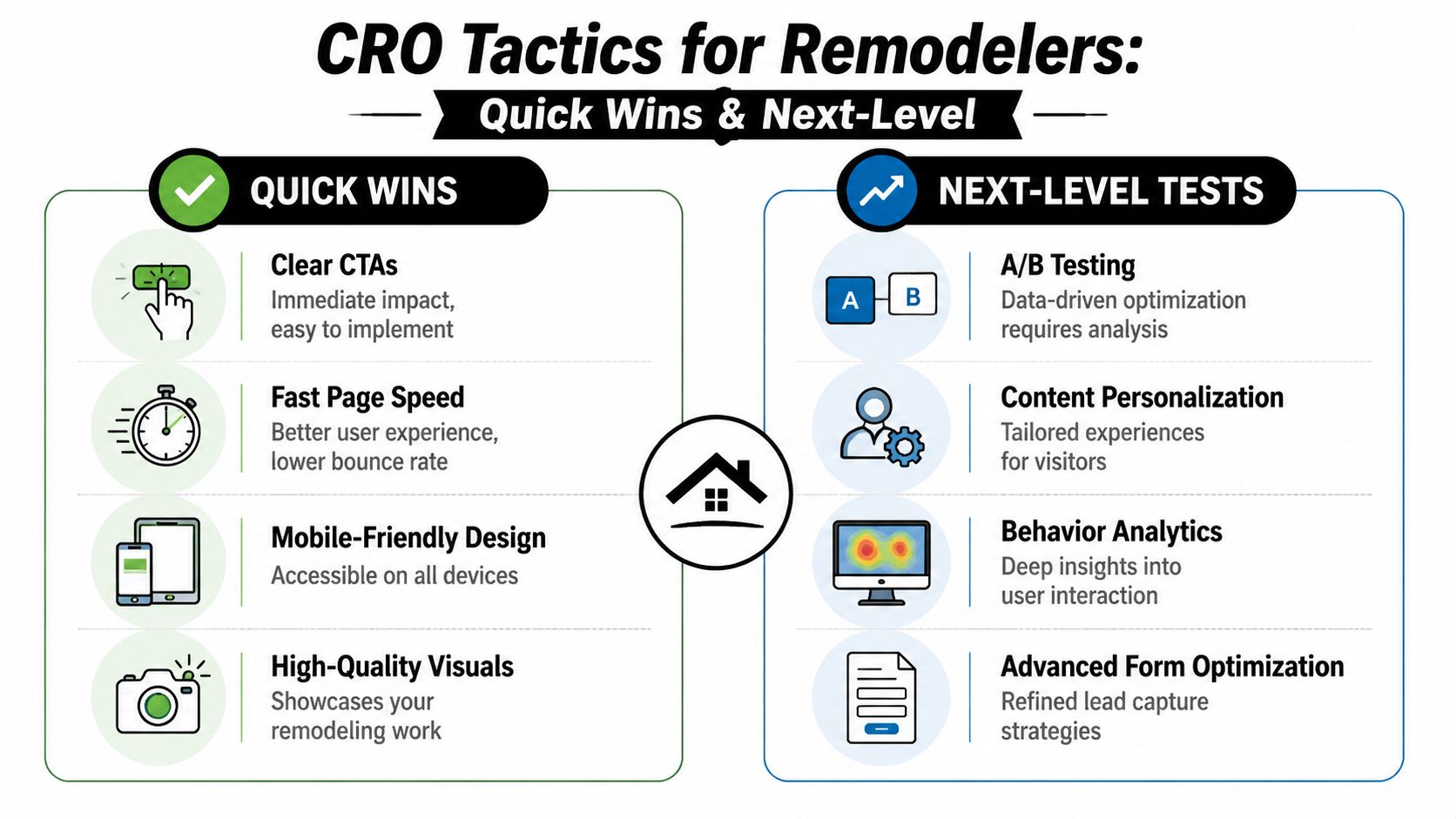
Quick wins you should fix first
Start with friction you can remove this week.
- Make the phone number tappable: Mobile visitors should be able to call in one tap.
- Put a short form on key pages: Service pages, location pages, and portfolio pages should all give people a clear way to inquire.
- Use direct CTA language: "Request a Consultation" and "Book a Design Call" work better than soft labels like "Learn More."
- Show strong project photos near the top: Homeowners want proof fast.
- Write a specific headline: Say what you do, who you serve, and where you work.
Homepage copy is where a lot of remodelers lose good leads.
A weak headline says, "Transforming spaces with excellence."
A stronger one says, "High-end kitchen and whole-home remodeling for homeowners in [market]."
That second version does the job. It tells the visitor they are in the right place. It also filters out low-fit traffic before it wastes your time.
Next-level tests after the basics are fixed
Once the obvious friction is gone, test one variable at a time. Do not redesign five things and hope for the best. Change one element, measure the result, keep the winner.
For a remodeler, useful tests usually look like this:
- Headline A vs. Headline B
- A gallery led by finished-room photos vs. before-and-after photos
- A short form vs. a form that asks budget range
- "Request a Consultation" vs. "Schedule an Estimate"
One of the best ways to get more qualified leads is to build pages that match what the homeowner is looking for. A kitchen prospect should land on a kitchen page. An addition prospect should land on an additions page. Sending both to one general services page is like handing every client the same floor plan and hoping it fits the lot.
WordStream points to a HubSpot benchmark showing that businesses with more landing pages often generate more leads, as covered in this CRO statistics roundup. For remodelers, the takeaway is straightforward. More specific pages create more chances for the right prospect to convert.
A better setup looks like this:
| Weak approach | Better approach |
|---|---|
| One general services page | Separate pages for kitchens, baths, additions, and outdoor living |
| One generic city page | Pages built for the towns you actually want to work in |
| One broad CTA | CTAs matched to the project type and buyer intent |
If you are improving those pages, these landing page best practices for contractors will help you tighten the structure.
Homeowners do not all show up with the same project, budget, or urgency. Your pages should do the sorting for them.
That is the core point of CRO for a remodeling company. Make it easy for the right person to recognize fit, trust your work, and contact you without extra steps.
Connecting CRO with SEO Ads and Your CRM
SEO, Google Ads, your website, and your CRM are one pipeline. Treat them like separate jobs and you will lose good prospects between the first click and the first conversation.
A homeowner searches for "high-end kitchen remodeler near me," clicks your ad, lands on your site, likes the photos, then hesitates because the page feels generic or the form asks for too much. You paid for that visit. CRO decides whether it becomes a real inquiry or dies on the page.
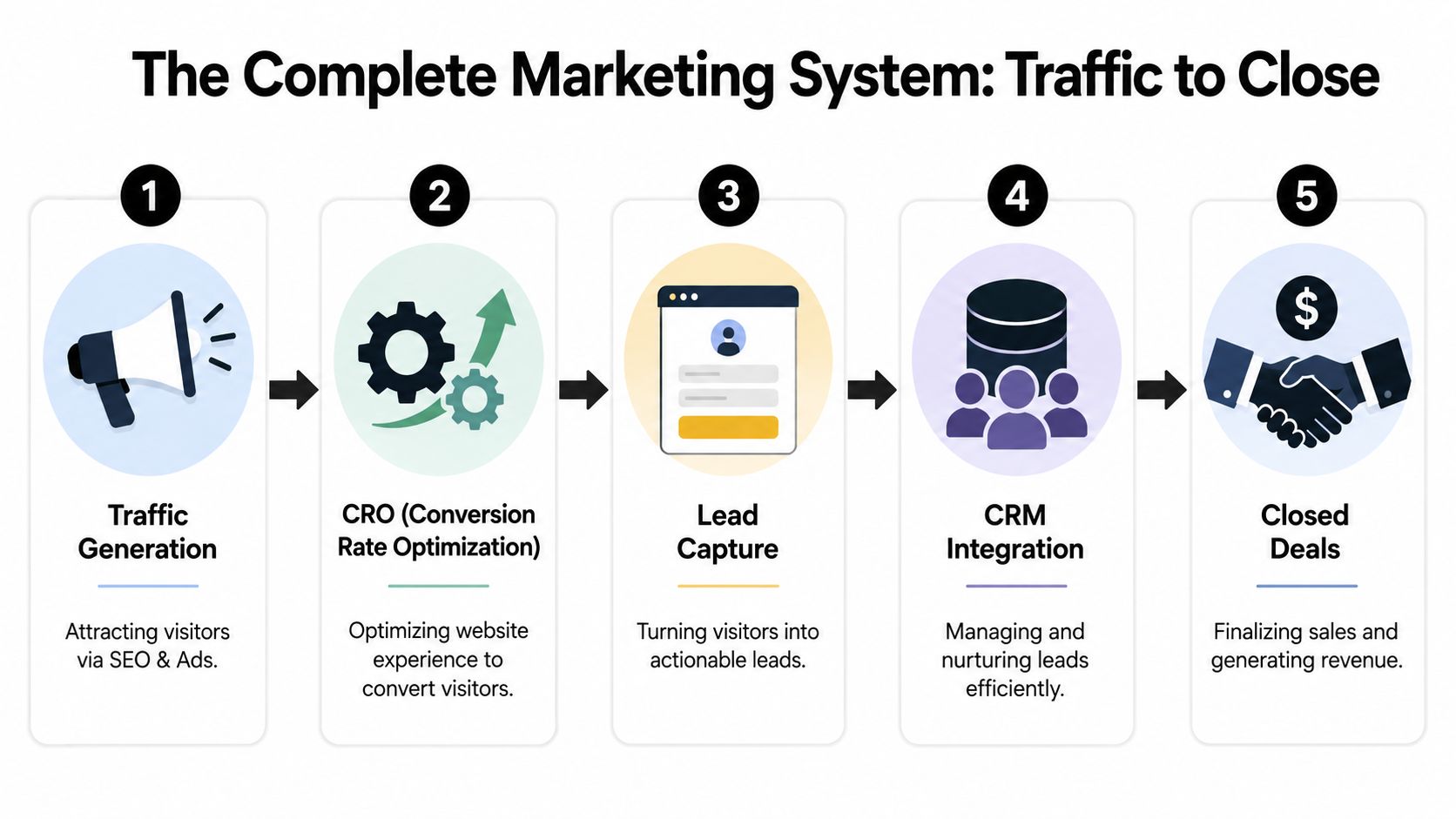
That is why CRO belongs in the middle of your marketing system. SEO brings in intent. Ads buy attention fast. CRO removes friction so the right homeowner calls, fills out the form, or requests an estimate. Then your sales process has something worth working on.
For a remodeler chasing $75K+ projects, this matters more than raw lead volume. Ten cheap leads with the wrong budget will waste your estimator's week. Three qualified inquiries in your target service area can change the month.
Your CRM reveals what worked
Website metrics only show the front half of the job. Your CRM shows whether the lead turned into a consultation, a proposal, or a signed project.
That feedback changes what you improve.
When your CRM is set up well, you can see:
- Which service pages bring in qualified leads
- Which ad campaigns create poor-fit inquiries
- Which offers lead to booked consultations
- Which sources produce real projects, not just form fills
Without that loop, you will optimize for shallow wins. A page might produce a pile of contact forms and still be a bad page if none of those people have the budget, timeline, or location you want.
Use a simple tracking structure:
Traffic source
Organic search, Google Ads, referrals, Google Business ProfileConversion point
Phone call, contact form, chat, consultation requestLead quality
Good fit, wrong project type, out of area, low budgetSales outcome
Reached, consultation booked, proposal sent, job won
A builder-focused CRM for contractors and remodelers helps you connect the click to the contract. That is the whole point. You are not trying to get more "leads." You are trying to get more of the right conversations with homeowners who can afford the kind of work you want to sell.
A page did not work because it got traffic. It worked because it helped produce a qualified inquiry for a real remodeling project. That is the standard.
Your First Steps to Improving Website Conversions
Your first-week plan
Don't overthink this. Start with three checks this week.
First, test your phone number on your own mobile site. Pull out your phone, open your website, and tap the number. If it isn't clickable, fix that first. If it is clickable but buried, move it somewhere obvious.
Second, review your main contact form. Ask one question: is this easy? If the form asks for too much, cut it down. You are trying to start a conversation, not conduct a deposition.
Third, read your homepage headline out loud. If it sounds like something any contractor could say, rewrite it. It should clearly say what you do, who you help, and where you work.
Use this checklist:
- Phone check: Tap to call works on mobile
- Form check: Short, clear, and easy to finish
- Headline check: Specific service, specific homeowner, specific market
That's enough to get momentum.
You don't need a giant redesign to start doing conversion rate optimization well. You need a cleaner path, clearer signs, and fewer reasons for a serious homeowner to leave. Small fixes stack up. And for a remodeler chasing larger projects, one better-qualified lead can matter a lot more than a pile of empty traffic.
If you want help turning your website into a better lead machine for bigger remodeling projects, Constructo Marketing is built for that job. They help remodelers connect SEO, Google Ads, conversion-focused websites, and CRM follow-up into one system that brings in better-fit leads and helps you close more of them.