


You're probably in the same spot a lot of remodelers hit.
You've put money into Google Ads. A few calls come in. A form gets filled out here and there. But too many of those “leads” want a handyman, a cheap patch job, or a ballpark price for something they aren't serious about. Some aren't even in your service area. Meanwhile, your actual sweet spot is the homeowner planning a real project and ready to hire the right firm.
That gap is why most advice about how to optimize Google Ads fails remodelers. It's built for generating activity, not for landing high-value projects. Clicks aren't jobs. Form fills aren't revenue. If you build custom kitchens, additions, and major renovations, you need a system that filters out junk and helps you spot the searches that turn into signed contracts.
Table of Contents
- Why Your Google Ads Are Wasting Money
- Build Your Foundation with Proper Measurement
- Design a High-Ticket Campaign Structure
- Use Keywords to Find the Best Homeowners
- Set Budgets and Bids for Project Value
- Write Ads and Build Pages That Get Leads
- Create a Routine to Scale Your Results
Why Your Google Ads Are Wasting Money
A remodeler in this position usually thinks one of two things. Either Google Ads “doesn't work,” or the agency running it has some secret settings they haven't figured out yet. Most of the time, neither is the actual problem.
The problem is that the account was built to chase traffic, not qualified homeowners.
If you bid on broad terms like “remodeling,” send everybody to one generic homepage, and count every call as a win, Google will gladly deliver a pile of mixed traffic. That includes DIY searchers, job seekers, tiny-project shoppers, and people who want the lowest price in town. The platform did its job. It found clicks. It just didn't find the kind of buyer you want.
More clicks usually means more noise unless your account is built to screen people out.
That's where a lot of bad advice starts. People say to raise budgets, try more keywords, or push click-through rate. That can make the problem worse. You don't need more volume if the volume is weak.
The problem isn't effort
You already know how this works in construction. If the plans are wrong, working harder doesn't fix the build. You just waste more labor and more material. Google Ads is the same.
Here's what wasted spend usually looks like for a remodeler:
- Bad search intent: Your ads show for research terms, low-budget terms, or service requests you don't even offer.
- Messy structure: Kitchens, baths, additions, and whole-home remodels all sit inside one bucket.
- Weak follow-through: A person fills out a form, but nobody knows whether that lead turned into a consultation, estimate, or signed agreement.
- Wrong success metric: The account celebrates cheap leads when the sales team knows those leads are garbage.
What optimization actually means
When people ask how to optimize Google Ads, they often think there's a button inside the platform that fixes everything. There isn't.
Optimization is a system. It starts with better measurement. Then it uses cleaner campaign structure, smarter keywords, tighter negative keyword control, stronger ads, and regular review. For remodelers, the entire point is simple. Use Google Ads to bring in homeowners who are planning meaningful projects and are worth your team's time.
Build Your Foundation with Proper Measurement
A homeowner calls about a “kitchen remodel.” Your team follows up, and discovers they want a backsplash swap and some paint. Google Ads counts that the same way it counts a full kitchen project with a real budget. If your tracking stops at the first form or phone call, you will keep paying for the wrong jobs.
For a remodeling business, measurement has one job. Show which clicks turn into qualified opportunities and which ones turn into signed work. Everything else is noise.
Google's keyword guidance supports this bigger goal. Your keywords should match intent, and your landing page should match the action you want the homeowner to take. For remodelers chasing larger jobs, that only works when you connect ad performance to lead quality inside your sales process, not just top-of-funnel lead count. You can review that in Google Ads help for choosing keywords that match your goals.
Stop counting hand-raisers like they are revenue
A form fill is a response. It is not proof of fit.
What matters is what happens next. Did your office reach them? Did they want the type of work you sell? Was the home in your service area? Did they book a consultation? Did the project make it to proposal? Did it close?
That is the standard. If you want Google Ads to help you win $75K-plus projects, you need to measure the whole path from click to contract.
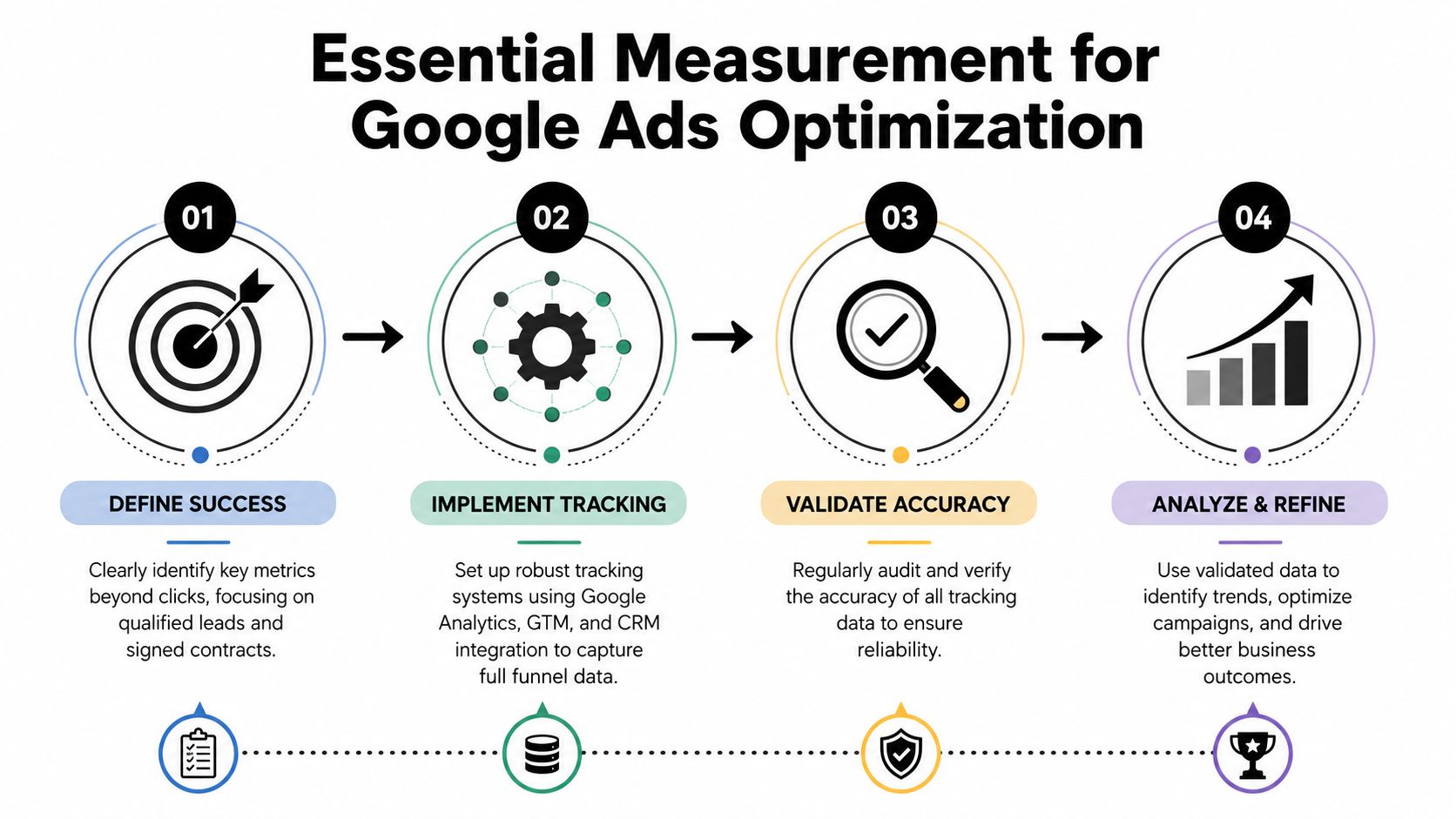
A clean reporting setup makes this visible fast. A practical KPI dashboard for marketing and sales visibility should show lead source, qualification status, booked consults, proposals, and closed revenue by campaign.
Build tracking around sales stages
Use a simple stage system your office can maintain consistently:
- Lead: Call or form submission.
- Qualified opportunity: Right service, right area, realistic budget, real intent.
- Consultation booked: The prospect committed to the next step.
- Proposal or design agreement: The opportunity moved into an active sales process.
- Won or lost: The final outcome, with revenue attached when possible.
This setup fixes a common problem in remodeling accounts. Cheap leads look good in Google Ads, but expensive searches often produce better projects. If you only optimize for cost per lead, Google will chase more low-quality inquiries because you taught it that any lead counts as success.
A measurement checklist that actually helps optimization
Audit your setup against these five items:
- Track every main lead action. Record phone calls and lead forms as conversion actions.
- Connect Google Ads to your CRM. Leads should move out of inboxes and into a system your team updates.
- Use offline conversion imports. Send back later-stage outcomes like qualified opportunity, consultation booked, and won deal so Google can optimize toward real business value.
- Apply clear lead-status labels. Use stages such as junk, qualified, consult booked, proposal sent, won, and lost.
- Pass revenue back when you can. A signed $120,000 addition should matter more than a dead-end bathroom inquiry.
Practical rule: If you cannot trace signed jobs back to campaigns, keywords, and search terms, you are not optimizing Google Ads. You are buying traffic and hoping for the best.
Remodelers do not need prettier reports. They need reporting that protects sales time and points budget toward jobs worth chasing. Once measurement is set up correctly, wasted spend stands out fast. So do the campaigns that bring in serious homeowners, bigger scopes, and signed contracts.
Design a High-Ticket Campaign Structure
Most Google Ads accounts for remodelers are too mashed together.
Kitchen remodeling, bathroom remodeling, home additions, and whole-home renovations should not live in one catch-all campaign. That's like dumping tile spacers, framing nails, and cabinet hardware into one bucket and hoping your crew sorts it out on site. Google gets confused, your ads get generic, and your budget gets spread across mixed intent.
Build campaigns like organized toolboxes
Your structure should follow the way a homeowner searches and the way your business sells.
Use separate campaigns by service line first. If location matters across multiple cities or markets, split by location where the data supports it. One campaign can focus on kitchen remodeling in one market. Another can focus on bathroom remodeling in that same market. A separate one can target additions if that's a major revenue line.
For local advertisers, one practical benchmark is to use separate campaigns for markets with more than 30 conversions per month so Smart Bidding has enough signal to work well. For smaller locations, a hybrid structure can work. The same guidance also recommends tightly themed ad groups of 5–20 keywords to protect relevance and data quality, as explained in this Google Ads campaign structure guide.
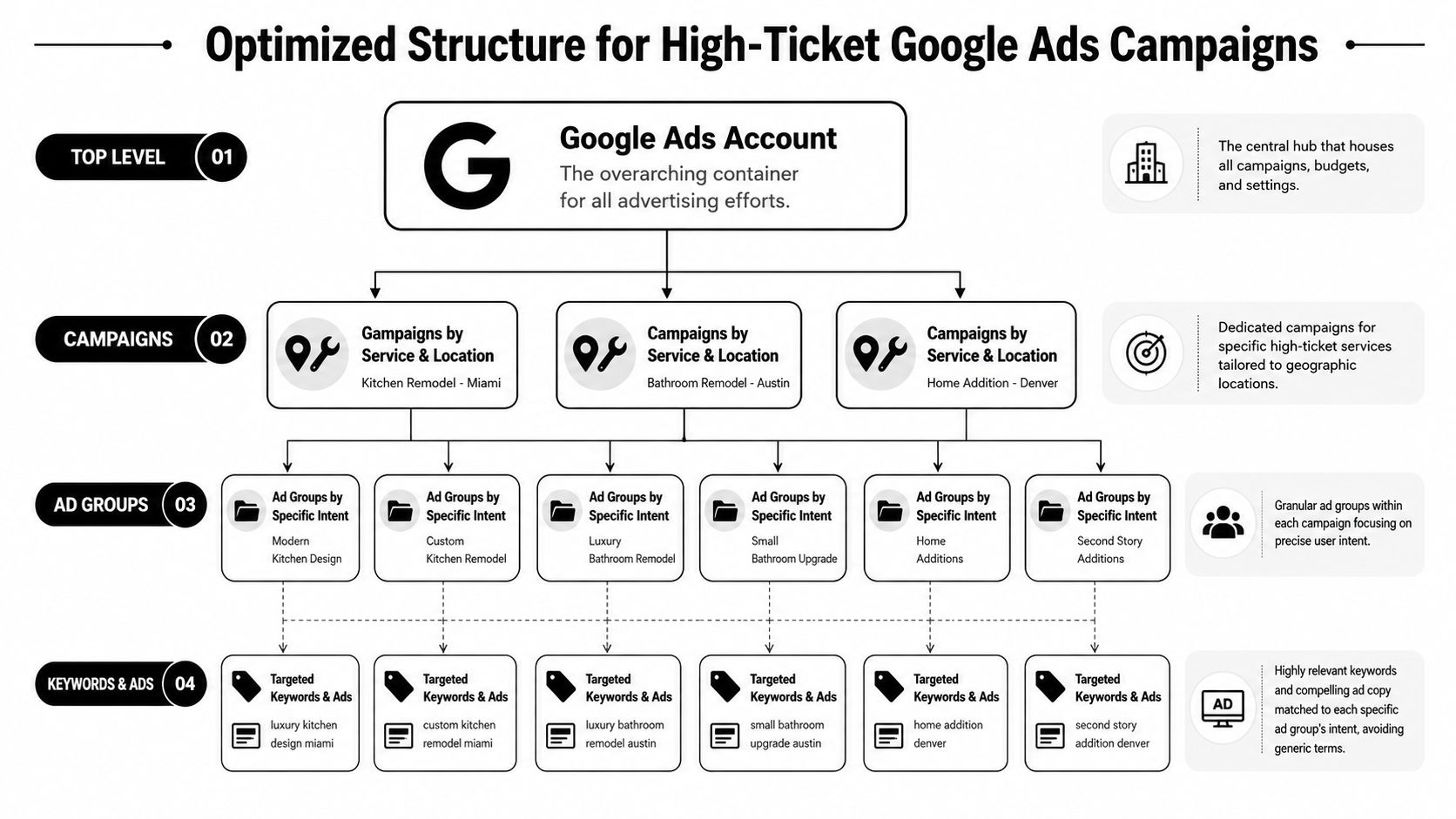
What a clean structure looks like
A simple example:
| Campaign | Ad Group | Keyword theme |
|---|---|---|
| Kitchen Remodel, City A | Luxury Kitchen Remodel | high-intent kitchen remodel searches |
| Kitchen Remodel, City A | Custom Cabinets | cabinet and design-build kitchen searches |
| Bathroom Remodel, City A | Primary Bath Remodel | full bath renovation intent |
| Home Additions, City A | Room Addition Contractor | addition-focused buyer intent |
That structure gives you control over:
- Budget allocation: Put more money behind the service lines that produce your best work.
- Ad messaging: Speak directly to the project type instead of writing bland ad copy for everybody.
- Landing page match: Send kitchen clicks to kitchen pages, not your homepage.
- Search term review: It's much easier to spot junk traffic when themes are tight.
A well-built account tells Google exactly what kind of homeowner you want. That's how you make the platform work like a blueprint instead of a junk drawer.
Use Keywords to Find the Best Homeowners
A homeowner searches “kitchen remodel ideas,” clicks your ad, looks around for 20 seconds, and disappears. You paid for that visit. It was never going to turn into a $75,000 project.
Keyword strategy decides who gets through the front door. If you want larger remodeling jobs, stop chasing traffic and start filtering for homeowners who are actively looking for a contractor, a design-build firm, or a company to price a real project.
Target searches with purchase intent
The best keywords usually sound like something a serious buyer would type after they have moved past inspiration and started looking for help.
Focus on themes like:
- Service plus location: kitchen remodeler in your city, bathroom remodel contractor near me
- High-value project terms: home addition contractor, whole home remodel contractor, custom kitchen remodel
- Hiring-stage searches: remodeling company, renovation contractor, licensed remodeler, design build firm
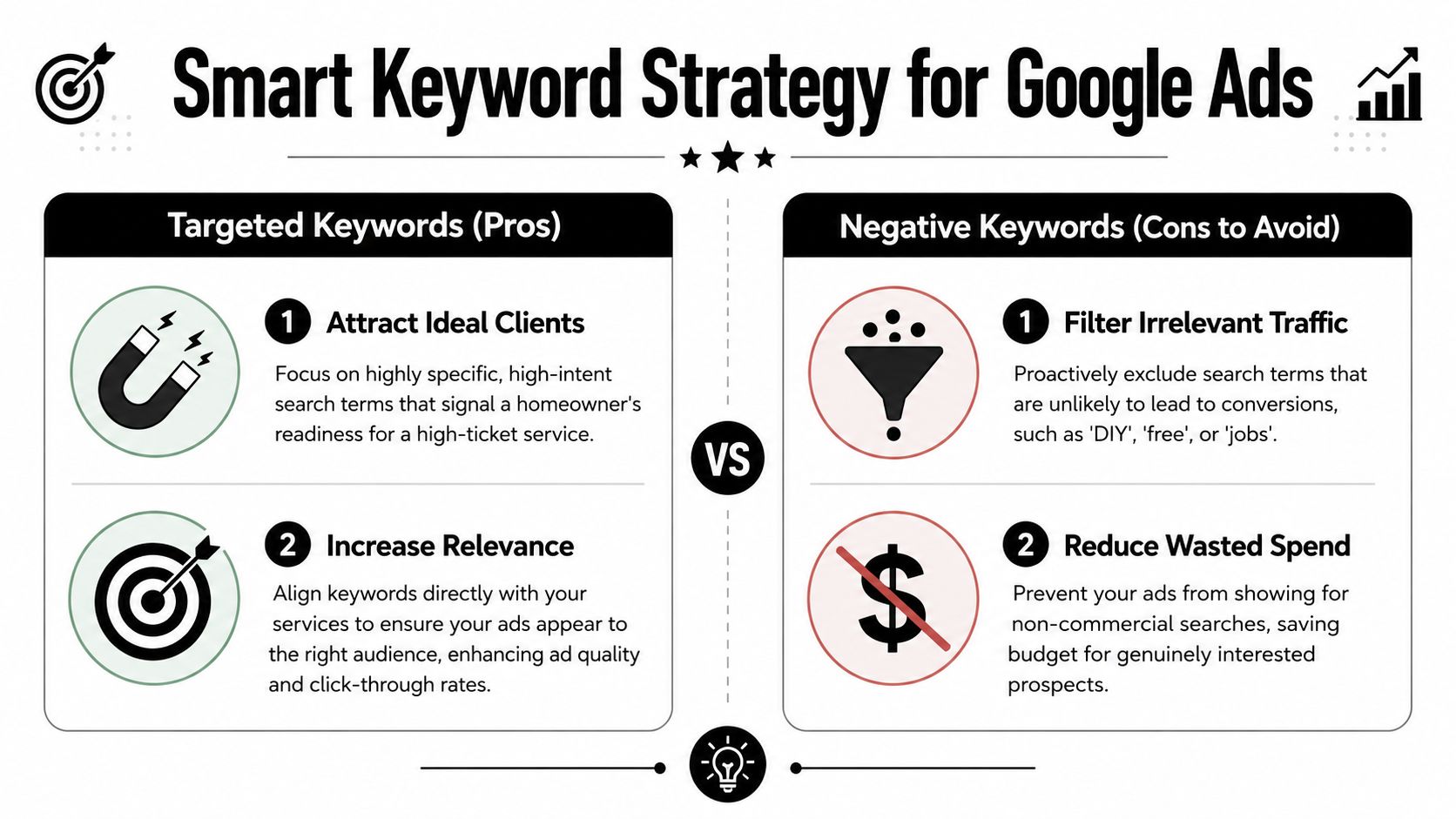
Skip broad research terms that attract browsers, students, and DIY homeowners. Words like ideas, inspiration, pictures, cost calculator, and before and after often bring cheap clicks that go nowhere.
That matters because your sales team does not close clicks. They close qualified homeowners with budget, urgency, and a project worth pursuing. If you are trying to figure out what a remodeling company should spend on marketing and what it really costs, this is part of the answer. Bad keywords make every budget look too small.
Use search terms to qualify, not just to expand
Many agencies treat the search terms report like a place to find more volume. That is backward.
Use it to find patterns tied to lead quality. Which searches turn into calls from homeowners discussing a full kitchen gut, an addition, or a whole-home renovation? Which ones produce people asking for handyman work, repair work, or low-budget refreshes?
Review search terms every week and sort them into three buckets:
- Keep: searches tied to services you want and projects large enough to matter
- Promote: strong search terms that deserve to become exact or phrase match keywords
- Block: irrelevant, low-budget, DIY, employment, and repair-related searches
That is how you optimize for signed contracts, not vanity lead counts.
Negative keywords protect your pipeline
Negative keywords are one of the fastest ways to improve lead quality. They tell Google who you do not want.
Start with obvious exclusions:
- Job-seeking terms: jobs, careers, salary, apprenticeship
- DIY terms: DIY, how to, tutorial, plans
- Bargain hunters: cheap, free, low cost
- Education terms: school, classes, course
- Wrong service types: repair, handyman, maintenance
Then go further. If your company wants full remodels and additions, exclude searches that signal small jobs. Terms like backsplash only, tub repair, cabinet refacing, or shower door installation can drain budget without producing the kind of opportunities your team wants.
Search terms expose the gap between the leads you asked for and the leads Google is sending.
The remodelers who win with Google Ads are not visible for everything. They show up for the searches that match their best jobs, then track which terms turn into consultations, proposals, and signed contracts. That is the difference between running ads and building a predictable pipeline for high-ticket work.
Set Budgets and Bids for Project Value
The wrong question is, “What's the cheapest click we can get?”
The right question is, “What is a real opportunity worth if it can turn into a major remodeling project?”
Cheap clicks feel efficient. They often aren't. Ten bargain clicks that produce weak calls are worse than one expensive click from a homeowner ready to discuss a meaningful project.
Cheap clicks are often expensive mistakes
When you're learning how to optimize Google Ads, don't chase low cost for its own sake. Focus on conversion rate, cost per conversion, and ROAS, and break performance down by device, time of day, geography, and audience so you can see where your money is working and where it's leaking. That framework is outlined in this guide to the Google Ads metrics that matter.
You should also set expectations for marketing spend based on your market, your goals, and your sales capacity. This breakdown of what a remodeling company should spend on marketing is a useful reality check if you're treating ad spend like a random monthly bill instead of a pipeline investment.
How to think about bidding
Think of bidding as giving Google instructions.
You're saying, “Go find more people like the ones who become real opportunities.” That's very different from saying, “Bring me the cheapest traffic possible.”
Use this logic:
- If tracking is weak: Fix that before trusting automated bidding.
- If tracking is solid: Let bidding strategies optimize toward meaningful conversions, not vanity actions.
- If one geography underperforms: Reduce spend there.
- If one service line produces stronger deals: Give it more room.
You'd rather pay more for a call that can become a serious remodel than pay less for noise.
Budget follows business value. The campaigns tied to high-quality consultations, strong close rates, and better project value deserve more fuel. The ones producing low-quality leads need tighter controls, different messaging, or less spend.
Write Ads and Build Pages That Get Leads
Your ad is the sign on the street. Your landing page is the showroom.
If the sign promises a premium kitchen remodel and the click lands on a generic homepage with weak photos, cluttered text, and no clear next step, the homeowner leaves. That's not a traffic problem. That's a trust problem.
Your ad and page must match
A good remodeler ad is simple. It tells the searcher three things fast:
- what you do
- where you do it
- why they should trust you
A strong format looks like this:
- Headline one: service plus city
- Headline two: your differentiator
- Description: the outcome the homeowner wants, plus a clear action
Examples of differentiators include design-build expertise, premium craftsmanship, full-service project management, or a specialty in high-end kitchens or additions. Keep the message aligned with the keyword and the landing page. If the ad talks about bathroom remodeling, the click should not land on a page about your whole company.

What your landing page must include
Most remodeling websites are built like brochures. Landing pages need to work like sales tools.
Here's the short checklist:
- A headline that matches the ad: Don't make visitors wonder if they're in the right place.
- Strong project photos: Show finished work that looks like the type of project you want more of.
- Trust signals: Reviews, awards, years in business, process clarity, and service-area fit all help.
- A clear call to action: Call, request a consultation, or book a discovery conversation.
- A simple form: Ask for what your team needs to qualify the lead, but don't create friction for no reason.
If you want a deeper standard for page quality, review these landing page best practices for better lead conversion.
A mismatch between ad and page kills momentum fast. Homeowners click because they think you can solve a specific problem. Your page should confirm that belief immediately.
One more thing. Don't write ads like a general contractor talking to peers. Write them like a homeowner reads. Clear beats clever every time.
Create a Routine to Scale Your Results
Google Ads isn't a one-time setup. It's more like maintaining a high-performance truck. Ignore it long enough and small issues turn into expensive issues.
The accounts that improve over time usually follow a boring routine. That's a good thing. Boring systems beat random bursts of attention.
A simple weekly and monthly rhythm
A strong optimization workflow starts by auditing conversion tracking, reviewing campaign hierarchy for keyword overlap, building account-level negative keyword lists, and refreshing those lists weekly from the Search Terms report. Searches for free, cheap, DIY, and job-seeking terms are common sources of wasted spend. One framework also recommends judging efficiency with revenue-per-click, not just cost per conversion, in this Google Ads optimization workflow guide.
Here's the routine I'd use for a remodeling business:
- Weekly search term review: Add negatives fast. Promote strong search queries when they clearly fit your service.
- Lead quality check in the CRM: Look at which campaigns produced qualified conversations, not just inquiries.
- Budget review: Shift spend toward services, locations, and devices producing better downstream outcomes.
- Ad testing: Test one meaningful variable at a time, such as a new headline or a different offer angle.
- Landing page cleanup: Improve weak pages that get traffic but don't generate enough good inquiries.
Don't scale a campaign because it produces leads. Scale it because it produces business.
Scale what brings revenue
Remarketing can support this process well. If someone visited your kitchen remodeling page and didn't reach out, a follow-up ad can bring them back later. Think of it as a polite second knock, not a hard sell.
The bigger lesson is simple. Your account should get sharper as it gets more data. Weak search terms get blocked. Strong themes get expanded. Better ad copy gets more exposure. Better pages get more budget. And your team gets clearer on which work is worth pursuing.
That's how to optimize Google Ads in a way that is important for a remodeler. Not by chasing clicks. By building a repeatable machine that turns search intent into qualified opportunities and signed contracts.
If you want help building that kind of system, Constructo Marketing specializes in helping remodelers attract and track the right local leads for high-value projects. They focus on the full pipeline, from search visibility and paid traffic to CRM follow-up and KPI visibility, so you can stop guessing which marketing is working and start seeing which campaigns lead to real jobs.